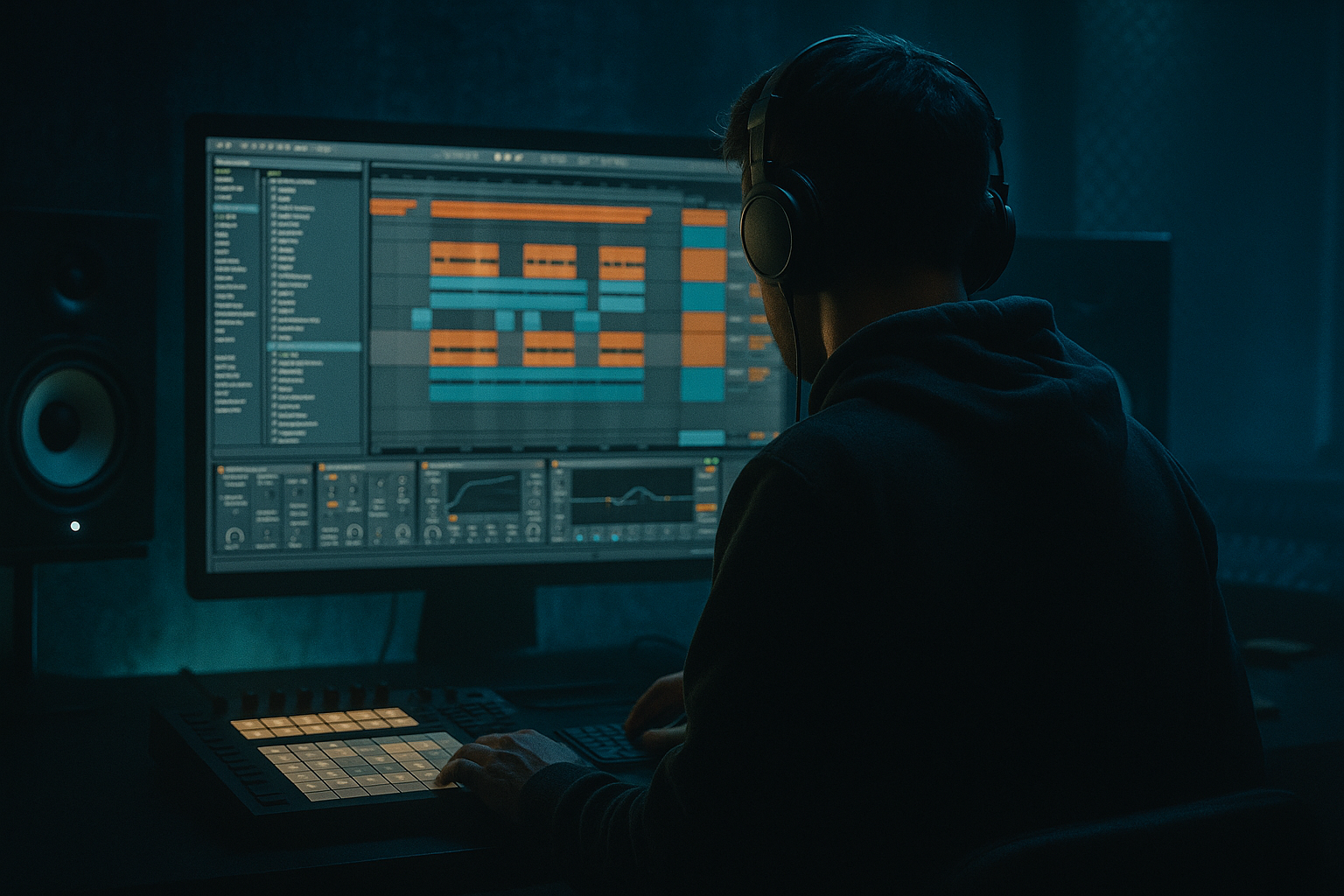
Main tutorial
Lesson Overview
A Vinyl Heat jungle pad is one of those classic DnB textures that can instantly make a track feel alive, dusty, and emotional. In this lesson, you’ll take a warm vinyl-style pad sound, flip it into a darker, more rhythmic jungle/DnB texture, and arrange it inside Ableton Live 12 so it works like a proper part of a tune — not just a loop sitting on top.
This matters because in Drum & Bass, pads are more than background atmosphere. They help define the mood of the intro, the pressure before the drop, and the emotional glue between drums and bass. A good pad can make a roller feel deeper, make a jungle track feel nostalgic, or give a neuro section a cinematic tension bed without stealing low-end space.
Since this is a Mastering-category lesson, we’ll treat the pad like a finishing-layer element: controlled, balanced, and placed so it supports the whole track. That means:
- cleaning unnecessary low end,
- shaping the stereo image,
- making room for drums and bass,
- and arranging it with enough movement to feel intentional.
- a vinyl-textured jungle pad loaded or created in Ableton Live,
- the pad flipped into a more usable DnB texture using Warp, resampling, filtering, and envelope shaping,
- a simple 8- or 16-bar arrangement that works in:
- a version that sits cleanly around drums, sub, and reese bass,
- and a pad chain that feels ready for final mix/master decisions.
- a dusty, emotional chord bed,
- with chopped or reversed motion,
- enough grit to sound vintage,
- but controlled enough to live under hard drums and bass.
- Leaving too much low end on the pad
- Making the pad too bright for a dark track
- Too much stereo width everywhere
- Overusing reverb
- Trying to keep the pad on top of the drums all the time
- Not committing to a resampled version
- Use reverse swells before snare hits
- Layer a vinyl noise bed quietly under the pad
- Automate the pad to duck slightly on kick/snare transients
- Distort the midrange, not the sub
- Pair the pad with a reese or bass call-and-response
- Use short phrase changes every 8 bars
- Keep the intro DJ-friendly
- A Vinyl Heat jungle pad is an atmosphere-and-tension layer that can define the mood of a DnB track.
- Clean the low end first so the sub and kick stay powerful.
- Use Warp, reverse edits, filtering, and resampling to “flip” the pad into a more rhythmic jungle texture.
- Control width and saturation so the pad feels warm, gritty, and supportive — not messy.
- Arrange it with clear DnB phrasing: intros, breakdowns, pre-drop tension, and drop contrast.
- In darker or heavier DnB, the best pad is the one that adds emotion without stealing impact.
We’ll stay beginner-friendly, but everything is rooted in real DnB workflow: break-driven intros, tension-building transitions, DJ-friendly phrasing, and low-end discipline.
What You Will Build
By the end of this lesson, you’ll have:
- intro,
- breakdown,
- pre-drop tension,
- or post-drop atmosphere,
Musically, the result should feel like:
Think of it as a jungle haze layer: not the main hook, but the thing that makes the whole tune feel expensive and complete.
Step-by-Step Walkthrough
1. Load the pad and decide its job in the track
Start by placing your vinyl pad audio or instrument on a new audio/MIDI track in Ableton Live 12. If it’s a sampled pad loop, drag it into Arrangement View and turn on Warp.
Ask one simple question first: Is this pad for atmosphere, tension, or transition?
For a beginner, keep it to one job:
- Atmosphere: long held chord in the intro or breakdown.
- Tension: filtered and rising before the drop.
- Transition: reversed or chopped to bridge sections.
If you’re building a jungle or rollers track, a pad usually works best in:
- bars 1–16 for intro mood,
- bars 17–24 as a pre-drop rise,
- or bars 33–48 in the breakdown after the first drop.
A practical choice: loop an 8-bar section first. DnB arrangement moves fast, so you want to hear whether the texture supports the groove quickly.
2. Clean the low end so it won’t fight your sub
Add EQ Eight after the pad.
This is a mastering-minded move even at demo stage: you’re controlling space early so the whole track stays easier to finish.
Use these starting points:
- High-pass around 120–180 Hz for most jungle pads
- If the pad is thick or muddy, try 150–220 Hz
- If it’s very airy, you might stop closer to 100–120 Hz
Why this works in DnB: your kick and sub need a clean lane. Pads often carry hidden low-mid and low-end energy that can make the bass feel smaller or less focused, especially in rollers and darker tunes where sub is a major part of the impact.
Also listen for mud around:
- 250–500 Hz: reduce gently if the pad feels boxy
- 2–5 kHz: reduce if it gets sharp or grainy on top
Keep EQ moves subtle: usually -2 to -5 dB is enough at the start.
3. Flip the pad into motion with Warp and resampling
If your pad is a sample, use Warp to make it more DnB-friendly.
Try these workflow moves:
- Set Warp mode to Complex Pro for smoother sustained textures
- If the pad is more rhythmic or chopped, try Beats with a short transient setting
- Use Warp markers to keep the important chord hits in time
For a flipped jungle feel, do one of these:
- Reverse a section of the pad
- Slice a phrase and place it on the offbeat
- Duplicate the pad and offset the copy by a 1/8 or 1/4 note
- Resample the pad onto a new audio track and cut up the result
A very usable beginner technique:
- duplicate the pad clip,
- reverse the duplicate,
- filter it down,
- and place it before the main chord hit to create a swell.
That gives you instant jungle tension without needing advanced sound design.
4. Shape the pad with filtering and movement
Add Auto Filter after EQ Eight.
Start with a Low-Pass Filter for a darker intro, then automate it open later.
Good starting settings:
- Cutoff: around 400 Hz to 2.5 kHz, depending on how bright the source is
- Resonance: keep low, around 5–15%, unless you want a noticeable sweep
- Drive: a little drive can help the pad feel more present, but don’t overdo it
For movement, automate:
- cutoff opening over 4 or 8 bars,
- a small resonance lift near transitions,
- or a slow filter pulse synced to the groove.
If you want a more broken, jungle feel, use LFO-style movement with:
- Auto Filter + LFO in Max for Live if available in your setup,
- or simpler: automation clips on the cutoff.
This works in DnB because pads should usually move with the arrangement, not sit static for too long. Fast genres need changing detail to stay interesting.
5. Control the stereo width so the mix stays solid
Use Utility after your filter.
This is a very important mastering habit: control width before the track gets too crowded.
Basic guidance:
- Set Bass Mono on if the pad has any lower-frequency stereo spread
- Reduce Width to 70–90% if the pad is wide but unfocused
- Keep it wider only if the rest of the arrangement is very central and dry
For DnB, a pad can be wide in the highs but should not smear the low-mid area. If the pad is too huge, it can blur the kick/snare impact and weaken the bass perception.
Good beginner move:
- keep the pad wide in the intro,
- then automate it slightly narrower in the drop so the drums hit harder.
That contrast makes the track feel bigger.
6. Add grit and glue without ruining clarity
Insert Saturator or Drum Buss after Utility.
For a vinyl heat pad, a small amount of saturation helps it feel more alive and less digital.
Try:
- Saturator Drive: 2–6 dB
- Soft Clip: on, if you want smoother edge
- Dry/Wet: around 20–50% depending on how obvious you want it
If using Drum Buss:
- keep Drive subtle,
- add a touch of Crunch only if you want more dirt,
- use Boom very carefully, since pads usually don’t need extra low end.
This is where the “vinyl heat” character comes from: not just warmth, but a slight unstable edge that makes the sound feel sampled and human.
If the pad starts to feel harsh, add another EQ Eight after saturation and slightly trim the sharp zone around 3–6 kHz.
7. Make the pad support the drums and bass, not compete with them
Put the pad in the context of the track.
Loop a simple DnB section:
- kick/snare or break,
- sub bass,
- and your pad.
Now check balance:
- Does the snare still punch through?
- Can you clearly hear the sub?
- Does the pad feel like atmosphere, not lead?
For arrangement, try this classic DnB structure:
- Bars 1–8: filtered pad + vinyl noise + light break
- Bars 9–16: open pad slightly, add a chopped break fill
- Bars 17–24: pad swells into pre-drop tension
- Bars 25–32: drop enters, pad gets thinner or disappears
- Bars 33–40: pad returns in a breakdown or second phrase
A musical example:
- In a dark roller, the pad might sit under a reese bass and sparse drums, opening only in the 8 bars before the second drop.
- In a jungle tune, the pad can support chopped breaks and old-school vocal snippets, giving the track a haunted, nostalgic feel.
That’s the real arranging skill here: deciding when the pad should be felt, not heard.
8. Automate the pad for tension and release
Automation is what makes the pad feel like part of the song instead of a static layer.
Useful automation ideas in Ableton:
- Auto Filter cutoff opening over 4 or 8 bars
- Utility width narrowing before the drop
- Reverb Dry/Wet increasing in a breakdown
- Saturator drive rising slightly into a transition
- Volume dips for call-and-response with the drums
If you use Reverb:
- keep decay moderate, around 1.5–4 seconds
- pre-delay around 10–30 ms
- use the High Cut to stop the reverb from getting too bright
A strong DnB move is to automate the pad out right when the snare and bass need maximum impact. Silence or thinness can be more powerful than extra sound.
Use an arrangement phrase like:
- pad rises in bars 13–16,
- drops out on beat 1 of bar 17,
- then comes back as a ghost texture after the drop hits.
That tension/release is a big part of why DnB arrangements feel exciting.
9. Resample your best version and keep editing simple
Once you like the pad chain, resample it.
Create a new audio track, set its input to Resampling, and record a 4- or 8-bar pass of the processed pad.
Why this is useful:
- it commits the sound,
- makes it easier to edit,
- and lets you slice the pad like a sample.
After resampling, you can:
- reverse tiny sections,
- cut out one-hit swells,
- place chopped accents before snare hits,
- or create a one-bar transition fill.
For beginner workflow, this is better than endlessly tweaking one live chain. In DnB, speed matters. Commit, move on, and build the arrangement.
10. Do a quick mastering-minded check before you move on
Even though this is a pad lesson, a mastering mindset means checking how it behaves in the full mix.
Do these quick checks:
- Turn the pad down until you barely miss it, then bring it back slightly.
- Toggle Utility Mono briefly to hear if the pad collapses awkwardly.
- Listen at low volume: does the mood still read?
- Check the pad against the kick/snare/bass at full loop length.
The goal is not to make the pad loud. The goal is to make it support the emotional and sonic identity of the track without causing mix problems.
If it sounds good when quiet, it’ll usually work better in a finished DnB mix.
Common Mistakes
Fix: high-pass more aggressively with EQ Eight, often around 150–220 Hz for dense arrangements.
Fix: use Auto Filter low-pass, then trim harsh top with EQ Eight around 3–6 kHz.
Fix: use Utility to narrow the pad, especially if the drop needs punch and center focus.
Fix: shorten decay, lower wet amount, and automate reverb mainly in transitions or breakdowns.
Fix: let it thin out or disappear during the drop. In DnB, contrast creates impact.
Fix: render the pad and edit the audio. This often leads to better arrangement decisions.
Pro Tips for Darker / Heavier DnB
A reversed pad into the snare can create a very classic jungle tension moment.
Keep it subtle. This adds old-school grime and helps the texture feel like a sampled source.
If needed, use Compressor with sidechain from the drum bus, but keep it gentle. You want motion, not obvious pumping.
If the pad needs more aggression, use Saturator or Drum Buss on the pad’s mids, then high-pass it so it doesn’t cloud the low end.
Let the pad hold space where the bass drops out. That contrast is very effective in rollers and darker neuro-influenced DnB.
Even a tiny change — filter open, reverse hit, or volume fade — keeps the pad interesting in fast arrangements.
Start with the pad and atmosphere, but leave room for a clean beat-in so the track can mix well in a set.
Mini Practice Exercise
Spend 10–20 minutes building this:
1. Find or create a vinyl-style pad loop in Ableton Live.
2. High-pass it with EQ Eight.
3. Add Auto Filter and automate the cutoff over 8 bars.
4. Duplicate the clip and reverse the copy to make a swell.
5. Add Utility and narrow the width slightly.
6. Add a small amount of Saturator or Drum Buss.
7. Place the pad in a simple DnB arrangement:
- bars 1–8 intro,
- bars 9–16 build,
- bars 17–24 drop minus pad,
- bars 25–32 return.
Try to make the pad feel strong in the intro, then almost vanish when the drums and bass hit. If it still works emotionally, you’ve done it right.
Bonus challenge: render the pad and make one chopped reverse fill that lands just before a snare in bar 16.

