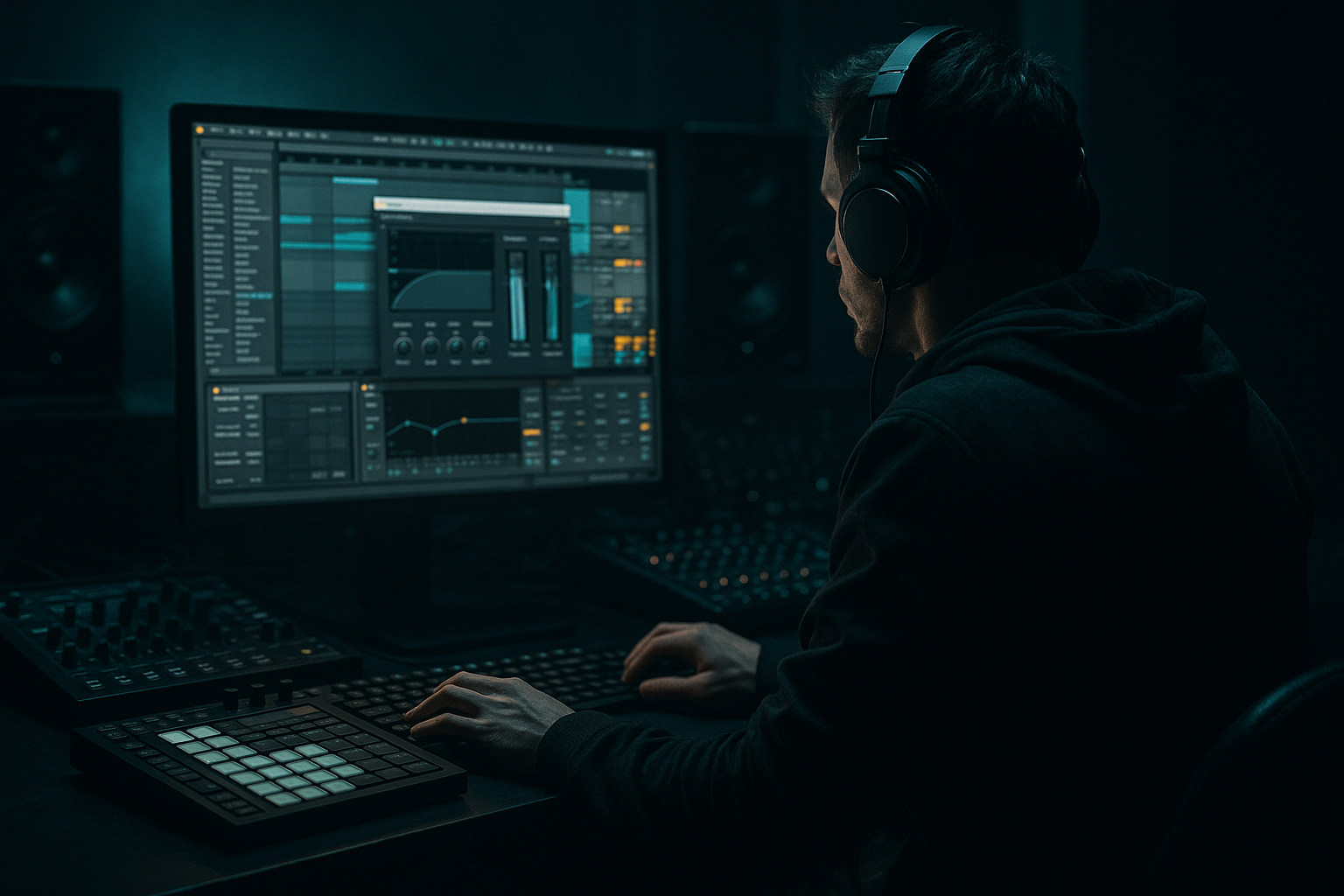
Main tutorial
Lesson Overview
This lesson is about creating that Vinyl Heat jungle swing feel in Ableton Live 12: the kind of push-pull energy where a break feels slightly unstable, the bassline leans forward, and the whole track sounds like it’s skating on hot wax 🔥
In DnB, this technique matters because it gives you movement without losing drive. A straight 2-step can hit hard, but jungle swing adds character: tiny delays, micro-edits, filtered lift, and arrangement shifts that make the groove feel alive. It’s especially useful in:
- Rollers that need constant forward motion
- Jungle / breakbeat sections that should feel human and dusty
- Darker neuro-leaning tracks where tension comes from timing and texture, not just aggression
- DJ-friendly arrangements where the intro, drop, and switch-up all need clean phrasing
- A weighted breakbeat loop that has vinyl-style swing and ghost-note movement
- A subby bassline that stays mono and clean under the drum swing
- Call-and-response bass phrasing that leaves room for the snare
- A transition FX chain for risers, rewind-style motion, and fill lift
- A switch-up arrangement that changes energy without losing DJ mixability
- Bars 1–4: main groove, rolling and slightly “behind the wheel”
- Bars 5–6: tension rise with filter movement and drum fill
- Bars 7–8: switch-up or reset with a more open bass rhythm
- Too much swing on everything
- Bass and break fighting in the low mids
- FX crowding the groove
- Over-distorting the sub
- No arrangement contrast
- Break sounds stiff after swing is applied
- Use parallel Drum Buss on the break: keep one clean drum layer and one processed layer with heavier drive. Blend for weight without killing transients.
- Automate Auto Filter resonance slightly upward before a drop to create pressure, then snap it back open on impact.
- Resample your bassline after saturation and filter movement, then re-edit the audio for one-off stabs or fills. This creates a more “produced” and less synthetic feel.
- For darker rollers, let the bass sit in a narrow midrange pocket while the sub does the real weight. Don’t try to make the mid-bass do everything.
- Use short reverb throws on snare fills or FX hits, but keep the main drums relatively dry. Underground DnB usually feels bigger when the core remains tight.
- If the track needs more menace, automate a subtle dip in the master of the bass return or FX return during the last beat before the drop. That tiny vacuum effect creates huge impact.
- Add atmosphere with restrained noise, room tone, or vinyl texture, but keep it low in the mix. The goal is vibe, not hiss.
- For neuro-leaning darkness, use movement in the bass timbre rather than huge note changes. Filter, phase, saturation, and envelope motion will feel more controlled and modern.
- Does the low end stay solid in mono?
- Does the groove feel like it pushes forward?
- Is there at least one moment of tension and release?
- Could you imagine mixing this into a DJ set?
- Build the groove from a stable drum/bass core with swung break details.
- Use Groove Pool, micro-timing, and automation to create the Vinyl Heat push.
- Keep the sub mono and clean, while the mid-bass provides movement and grit.
- Make FX purposeful: transitions, fills, tension, and arrangement punctuation.
- Arrange in 8-bar phrases with a clear switch-up so the loop becomes a track.
We’re not just making drums swing randomly. We’re building a controlled “vinyl heat” groove using Ableton stock tools: Drum Rack, Groove Pool, Auto Filter, Saturator, Echo, Simple Delay, Utility, EQ Eight, Drum Buss, and resampling workflows. The goal is a pattern that feels like a dusty break loop being pushed slightly ahead of the bar, then arranged into a proper DnB drop structure.
Why this works in DnB: the genre lives on the tension between machine precision and human feel. If the drums are too rigid, the drop can feel flat. If they’re too loose, the tune loses impact. This lesson teaches you how to push swing and arrangement just enough to create movement while keeping the kick, snare, and sub locked in.
What You Will Build
You’ll build a short but fully usable 8-bar jungle/DnB drop section with:
Musically, the result should feel like:
Think of it as a vinyl-dusted jungle roller with darker bass pressure, ready to drop into a mix or become the basis for a full track.
Step-by-Step Walkthrough
1. Set up a clean DnB template at 174 BPM
Start by setting your project to 174 BPM. That’s the center of gravity for most modern DnB and jungle workflows. If you want a slightly more halftime, moody feel, you can also test 172–176 BPM, but 174 is the safest place to lock in the swing.
Create these tracks:
- Drum Rack for breaks / one-shots
- Sub bass track
- Reese or mid-bass track
- FX track
- Return tracks for delay and reverb
On the master, keep plenty of headroom. Aim for peaks around -6 dB while building. DnB arrangements need room for aggressive drums, bass transients, and FX automation later.
2. Build the break foundation with a dusty, edited groove
Drag a break loop into Audio Track, or slice one into Simpler with Slice to New MIDI Track if you want more control. If you’re using a jungle break, focus on the kick/snare relationship first, then add ghost notes and top-end detail.
In Ableton, add:
- EQ Eight: high-pass around 25–35 Hz to remove unnecessary sub rumble
- Drum Buss: Drive around 10–20%, Crunch low to moderate, Boom very subtle or off
- Saturator: Soft Clip on, Drive around 2–5 dB
For the break itself:
- Keep the main snare hits strong at 2 and 4
- Lower ghost notes slightly so they feel like groove, not clutter
- If the break has too much top-end, trim a little around 7–10 kHz
This is where the “vinyl heat” vibe starts: not by drowning it in effects, but by making the break feel slightly compressed, slightly worn, and rhythmically alive.
3. Apply swing the smart way: Groove Pool and micro-push
Open the Groove Pool and test a swing groove from Ableton’s stock presets. A good starting point for jungle/DnB is a swing amount around 54–58% depending on the source material. Don’t go extreme unless you’re after a very off-grid old-school vibe.
Use groove in two different ways:
- Apply it to the break chops for natural shuffle
- Apply a lighter version to top percussion or hats so the groove spreads across the drum kit
Then manually “push and arrange” by moving selected hits a few milliseconds:
- Push certain ghost notes slightly later for lazy, cracked-vinyl feel
- Pull some percussion slightly earlier to create forward motion
- Keep the main snare and sub kick anchors more stable than the ornamentation
Why this works in DnB: the groove feels exciting because the ear hears a stable downbeat and snare grid, while the smaller details move around it. That contrast creates tension and momentum.
4. Create the bass response: mono sub plus mid movement
Build your bass in two layers:
- Sub layer: a clean sine or filtered low oscillator in Operator or Wavetable
- Mid layer: a Reese, resampled bass, or detuned moving mid-bass
For the sub:
- Keep it mono with Utility width at 0% if needed
- Use EQ Eight to cut anything above 100–120 Hz if the sub is fighting the mid layer
- Use a simple envelope so notes don’t blur together
For the mid layer:
- Add Saturator or Overdrive for harmonics
- Use Auto Filter with subtle movement
- Try LFO-style motion by automating cutoff in 1/8 or 1/16 phrases
A practical starting point:
- Reese detune: moderate, not huge
- Filter cutoff: somewhere around 200–800 Hz depending on the texture
- Resonance: keep low to medium, unless you want a sharper edge
The bassline should answer the drums, not sit on top of them. Leave spaces around snare hits so the track can breathe.
5. Program the bass phrasing like a conversation
In DnB, a bassline that just runs continuously can flatten the energy. Instead, phrase it like call-and-response between the drums and bass.
In your MIDI clip:
- Put stronger bass notes around the gaps between snare hits
- Use shorter notes for groove and longer notes for sustained pressure
- Leave intentional holes before fill moments or turnarounds
A good pattern example:
- Bar 1: bass hits on the off-beat and ends before the snare
- Bar 2: slightly more active response
- Bar 3: repeat the motif with one extra note variation
- Bar 4: reduce density to set up the switch-up
If you want a darker roller feel, keep the bassline rhythmically simple but timbrally evolving. That means the pattern may stay sparse while the filter, distortion, or envelope changes over time.
Use clip envelopes or automation lanes for:
- Filter cutoff opening over 4 or 8 bars
- Saturation drive increasing in the lead-up to the drop
- Small note length changes for groove variation
6. Design the “vinyl heat” FX layer
This is where the lesson becomes more than just drums and bass. Create a dedicated FX track with a few short, useful sounds:
- Noise burst or vinyl crackle texture
- Reverse cymbal or reversed break tail
- Impact hit for section changes
- Short uplifter or downlifter
- A subtle rewind-style transition
Stock Ableton chain ideas:
- Auto Filter for sweeps
- Echo for a dubby transition tail
- Reverb with short decay for space
- Simpler on a noise sample for one-shot FX
- Utility for quick gain shaping
Keep FX disciplined:
- High-pass most FX around 150–300 Hz
- Use short decay times in dense sections
- Place FX at the end of 4-bar phrases or right before the drop reset
A useful trick: resample a filtered break tail plus delay into audio, then reverse it. That gives you a gritty, custom transition that sounds like it belongs to your tune, not a generic riser.
7. Automate push and release across 8 bars
Now arrange the section so the groove feels like it’s breathing. In Ableton, automate:
- Break filter cutoff
- Bass saturation amount
- Drum Buss Drive
- FX send levels
- Reverb size or wet/dry on transition moments
Suggested arrangement shape:
- Bars 1–2: full groove, restrained FX
- Bars 3–4: tiny increase in top-end or bass movement
- Bar 5: break fill, filtered bass dip, impact or reverse
- Bar 6: re-entry with more drive
- Bars 7–8: switch-up, stripped drums, or an alternate bass rhythm
Keep automation musical, not constant. If everything is moving all the time, nothing feels like a change. Use automation to create sections, not just decoration.
8. Tighten the low end and check the drum-bass balance
Once the groove feels good, switch into mixing judgment mode. Use Utility and EQ Eight to keep bass mono and avoid low-end clutter. Check:
- Is the sub strong but not boomy?
- Is the kick cutting through without masking the bass?
- Are the break lows fighting your sub?
Practical balance rules:
- Sub should own the deepest energy below roughly 80 Hz
- If the kick is too soft, boost its presence a little in the 90–150 Hz or 2–4 kHz area depending on the sample
- If the break is muddy, reduce low mids around 200–400 Hz
Use mono checks regularly. DnB loses impact fast if the low end spreads too wide. Keep the sub focused and let the stereo width live higher up in the percussion, FX, and texture layer.
9. Arrange for DJ usefulness and replay value
A good DnB loop becomes a real track when the arrangement makes sense for DJing and mix flow. Build:
- A clear intro with drums or filtered break
- A drop section with the full swing
- A switch-up that changes the bass phrase or drum density
- A breakdown or reset with atmospheric space
- An outro that allows clean mixing
For a club-ready arrangement:
- Keep the intro minimal for 16 bars
- Bring in the full bass around the drop
- Use a 4-bar or 8-bar variation before repetition becomes stale
- Leave a DJ-friendly tail at the end with drums or filtered atmospheres
This matters because DnB thrives on phrasing. If your “vinyl heat” groove only works as a loop, it won’t survive a full arrangement. The switch-up is what keeps the tune feeling like a record, not a beat sample.
Common Mistakes
Fix: keep the snare and main kick anchors stable, and apply heavier swing only to ghost notes, tops, and break fragments.
Fix: carve space with EQ Eight. Let the sub dominate the deepest zone and trim muddy overlap in the break.
Fix: high-pass transition sounds and use them at phrase boundaries, not constantly.
Fix: distort the mid-bass more than the sub. Keep the bottom clean and mono.
Fix: create at least one switch-up every 8 bars. Even a small change in drum density or bass phrasing can refresh the whole section.
Fix: manually move a few hits by ear. Groove settings help, but DnB often needs targeted micro-edits to feel right.
Pro Tips for Darker / Heavier DnB
Mini Practice Exercise
Spend 15 minutes making one 8-bar loop:
1. Load a break and edit it into a groove with Groove Pool swing between 54–58%.
2. Add a mono sub bass using Operator or Wavetable.
3. Create a simple 2-note or 3-note bass phrase that leaves space for the snare.
4. Add one FX transition: reverse cymbal, noise rise, or a resampled filtered break tail.
5. Automate one filter cutoff move over 8 bars.
6. Make one switch-up by changing either the bass rhythm or drum density in bars 5–8.
Then test this checklist:
If yes, you’re already close to a usable DnB drop idea.
Recap
The big idea: in DnB, swing is not just a feel setting. It’s a structural tool. When you push and arrange it properly in Ableton Live 12, your jungle groove stops sounding looped and starts sounding like a record with attitude.

