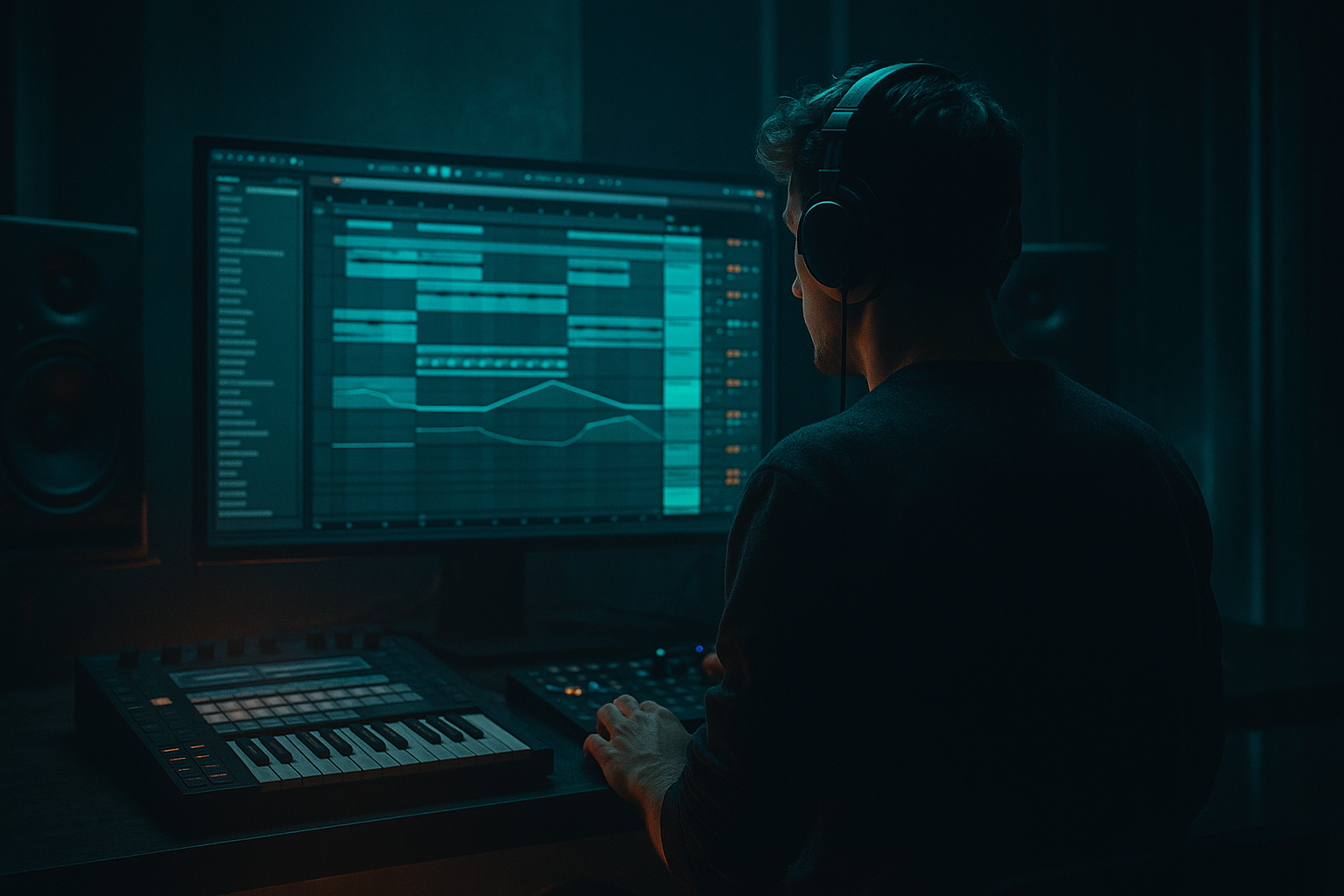
Main tutorial
Vinyl Heat Jungle Vocal Texture: Sequence & Arrange in Ableton Live 12 (DnB/Jungle)
1) Lesson overview
In jungle and rolling DnB, short vocal fragments—run through vinyl wear, pitch drift, resampling, and rhythmic gating—become texture as much as “lyrics.” This lesson shows you how to build that Vinyl Heat vocal layer, then sequence and arrange it so it pushes momentum in a 170–175 BPM track. 🔥
You’ll focus on:
- Turning a clean vocal into a gritty, nostalgic, “found on wax” loop
- Making it groove with swing, chops, call/response
- Arranging it like a real DnB record: intro → drop → variation → breakdown → second drop
- Sounds like it’s coming off a worn dubplate 🎚️
- Has micro-chops and syncopation that interlock with breaks
- Evolves across your arrangement using automation + resampling
- Sits in the mix with controlled highs, rumble managed, and vibe intact
- Main chopped vocal
- Air/ghost layer (filtered + wide)
- Throw FX (reverb/delay hits only)
- Drag an audio vocal into an Audio Track.
- Right-click → Warp on.
- Warp Mode:
- If it’s loose timing, click Warp From Here (Straight) on a strong transient.
- Record 10–20 seconds of takes (even whispery works).
- You only need 1–2 seconds of “gold.”
- EQ Eight: HP at 120–180 Hz (12 or 24 dB/oct)
- Compressor: gentle leveling, Ratio 2:1, 2–4 dB GR
- Utility: set mono if it’s weirdly wide already
- Arm the track and tap pads/keys to find 4–10 great slices.
- Keep the main snare on 2 and 4 (half-time feel inside 2-step or breaks).
- Place vocal chops:
- Bar 1: short chop on 1.2, another on 1.3.3, tiny ghost on 1.4.4
- Bar 2: call/response: one longer slice on 2.1, two quick ticks on 2.2.3 and 2.3.2
- Set clip Loop on.
- Adjust Note Lengths short (staccato) to keep it percussive.
- Use Groove Pool:
- Add Analog or Wavetable set to Noise (or use a noise sample).
- Add EQ Eight:
- Add Auto Pan (very subtle drift)
- Sidechain it to your drums using Compressor:
- Use filtered, washed version:
- Sparse hits every 2 bars
- Add Reverse on one chop as a riser into bar 17
- Full “Vinyl Heat” chain
- More consistent 2-bar loop
- Keep it midrange: avoid fighting the snare snap and bass presence
- Duplicate the MIDI clip and change:
- Add “throw” FX only at phrase ends:
- Every 8 bars: mute vocals for 1 bar, then slam back in
- Before drop: bandpass sweep + tape-stop-style pitch automation (Shifter down a few semitones quickly)
- In breakdown: resampled vocal stretched + filtered = instant atmosphere
- Over-warping the vocal until it sounds phasey: use Complex Pro sparingly; for short chops, try Tones or Repitch.
- Too much reverb in the drop: DnB needs transient clarity—use sends and automate throws instead.
- Fighting the snare: harsh vocal energy around 2–5 kHz can dull the crack. Carve small EQ dips.
- No variation: a 2-bar loop with zero changes gets stale fast. Change something every 8 bars.
- Overdoing vinyl FX: if the vibe becomes “plugin demo,” back off. The best texture is felt more than heard.
- Parallel distortion: Duplicate the vocal slice track → distort hard (Roar + Saturator) → low-pass to 3–5 kHz → blend quietly for menace.
- Formant shifting: Use Shifter to pull formants down slightly for darker tone (subtle = scarier).
- Rhythmic gating: Use Auto Pan with Phase at 0° as a tremolo:
- Sidechain to the snare (not the kick): In jungle, snare is king. Duck the vocal slightly on snare hits to keep impact.
- Re-slice the resample: The best jungle textures come from second-generation sampling. Print → slice again → rearrange.
- You built a Vinyl Heat vocal texture using Ableton stock devices (Redux, Saturator, Roar, EQ Eight, Echo, Reverb).
- You sliced to Simpler, programmed a rolling 2-bar jungle pattern, and added swing for feel.
- You arranged it across a DnB structure using states, automation, throws, and resampling.
- You avoided common pitfalls (reverb wash, snare masking, static looping) and learned darker variations for heavier vibes. ✅
---
2) What you will build
A 2–4 bar jungle vocal texture that:
Final result: a dedicated “Vocal Texture” group with 2–3 lanes:
---
3) Step-by-step walkthrough
Step 0 — Session setup (so it feels like jungle)
1. Set tempo to 172 BPM (classic sweet spot).
2. Set Global Groove later, but for now:
- Keep the grid straight while chopping.
3. Create an arrangement skeleton:
- Intro 16 bars
- Drop 32 bars
- Breakdown 16 bars
- Drop 2 32 bars
> DnB arrangement tip: plan variation every 8 bars—even small changes keep energy moving.
---
Step 1 — Choose and prep a vocal (the raw clay)
Use something short and characterful: a phrase, shout, ad-lib, or even one word.
Option A: Audio sample
- Complex Pro for full phrases
- Tones for cleaner short notes
Option B: Record your own
Quick cleanup chain (temporary)
---
Step 2 — Create the “Vinyl Heat” texture chain (Ableton stock)
Put this chain on the vocal track (or on a Vocal Texture Group bus).
#### Device chain (in order)
1. Redux (for crunchy “sampled” edge)
- Downsample: 10–18 kHz (start 14k)
- Bit Reduction: 0–3 (subtle)
- Dry/Wet: 10–25%
2. Saturator (warmth + density)
- Mode: Analog Clip
- Drive: 2–6 dB
- Soft Clip: ON
- Output: trim to match level
3. Roar (modern grit + movement)
- Style: start with Tape or Noise flavor
- Drive: small (you want texture, not obliteration)
- Modulation: slow LFO on Drive or Tone for drift (very subtle)
4. EQ Eight (vinyl-ish band limiting)
- HP: 150–250 Hz
- Gentle dip around 2–4 kHz if harsh (1–3 dB)
- Low-pass: 9–12 kHz (mimics older top-end)
5. Vinyl “wobble” (fake turntable drift)
- Use Shifter (Pitch mode) or Chorus-Ensemble very lightly.
- Shifter (Pitch):
- Fine: ±5 to ±15 cents via automation (don’t leave static)
- Mix: 10–30%
6. Echo (dubby movement)
- Time: 1/8 or 1/4 (try dotted 1/8 for jungle bounce)
- Feedback: 15–35%
- Filter: HP around 250 Hz, LP around 6–8 kHz
- Dry/Wet: 8–20% (keep it tucked)
7. Reverb (space, but controlled)
- Size: small/medium
- Decay: 0.8–1.8s
- Pre-delay: 10–25 ms
- Low Cut: 250–400 Hz
- High Cut: 6–9 kHz
- Dry/Wet: 6–15%
✅ Goal sound: midrangey, slightly crunchy, drifting, “in the room,” not glossy.
---
Step 3 — Chop like a junglist (Audio → Simpler for playable slices)
You’ll get the best sequencing control by slicing to MIDI.
1. Select your vocal clip → Right-click → Slice to New MIDI Track
2. Slice preset:
- Transient (good for phrases)
- Or 1/8 if you want strict rhythmic chops
3. In the new Simpler (Slice mode) track:
- Set Voices: 1–3 (keeps it tight and old-school)
- Enable Filter:
- Type: LP or BP
- Map cutoff to a Macro later
Make it playable:
---
Step 4 — Sequence a rolling 2-bar vocal pattern (the “texture,” not the hook)
Create a MIDI clip: 2 bars.
At 172 BPM, jungle vocals often sit between snare hits.
DnB-friendly placement ideas
- Slightly after the snare (late feel) for swagger
- Or before the snare as a pickup for urgency
Practical pattern (2 bars)
Then:
Groove (swing)
- Try MPC-ish swing or shuffled 16th
- Amount: 15–35%
- Apply more swing to vocals than drums for that “floating” feel 🎛️
---
Step 5 — Make it sound like it came from vinyl (movement + noise + resample)
#### A) Add vinyl noise the smart way (sidechained and band-limited)
Create a new Audio Track: Vinyl Noise.
- HP 300 Hz
- LP 8–10 kHz
- Rate: 0.05–0.15 Hz
- Amount: 10–25%
- Sidechain input: Drum bus
- Ratio: 4:1
- Fast attack, medium release
- 3–6 dB GR
This keeps the vibe without washing your transients. ✅
#### B) Resample for that “printed” texture
1. Solo your vocal slice track (and noise if you want it baked).
2. Create a new Audio Track called Vox Resample.
3. Set input to Resampling.
4. Record 4–8 bars while you tweak:
- Redux amount
- Shifter drift
- Echo feedback
Now you have an audio “print” you can re-chop, reverse, and stretch like classic jungle workflow. 🎚️
---
Step 6 — Arrange it like a proper DnB record (energy control)
Create 3 vocal states and switch between them across the track.
#### State 1: Intro (tease + atmosphere) 🌫️
- EQ Eight LP down to 4–6 kHz
- Reverb slightly higher wet
#### State 2: Drop (rhythmic engine) ⚡
- If snare crack is 2–5 kHz, carve a small dip there on the vocal
#### State 3: Variation / Second drop (call-response + fills) 🔁
- Different slices on the same rhythm (keeps groove, changes content)
- Add a 1/8-stop (a single silent gap) before an 8-bar boundary for tension
- Put Echo/Reverb on a Return track
- Automate send up on the last word of every 4 or 8 bars
Arrangement moves that always work in jungle
---
Step 7 — Mix placement (so it slaps, not splats)
On the Vocal Texture Group, add:
1. EQ Eight
- HP 150–250 Hz
- Optional notch if it masks snare or lead
2. Glue Compressor
- Attack: 3 ms
- Release: Auto
- 1–2 dB GR (just to “seat” it)
3. Utility
- Width: 80–120% depending on your mix
- If your bass is huge, keep vocals more mono: 0–50% width below 200 Hz (use EQ Eight Mid/Side or keep HP higher)
> If the vocal feels “too on top,” don’t just lower volume—shorten reverb, reduce 3–6 kHz a touch, and push it slightly wider.
---
4) Common mistakes
---
5) Pro tips for darker/heavier DnB 🖤
- Rate 1/8 or 1/16, Amount 30–70%
- Great for “machine” vocal textures that roll with breaks.
---
6) Mini practice exercise (15–20 minutes)
1. Pick a 1–2 second vocal phrase.
2. Slice to MIDI (transients).
3. Program a 2-bar pattern with 8–12 hits.
4. Build two versions:
- A: Intro version (LP at 5 kHz, more space)
- B: Drop version (full chain, tighter reverb)
5. In Arrangement View:
- Use A for bars 1–16
- Switch to B at bar 17
- Every 8 bars, add one Echo throw on the last chop
6. Resample 8 bars of B and reverse one hit leading into bar 49.
Deliverable: a 64-bar sketch where the vocal texture evolves without becoming a lead.
---
7) Recap
If you want, tell me your subgenre (classic jungle, rollers, neuro, techstep) and the kind of vocal (MC shouts, diva phrases, spoken word), and I’ll suggest a tailored slice rhythm + device settings for your exact vibe.

