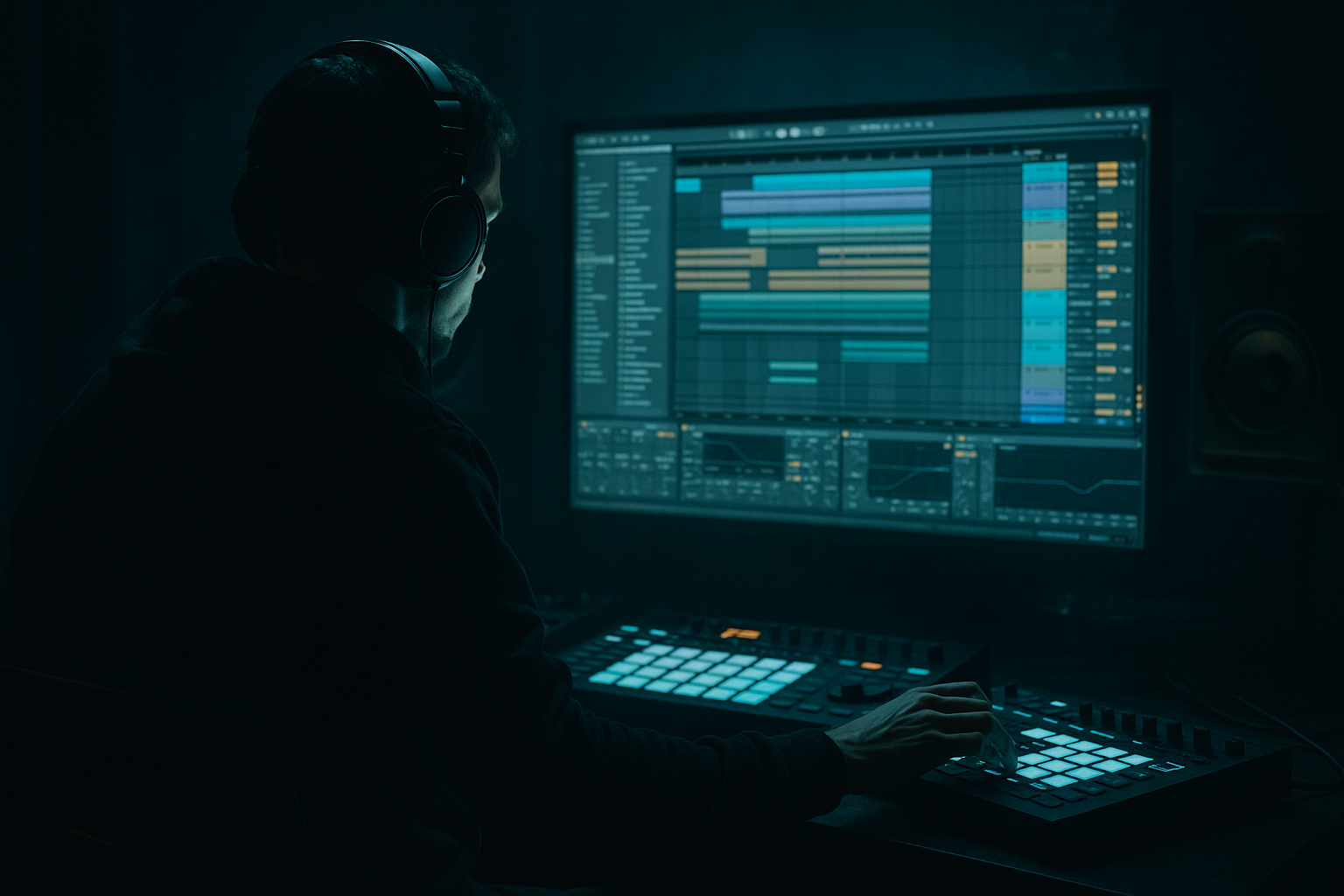
Main tutorial
VIP Bass Redesign Methods for Clean Mixes
1. Lesson overview
In drum and bass, a VIP bass redesign means taking an existing bass idea, preserving its identity, and rebuilding it into a new variation that hits harder, feels fresher, and fits a cleaner mix. This is especially important in DnB because bass parts often carry the entire drop energy—but if your redesign adds weight without control, the tune collapses into mud fast.
In this lesson, we’re going to focus on advanced Ableton Live workflows for redesigning a bass into a VIP version while keeping the mix clean, punchy, and club-ready. We’ll stay rooted in rolling DnB / jungle-informed bass music aesthetics: reese movement, neuro-style texture control, sub discipline, mid-bass layering, and arrangement decisions that create impact without overcrowding the low-mid range. 🔊
The goal is not just “make it dirtier.”
The goal is:
- keep the groove
- upgrade the tone
- improve separation
- retain sub consistency
- make the VIP feel intentional
- a clean bass group processing chain
- a resampling workflow for VIP creation
- an arrangement variation method so the VIP feels like a real second drop version
- a mix-safe strategy to stop the redesign from clashing with drums and sub
- Original drop: warm rolling reese
- VIP drop: same rhythm and motif, but with sharper transient growl, more upper-mid bite, altered phrase endings, and better drum pocket space
- a strong rhythmic pattern
- recognizable note movement
- a bass identity worth preserving
- room for a tonal upgrade
- a 2-bar or 4-bar rolling phrase
- a reese, wobble-reese hybrid, or snarling FM bass
- a bassline that already works musically but feels too flat or crowded
- Is the issue sound design or arrangement?
- Does the bass need more aggression, or just less conflict with drums?
- Can I keep the same MIDI and redesign only the processing?
- `Bass_SUB`
- `Bass_BODY`
- `Bass_TOP`
- Oscillator A: Sine wave
- Voices: 1
- Glide: Off or very short
- Envelope:
- Bass Mono: On
- Width: 0%
- Gain: adjust to sit right
- Low cut only if needed: around 25–30 Hz
- Gentle notch if there’s resonant junk from previous processing
- Do not hype upper harmonics unnecessarily
- keep the sub movement only if it translates clearly
- if the mid-bass is complex, simplify the sub notes
- in heavier DnB, the sub often works best as a stable anchor while the mids do the talking
- sub fundamentals often sit around E1 to G1
- lower than that can be huge, but harder to manage cleanly
- High-pass around 70–100 Hz
- Low-pass around 1.5–4 kHz, depending on how much top layer you want later
- Use steep-ish slopes if you want strong separation
- the note movement
- the growl
- the rolling energy
- the low-mid weight
- choose two harmonically rich oscillators
- detune slightly
- modulate wavetable position slowly with an LFO
- add a filter envelope for movement
- try FM from B into A
- keep FM amount moderate
- automate coarse/fine changes for phrase variation
- warp in Complex Pro or Repitch depending on the effect
- resample chunks
- re-trigger with Simpler
- HP at 80 Hz
- broad dip around 200–350 Hz if muddy
- tame honk around 500–800 Hz if nasal
- slight boost around 1–1.5 kHz if you want more articulation
- Mode: Analog Clip or Soft Sine
- Drive: 3–8 dB
- Soft Clip: On
- Output: trim to level-match
- Dry/Wet: often 70–100%
- enable Wave Shaper
- slightly bend the curve for asymmetry
- standard bars: 4–5 dB
- fill bars: 7–9 dB
- Rock for mid bite
- Heavy for growl
- Bass for low-mid reinforcement
- Gain: 3–6
- Volume: compensate carefully
- Presence: moderate
- Dry/Wet: 20–50%
- Low-pass with envelope movement for talking bass
- Band-pass for thinner, more aggressive stabs
- High-pass sweeps on fill notes
- Filter type: MS2 or OSR
- Envelope amount: subtle to moderate
- Resonance: 10–25%
- LFO rate synced: 1/8, 1/16, or dotted values
- LFO amount: small for rolling movement
- low-pass movement on the body
- separate bright top layer handling the aggression
- Attack: 10 ms
- Release: Auto or 0.3 s
- Ratio: 2:1
- Aim for 1–4 dB of gain reduction
- a resampled copy of your body layer
- a heavily processed duplicate
- or a slice of audio bounced from the original bass
- high-pass around 1 kHz
- sometimes even 1.5–2 kHz
- low-pass around 8–14 kHz depending on harshness
- Mode: Classic or One-Shot
- Start offset: tweak for tighter attacks
- Filter on
- Envelope shortened for staccato re-triggers
- Warp on/off depending on texture
- non-linear artifacts
- transient irregularities
- unusual formant-like moments
- phrase-specific character
- Downsample: mild to moderate
- Bit reduction: subtle
- Dry/Wet: 10–35%
- more drive than body layer
- brighter harmonic edge
- then EQ harshness out after
- use multiband mode
- keep low band clean or bypassed
- drive mids/highs only
- Tune to the track key or fifth
- Decay low
- Dry/Wet: 5–20%
- Phase: 180°
- Rate: slow, e.g. 1/4 or 1/2
- Amount: low to moderate
- Shape: smooth sine
- Width: around 120–170%
- automate width narrower in dense sections if needed
- put Hybrid Reverb on the top layer only
- high-pass the reverb return
- keep decay short
- Decay: 0.3–0.8 s
- Pre-delay: 5–20 ms
- Dry/Wet: low
- EQ the reverb return heavily
- low cut around 25 Hz
- broad cut around 250–400 Hz if the whole group clouds the mix
- tiny high shelf reduction if top layer gets harsh
- Attack: 10 ms
- Release: Auto
- Ratio: 2:1
- GR: 1–2 dB max
- Drive: 1–2 dB
- Soft Clip: On
- Mono the low end if needed using Bass Mono
- check gain staging
- automate overall bass level between phrases
- sub peak consistency
- low-mid build-up
- harsh spikes at 2–5 kHz
- Sidechain input: Kick
- Attack: 0.1–3 ms
- Release: 40–90 ms
- Ratio: 2:1–4:1
- Threshold: enough for a controlled dip
- less reduction than kick
- especially useful if your snare body lives around 180–250 Hz and 1–2 kHz
- sub ducks to kick
- body ducks slightly to snare
- top layer barely ducks, preserving aggression
- core motif
- note rhythm
- recognizable call-and-response structure
- phrase endings
- fill bars
- bass articulation
- top-layer movement
- silence placement
- Drop 1: original bass
- Drop 2: VIP redesign with sharper top layer and altered last bar every 8 bars
- first 8 bars: original
- bars 9–16: filtered body layer + aggressive resampled fills
- keep rolling bassline stable
- add chopped amens and a more distorted top layer on every 4th bar
- automate filter opening during edits
- Bars 1–2: familiar groove
- Bars 3–4: slight filter movement
- Bars 5–6: additional top bite or re-trigger
- Bars 7–8: VIP fill, resampled stab, or phrase inversion
- Saturator Drive
- Auto Filter frequency
- Utility Width on the top layer
- Amp Dry/Wet
- mute states of texture layers
- reverb send on phrase ends only
- Bars 1–3: stable
- Bar 4: filter push
- Bars 5–7: stable but wider top
- Bar 8: resample fill + brief distortion automation
- play with kick, snare, hats, break layers
- compare with and without top layer
- compare with and without sub
- test low-mid clarity under snares and ghost hits
- Sub level
- Body level
- Top level
- Distortion amount
- Filter amount
- sub is mono and stable
- body has enough weight without swallowing snare body
- top adds excitement without harsh fizz
- phrase variation is obvious by arrangement, not just distortion
- bass still grooves with drums
- the VIP sounds like the same tune, just evolved
- separate the sub
- keep it clean
- if you want audible harmonics, add them on a duplicate layer above 100 Hz
- carve each layer intentionally
- use EQ Eight before and after processing
- don’t be afraid of aggressive filtering on top layers
- mono sub
- keep the body mostly centered
- let stereo live mainly in upper harmonics
- assign one dominant movement source
- let the rest support it subtly
- alter phrase endings
- insert fills
- switch articulation or layering in specific bars
- use drop 2 as a progression, not a duplicate
- sidechain selectively
- carve low-mids around snare body
- reduce top-layer harshness around snare crack frequencies if they clash
- shorten MIDI note lengths on body layer
- let sub sustain slightly longer underneath
- every second bar
- or the last hit before the snare
- Saturator
- Amp
- EQ Eight boosts/cuts
- resampling artifacts
- open the filter slightly during an Amen chop
- mute the top layer for one snare hit
- add a resampled bark after a break fill
- resample it
- commit it to audio
- slice the best moments
- sub only + drums
- then reintroduce body and top aggressively
- 2 bars
- simple rolling reese or FM growl
- around 174 BPM
- same MIDI rhythm
- same root notes
- cleaner mix
- more aggression
- one phrase variation in bar 2
- `SUB`
- `BODY`
- `TOP`
- Operator or Wavetable
- EQ Eight
- Saturator
- Auto Filter
- Utility
- Glue Compressor
- Simpler or Resampling
- Is the VIP clearly related to the original?
- Does the snare still cut through?
- Is the sub cleaner than before?
- Does the top layer add excitement without harshness?
- Does the bar 2 variation make the loop feel more alive?
- Keep the sub clean, mono, and stable
- Split the bass into sub / body / top
- Use EQ before distortion
- Build aggression with harmonics and resampling, not uncontrolled low-end
- Use Automation and phrase variation to make the VIP feel like a real progression
- Mix the bass with the drums, never in isolation
- Operator for sub
- Wavetable / Operator / Simpler for body and top creation
- EQ Eight for carving
- Saturator and Amp for controlled redesign
- Auto Filter for motion
- Glue Compressor / Compressor for control and sidechain
- Utility for mono, width, and gain
- Resampling for real VIP character
- a 16-bar Ableton session blueprint
- a stock-device bass rack
- or a VIP bass redesign checklist for your own projects
We’ll use primarily Ableton stock devices, with workflow techniques that work whether your original bass came from Operator, Wavetable, Serum, resampling, or audio manipulation.
---
2. What you will build
By the end of this lesson, you’ll build a VIP bass redesign chain from an existing DnB bass phrase using a controlled 3-layer structure:
1. Sub layer
Clean, mono, stable, minimal movement below ~90 Hz
2. Body / mid-bass layer
Carries the note identity and rolling power in the 100 Hz–1.2 kHz region
3. Texture / top layer
Distortion, stereo movement, resampling artifacts, grit, and aggression above ~1 kHz
You’ll also build:
A typical result might be:
---
3. Step-by-step walkthrough
---
Step 1: Choose the right bass to VIP
Not every bass should get a redesign. The best candidates usually have:
In DnB, this often means:
#### Practical rule
Before redesigning, ask:
Very often, the cleanest VIP comes from keeping the MIDI groove mostly unchanged and redesigning the tone and phrase endings.
---
Step 2: Duplicate and split the bass into functional layers
Take your original bass track and create three versions:
Group them into a single group called:
`BASS VIP GROUP`
This instantly gives you cleaner control than trying to make one patch do everything.
---
Step 3: Build the sub layer first
The sub should be boring in the best way possible.
#### Recommended device chain
Operator or Analog is perfect here.
##### Operator settings
- Attack: 0–5 ms
- Decay: around 300 ms if plucky, or full sustain for rolling notes
- Sustain: 0 dB
- Release: 80–150 ms
#### Add utility control
Use Utility:
#### EQ Eight on sub
#### Sub workflow advice
If your original bass has pitch bends or movement:
#### Key range suggestion
For most rolling DnB:
---
Step 4: Create the body layer from the original bass
This is where the VIP still sounds like the original tune.
Duplicate your original bass source and strip out unnecessary extremes.
#### EQ Eight starting point
On `Bass_BODY`:
This layer should own:
#### Good source methods
If using Wavetable:
If using Operator:
If using audio:
---
Step 5: Redesign the body layer into a VIP tone
This is the key stage: preserve the groove, redesign the texture.
Here’s a strong Ableton stock chain for `Bass_BODY`:
Device chain: VIP body redesign
1. EQ Eight
2. Saturator
3. Amp
4. Auto Filter
5. Compressor or Glue Compressor
6. Utility
---
#### 5A. EQ Eight: shape before distortion
Before saturating, remove junk.
Suggested moves:
This keeps the distortion focused.
---
#### 5B. Saturator: controlled harmonic build
Use Saturator first because it’s more controllable than Amp.
Suggested settings:
If the bass starts sounding flat:
#### Trick
Automate Saturator Drive at phrase ends:
That gives the VIP more dynamic personality without rewriting the whole riff.
---
#### 5C. Amp: aggression and edge
Use Amp after Saturator for character.
Good DnB options:
Suggested settings:
Don’t overdo it. Amp can quickly blur the low-mids. If the bass gets cloudy, reduce Gain and increase the post-EQ cleanup.
---
#### 5D. Auto Filter: movement and phrasing
Use Auto Filter to create VIP differentiation.
Options:
Suggested settings:
For modern darker DnB, a great trick is:
This stops the whole bass from turning fizzy.
---
#### 5E. Compression: lock movement into the groove
Use Glue Compressor if your redesigned layer has too much dynamic spikiness.
Suggested settings:
This helps keep the bass consistent through dense drum programming.
---
Step 6: Build a separate top layer for VIP personality
This is where you make the VIP version feel like an event.
Create `Bass_TOP` from:
#### EQ this layer aggressively
On `Bass_TOP`:
This layer should not carry fundamental weight.
---
Step 7: Use resampling for more interesting VIP textures
This is one of the most effective advanced DnB methods in Ableton.
#### Resampling workflow
1. Solo your `Bass_BODY`
2. Create a new audio track called `Bass_Resample`
3. Set input to Resampling
4. Record 8–16 bars of bass variations
5. Chop the best moments
6. Drag them into Simpler
Now you can treat the bass like playable audio material.
#### In Simpler, try:
#### Why this works
Resampling gives you:
That’s exactly the kind of thing that makes a DnB VIP feel more dangerous and less preset-based 😈
---
Step 8: Build a top-layer chain that stays out of the mix
Try this chain on `Bass_TOP`:
Device chain: VIP top layer
1. EQ Eight
2. Redux or Roar / Saturator
3. Corpus or Resonators (optional)
4. Auto Pan
5. Hybrid Reverb or Reverb
6. Utility
---
#### 8A. Distortion / reduction
Use Redux carefully:
Or use Saturator:
If you have Roar, it’s excellent for this:
---
#### 8B. Resonant flavor
Corpus can add metallic snarl if used lightly.
Suggested ideas:
This is great for neuro-ish metallic tails, but too much will make the bass feel disconnected from the groove.
---
#### 8C. Stereo motion
Use Auto Pan not for volume tremolo, but width movement.
Suggested settings:
Then use Utility after it:
Important: only do this on the top layer, not the sub.
---
#### 8D. Reverb as texture, not space
A lot of producers smear bass with reverb. Don’t.
Instead:
Suggested settings:
This gives your VIP bass a haunted jungle-industrial aura without burying the drums.
---
Step 9: Create a bass group bus for cleanliness
Now process the whole `BASS VIP GROUP`.
#### Suggested group chain
1. EQ Eight
2. Glue Compressor
3. Saturator
4. Utility
5. Spectrum
---
#### EQ Eight on group
Use it for broad cleanup:
#### Glue Compressor
Very light control:
#### Saturator
Very subtle:
This glues the layers together.
#### Utility
#### Spectrum
Watch:
---
Step 10: Sidechain properly for drum pocket
In DnB, “clean bass” often means “kick and snare still feel huge.”
Use Compressor or Glue Compressor sidechained on the group or on selected layers.
#### Kick sidechain
On `Bass_SUB` or full group:
#### Snare sidechain
Sometimes sidechain the body or top layer slightly to the snare too:
#### Advanced DnB approach
Don’t always sidechain the whole bass equally.
Try:
This sounds more natural and keeps the roll alive.
---
Step 11: Arrange the VIP so it earns its place
A VIP isn’t just a new patch on the same loop.
For a proper second-drop or alt-drop VIP in DnB:
#### Keep these from the original:
#### Change these:
Strong arrangement ideas
#### Option A: Second-drop VIP switch
#### Option B: Mid-drop mutation
#### Option C: Jungle-style contrast
#### 8-bar phrase suggestion
This keeps energy moving without cluttering every bar.
---
Step 12: Use automation to create variation without mix mess
Automation is where the VIP comes alive.
Automate:
#### DnB-safe automation rule
If the bass is already dense, automate one parameter at a time per phrase.
Too many moving targets = weaker groove.
A great pattern:
---
Step 13: Check the bass against drums, not in solo
This is critical.
A VIP bass might sound massive in solo and useless in context.
When checking:
#### Quick Ableton check method
Create a rack macro for:
Then adjust while the full drop loops.
This helps you rebalance in context quickly.
---
Step 14: Final clean-mix checklist
Before calling the VIP finished, verify:
---
4. Common mistakes
1. Distorting the sub
This is one of the fastest ways to lose a clean DnB mix.
Fix:
---
2. Letting all layers occupy the same low-mid space
If sub, body, and top all contain 150–500 Hz content, the mix gets boxy and flat.
Fix:
---
3. Overstereo bass
Wide bass sounds cool in headphones and weak in clubs.
Fix:
Use Utility to check mono compatibility often.
---
4. Too much movement everywhere
If the wavetable, filter, distortion, panning, and reverb are all modulating hard, the bass loses identity.
Fix:
---
5. VIP that changes the sound but not the musical role
A true VIP should add contrast in the arrangement.
Fix:
---
6. Ignoring drum masking
In DnB, bass and drums are married. If the snare disappears, the bass redesign failed.
Fix:
---
5. Pro tips for darker/heavier DnB
Use controlled note length
For darker rollers, shorter bass notes often sound heavier because they leave room for drum transients and sub decay.
Try:
This creates a tight “bite + weight” combo.
---
Emphasize 2nd and 4th bar mutations
Instead of changing every hit, mutate only:
This keeps the hypnotic roller feel while adding menace.
---
Build aggression in the upper mids, not just sub gain
A lot of “heavy” DnB actually gets its perceived power from 700 Hz–3 kHz.
Use:
This lets the bass feel savage without crushing headroom.
---
Use break interaction as part of bass design
For jungle and darker rolling styles, let the bass answer the break edits.
Examples:
This ties the VIP into the rhythm section.
---
Print audio often
Once you have a nasty VIP texture:
Audio editing usually gives darker DnB more attitude than endlessly tweaking the synth.
---
Create “impact bars”
Every 8 or 16 bars, strip things down:
That contrast makes the VIP hit harder than just stacking more distortion all the time.
---
6. Mini practice exercise
Here’s a practical exercise you can do in Ableton in 20–30 minutes.
Exercise: Redesign a 2-bar roller into a VIP
Starting point
Use an existing bass phrase:
Your task
Create a VIP version with:
Required layers
Build:
Required stock devices
Use at least:
Target workflow
1. Make a clean mono sub in Operator
2. Duplicate original bass for body
3. High-pass body at 80–100 Hz
4. Add Saturator + Amp to body
5. Resample the body
6. Chop one aggressive moment into Simpler for a top stab
7. Put that stab at the end of bar 2
8. Group all bass layers
9. Sidechain sub to kick
10. Compare original vs VIP in context with drums
Self-check questions
---
7. Recap
A clean VIP bass redesign in Ableton Live comes down to separation, intention, and arrangement-aware sound design.
Key principles
Core Ableton tools for this lesson
If you get this workflow right, your VIP basses will sound bigger, darker, and more exciting—without wrecking the mix. That’s the real skill in drum and bass production: not just making chaos, but making chaos behave. 🖤🥁
If you want, I can also turn this into:

