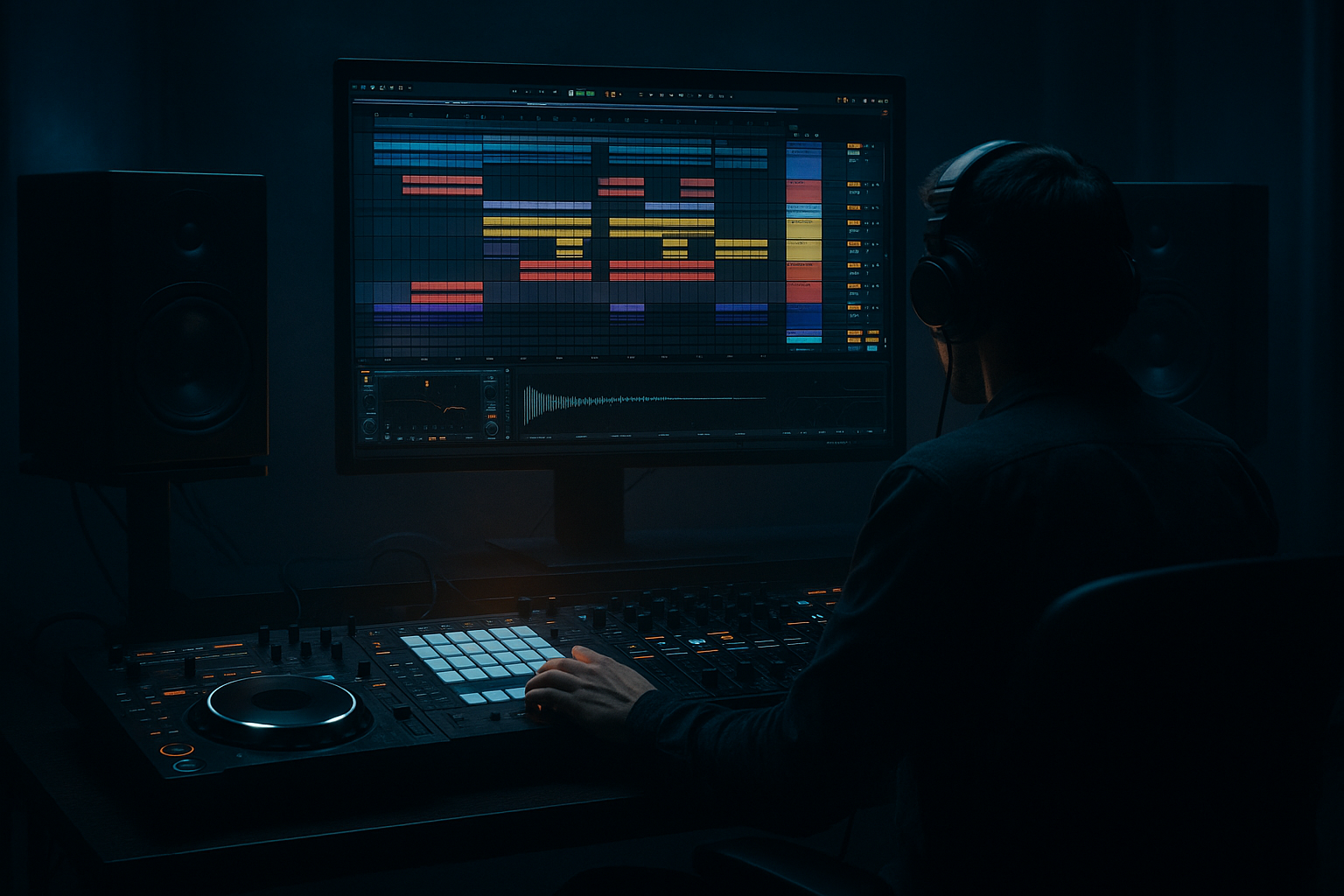
Main tutorial
```markdown
Vocal Cadence as Composition Guide (Resampling Only) — DnB in Ableton Live 🎛️🎤
1) Lesson overview
This lesson shows you how to write and arrange drum & bass using vocal cadence as the “score”—but with a hard constraint: you only progress by resampling audio.
No MIDI-instrument tweaks forever, no “just one more synth patch.” You’ll design moments, commit them to audio, and build a rolling DnB arrangement where phrasing = structure.
We’ll use:
- A short spoken/rap vocal (your own, a royalty-free acapella, or a recorded phone memo)
- Ableton stock devices
- Resampling + Freeze/Flatten as the main workflow
- A vocal-cadence map that dictates drops, fills, rests, and energy ramps
- A call/response bass written from the vocal rhythm
- A drum arrangement that mirrors consonants, breaths, and phrase endings
- A resampled audio palette (vocal chops, bass hits, drum fills, FX) you can perform like an instrument
- Set Audio From: Resampling
- Monitor: Off
- Arm it when printing
- Create Locator points at:
- Gate
- EQ Eight
- Saturator
- Optional: Drum Buss
- Kick on 1
- Snare on 2 and 4 (classic DnB backbeat)
- Closed hats: 1/8 or 1/16 with swing
- Add Groove Pool: try MPC 16 Swing 55–58 (subtle)
- Commit later via resampling; don’t obsess now.
- When the vocal has a hard consonant (t/k/p), drop a snare ghost or stick hit slightly before it (-5 to -15 ms).
- Slice by: Transient
- Create one-shot slices: On
- Warp slices: Off (usually tighter for drums)
- Operator
- Saturator (Soft Clip On, Drive 3–10 dB)
- Auto Filter
- EQ Eight: keep sub clean, carve mud around 200–400 Hz if needed
- Optional: Amp (for bite), then Limiter (safety)
- Use 2-bar question / 2-bar answer
- Bar 4 and bar 8: turnaround (short fill or pitch dip)
- If it’s clean and sustained: Complex or Complex Pro
- If it’s stabby: Beats (Preserve Transients) can keep punch
- Use Consolidate (Cmd/Ctrl+J) to create clean chunks
- Create:
- Put a chopped word right before the snare on bar 4/8/16 = instant tension.
- Bars 1–16 (Intro): cadence click quiet + atmos + sparse breaks
- Bars 17–32 (Drop 1): full drums + bass call/response following cadence
- Bars 33–48 (Bridge): strip drums where vocal rests; feature vocal tail FX
- Bars 49–64 (Drop 2): heavier variation; cadence becomes more chopped/percussive
- Writing to lyrics instead of cadence: You want rhythm + phrasing. If the words distract, low-pass the guide.
- Over-warping the vocal: Too many warp markers kills groove. Use the minimum needed to lock the phrase.
- No holes in bass: Rolling DnB needs negative space. If bass plays constantly, cadence won’t read.
- Not committing soon enough: If you keep instruments live, you’ll “sound-design” forever. Print early.
- Ignoring phrase endings: The end of a line is where DnB lives—fills, edits, crashes, reloads.
- Make cadence more aggressive with distortion printing
- Sub discipline
- Weaponize silence
- Neuro-ish movement without synth noodling
- Breakbeat grit
- Use a vocal as a cadence score, not just a feature.
- Convert cadence into a printed percussive guide.
- Write drums and bass to phrasing and gaps, then resample everything.
- Slice and rearrange printed audio to stay fast, decisive, and DnB-authentic.
- Let phrase endings dictate fills, edits, and drop mechanics.
Skill level: Advanced (we’ll move fast and commit aggressively).
---
2) What you will build
A 16–64 bar DnB sketch (think rolling/jungle-influenced) featuring:
You’ll end with audio clips only (besides the original vocal reference).
---
3) Step-by-step walkthrough
Step 0 — Project setup (fast + reliable)
1. Set tempo to 174 BPM (170–176 is fine).
2. Global quantize: 1/16 (you can go 1/8 for broader edits, but 1/16 keeps DnB tight).
3. Create these tracks:
- Vox Guide (audio)
- Vox Resample (audio)
- Drums Resample (audio)
- Bass Resample (audio)
- FX Resample (audio)
- PRINT (Resample In) (audio) — this is your main resampling lane
PRINT track routing
> Why: “Resampling” captures exactly what you hear (including buss processing), perfect for commitment.
---
Step 1 — Create the vocal cadence “score” 🎤
Your goal: extract rhythmic phrasing, not lyrics.
1. Drag a vocal into Vox Guide.
2. Warp settings (advanced but practical):
- Warp: On
- If it’s a full vocal with transients: start with Complex Pro
- Formants: 0 (adjust later)
- Envelope: 128
- If it’s percussive/spoken: try Beats
- Preserve: Transient
- Transient Loop: Off
3. Find the strongest 1–4 bar phrase (something with clear cadence: pauses, emphases).
4. Slice a clean loop (e.g., 4 bars) and duplicate it out to 16 bars.
Turn cadence into markers:
- Phrase starts (strong downbeats)
- Breath/pause moments (perfect for drum drops)
- End-of-line hits (perfect for fills/stabs)
> Think like an MC: the cadence already tells you where the “reload” energy lives.
---
Step 2 — Resample a “cadence click track” (your hidden grid)
We’ll convert the vocal into a percussive guide that drums/bass can lock to.
On Vox Guide, insert:
- Threshold: adjust so only syllables open it (start around -25 dB)
- Return: 80–150 ms
- Floor: -inf
- HP at 200–400 Hz
- Boost 3–6 kHz if you need more consonant bite
- Drive: 4–8 dB
- Soft Clip: On
- Drive: 5–15
- Crunch: 5–15%
- Boom: 0 (we don’t need low end here)
Now print it:
1. Arm PRINT
2. Solo Vox Guide
3. Record 8–16 bars into PRINT
4. Drag the recorded clip to Vox Resample and rename it: `CADENCE_CLICK`
Now you have a tight, gritty “cadence metronome” that is derived from the vocal.
---
Step 3 — Build drums by copying the vocal’s consonants 🥁
We’re going for rolling DnB with vocal-shaped fills.
#### 3A) Start with a basic DnB skeleton
Create a Drum Rack (temporarily—then we print). Use any solid samples:
Quick Ableton-native groove:
#### 3B) Use the cadence click to design fills
1. Solo `CADENCE_CLICK` and listen for:
- Clusters of syllables → put ghost snares, rimshots, or shuffled hats
- Long gaps → strip drums back (kick + hat only, or just atmos)
A very DnB trick:
#### 3C) Print your drum loop
Route drums to resampling:
1. Mute everything except drums
2. Arm PRINT
3. Record 8–16 bars
4. Drag to Drums Resample and Slice to New MIDI Track (yes, slicing audio is still “resampling only” because you’re not going back to instrument design)
Slice settings
Now you can rearrange drum hits from the printed audio, not the original kit.
---
Step 4 — Write bass from the vocal rhythm (call/response) 🔊
We’ll “translate” cadence into bass phrasing—then print it.
#### 4A) Temporary bass instrument (only to generate audio)
Create an instrument track TEMP Bass (you will print and then delete/disable it).
Device chain idea (stock):
- Osc A: Sine
- Osc B: Saw at low level (for harmonics)
- Add a touch of FM if you like (very small)
- Type: LP24
- Envelope: On
- Env Amount: 10–30
- Attack: 0–5 ms
- Decay: 100–250 ms
#### 4B) Use the cadence click as your MIDI trigger guide
You’re advanced—so do this fast:
1. Look at `CADENCE_CLICK` waveform.
2. Place bass notes where syllable clusters happen.
3. Leave holes where the vocal breathes (that’s your groove).
DnB phrasing suggestion:
#### 4C) Print bass and commit
1. Solo TEMP Bass
2. Arm PRINT
3. Record 8–16 bars
4. Drag to Bass Resample
5. Now disable TEMP Bass (commitment rule).
Audio-warp choices for bass:
---
Step 5 — Create vocal chops that become “arrangement glue” ✂️
Now we turn the vocal into hooks and fills without overproducing.
1. Duplicate `CADENCE_CLICK` and also print a “tonal vocal” version:
- On Vox Guide:
- Remove Gate
- Add Pitch (or use Clip Transpose)
- Add Hybrid Reverb (small plate or dark room)
- Add Delay (Echo works too)
2. Resample this wet chain into Vox Resample as `VOX_WET_PRINT`.
Chop workflow (fast):
- 1–2 signature one-shots (a word, a vowel, a breath)
- 2–4 fills (end-of-phrase tails)
- 1 “reload” moment (big tail with reverb)
DnB arrangement function:
---
Step 6 — Build the arrangement from cadence (not from drums) 🧱
This is the core concept: the vocal phrasing dictates energy, even if the vocal is not always audible.
A practical 64-bar blueprint (adjust to taste):
How to do it in Ableton:
1. Lay `CADENCE_CLICK` across the whole arrangement at low volume.
2. Wherever cadence has space, you:
- remove hats
- open reverb tails
- let bass sustain or stop entirely
3. Wherever cadence is busy, you:
- add ghost notes
- add bass syncopation
- add small edits (1/16 stutters)
---
Step 7 — FX via resampling (riser, downlifter, impacts) 🌪️
Create FX from your existing prints (no synth risers needed).
FX recipe A: Vocal “suck” into drop
1. Take a vocal tail from `VOX_WET_PRINT`
2. Reverse it
3. Add Auto Filter (HP rising)
4. Add Reverb (long decay, 4–8s)
5. Resample to FX Resample
6. Reverse again if you want a classic “into impact” swell
FX recipe B: Bass-stab impact
1. Take a bass hit from Bass Resample
2. Pitch down -12 in Clip Transpose
3. Add Drum Buss (Drive 10–25)
4. Add Limiter
5. Print to FX Resample
---
Step 8 — Final “all-audio” performance pass (the commitment move) ✅
Once your 16–64 bars feel good:
1. Mute Vox Guide (keep resampled elements only)
2. Arm PRINT
3. Record the entire arrangement as a stereo print
4. Do micro-edits on the stereo print:
- 1/8 mutes
- tape stops (Repitch warp + automation)
- tiny dropouts before snares
This is classic jungle/DnB energy: edits over perfection.
---
4) Common mistakes
---
5) Pro tips for darker/heavier DnB 🖤
- On cadence click: Roar (if you have it) or Saturator + Drum Buss
- Print, then slice it like percussion
- Keep sub mostly mono: use Utility on Bass Resample (Width 0% below ~120 Hz via EQ M/S or split chain)
- Before a big snare: mute everything for 1/16–1/8, but let a vocal tail or noise remain
- Resample bass through Auto Filter + Phaser-Flanger subtle movement
- Then slice the best 1/4-bar moments into new patterns
- Print a break loop through Redux (light) + Drum Buss
- Layer under your clean drums at -18 to -12 dB for texture
---
6) Mini practice exercise (20–30 minutes) ⏱️
Goal: 16 bars that feel like a drop built from cadence.
1. Pick a 2-bar vocal phrase with a clear pause.
2. Make `CADENCE_CLICK` and print it (2–4 bars).
3. Create one drum loop (2 bars), print it, slice it, then make a variation for bars 3–4.
4. Create one bass phrase that matches syllable clusters, print it.
5. Arrange:
- Bars 1–8: tease (half drums, cadence audible)
- Bars 9–16: full drop (cadence mostly hidden, but guiding edits)
6. Export and listen away from Ableton. If you can feel the phrasing without hearing the vocal clearly, you nailed it.
---
7) Recap
If you want, tell me what kind of vocal you’re using (rap/spoken/female topline) and what substyle (roller, jungle, dancefloor, neuro), and I’ll give you a matching 32-bar arrangement template + device chains.
```

