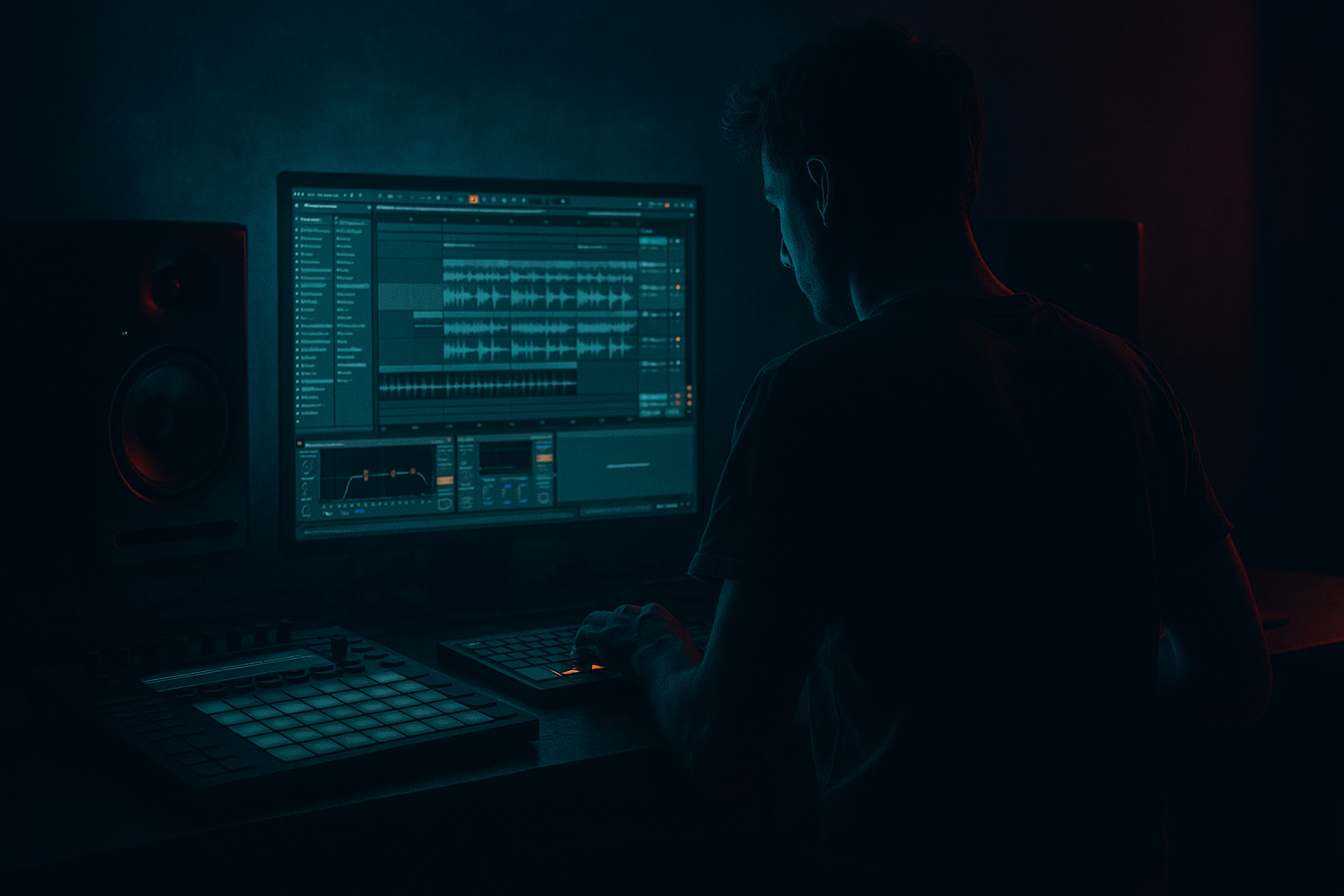
Main tutorial
Vocal Sample Sit & Blend From Scratch (90s Rave Flavor) — Ableton Live (DnB Mixing) 🔊🧪
1) Lesson overview
In 90s jungle/DnB, vocals weren’t “hi‑fi pop lead vocals.” They were samples—often short phrases—processed hard, sitting inside the mix like part of the drums and bass. In this lesson you’ll learn how to take a raw vocal sample and make it sit, cut, and feel authentically rave: tight timing, controlled dynamics, gritty tone, and the right space.
We’ll do this from scratch using Ableton stock devices and a DnB‑friendly workflow.
---
2) What you will build
You’ll end up with:
- A vocal sample track that locks to the groove of a rolling DnB beat (170–175 BPM)
- A clean-but-rave vocal chain (EQ → compression → saturation → tone shaping → space)
- A parallel “rave grit” return channel (distortion + bandpass + short room)
- A simple arrangement approach: call/response, fills, and “one-liner” hooks that work in jungle/DnB
- Short phrases: “come again”, “selecta”, “original”, “in the place”, “run the track”
- Shouts / MC snippets / diva one-liners
- Spoken word fragments
- Try nudging the clip -5 to -15 ms earlier so it feels like it’s pushing the drums. Keep it subtle.
- A section (16 bars): vocal appears every 4 bars (tease)
- Drop (32 bars): vocal hits every 2 bars (call/response with drums)
- Breakdown: long reverb throw + filtered vocal tail
- Set the vocal clip gain so the track peaks around -12 to -9 dBFS.
- You want headroom because we’re going to add saturation/parallel stuff.
- HP filter: 24 dB/oct at 120–180 Hz
- Cut mud: -2 to -5 dB around 250–450 Hz (wide Q)
- Tame harshness (if needed): -2 to -4 dB around 2.5–5 kHz
- Add presence (if needed): +1 to +3 dB around 1–3 kHz (wide Q)
- Ratio: 3:1 to 4:1
- Attack: 10–30 ms (let transients through a touch)
- Release: 60–120 ms (tempo-friendly)
- Threshold: aim for 3–6 dB gain reduction on peaks
- Turn on Soft Clip (if available on your Live version) or handle peaks later.
- Mode: Analog Clip or Soft Sine (start with Analog Clip)
- Drive: 2–6 dB
- Output: reduce to match level (A/B fairly!)
- Turn on Soft Clip for extra control
- Threshold: set so it closes between phrases
- Return: 0 ms
- Hold: 20–60 ms
- Release: 80–150 ms (natural tail without dragging)
- Hybrid Reverb
- After Hybrid Reverb add Saturator (Drive 1–3 dB)
- Optional: EQ Eight after to band-limit (more authentic)
- Echo
- After Echo: Compressor (light) or Limiter to catch spikes
- Room send: -18 to -10 dB (subtle glue)
- Delay send: keep low most of the time, and automate for throws.
- Start at -24 dB send and bring up until you feel it more than hear it.
- Snare (body + crack)
- Hats/top loop
- Bass midrange (reese growl)
- Add Compressor after EQ/Sat (or reuse if you prefer)
- Enable Sidechain
- Input: your Snare track (or drum bus)
- Settings:
- On the vocal, consider a gentle cut around 300–700 Hz if it sounds boxed.
- Or on the bass, cut a small dip around 1–3 kHz if the vocal needs presence.
- Pan: keep main vocal mostly center (classic), but you can duplicate + pan a filtered layer.
- Vocal fader: set it so it’s audible on small speakers but not “front of the band.”
- Check at low volume: can you still understand the phrase? If yes, you’re winning.
- Vocal often sits just below the snare, not above it, in rolling DnB.
- Automate Echo send at the end of phrases (delay throw)
- Automate Auto Filter on the vocal:
- Automate Reverb send on the last word of a bar, then cut it back before the next bar hits
- Too much long reverb → washes over breaks and kills punch. Use short room + controlled throws.
- Not warping properly → vocal feels late/draggy against fast drums.
- Over-EQ’ing the top end → harsh “digital” vocal that fights hats and snare crack.
- No headroom → saturation/distortion turns into brittle clipping.
- Vocal too loud → instantly sounds like a pop mix, not jungle/DnB.
- Ignoring the bass midrange → reese masks intelligibility; you think you need more volume but you actually need space.
- Band-limit for menace: Put an EQ Eight at the end and low-pass around 8–10 kHz to avoid shiny modern top.
- Pitch down slightly: Try -1 to -3 semitones with Complex Pro (watch artifacts). Darker, more rave.
- Formant shift (subtle): In Complex Pro, small Formants adjustments can turn a vocal into a spooky texture.
- Distort the return, not the main: Keep intelligibility in the dry vocal; get filth from parallel sends.
- Mono your vocal (often): Use Utility → Width 0% on the main vocal, then create width using returns/delays.
- Make the vocal part of the rhythm: Chop to 1/8 and 1/16 repeats leading into snare fills. DnB is percussive—treat vocals the same.
- Warp + micro-timing makes vocals groove with fast DnB drums.
- Keep phrases short and rhythmic for true rave/jungle energy.
- Core chain: EQ → compression → saturation (→ gate optional).
- Use short room for glue and Echo throws for hype.
- Add 90s grit with parallel bandpass distortion on a return.
- Make space with snare sidechain and small EQ pockets instead of turning the vocal up.
---
3) Step-by-step walkthrough
Step 0 — Pick the right type of vocal sample 🎙️
For 90s rave flavor, these tend to work best:
Tip: If the sample is long, you can still use it—just plan to chop it into smaller phrases.
---
Step 1 — Warp it correctly (this is where “sitting in the pocket” starts)
1. Drop the vocal sample into an Audio Track.
2. Turn on Warp.
3. Choose a Warp mode:
- Complex Pro (best for full phrases)
- Formants: 0 to 20 (start at 0)
- Envelope: ~128
- Tones (great for shouty / cleaner fragments)
- Grain Size: 20–40
4. Set your project tempo to 172 BPM (classic rolling zone).
5. Align the phrase so the important syllable hits the groove:
- In DnB, vocals often hit on the “and” or just before the snare for urgency.
6. Right-click the clip → Warp From Here (Straight) if it’s loosely timed, then nudge warp markers manually.
Micro-timing move (very DnB):
---
Step 2 — Chop for 90s vibe (don’t let it ramble) ✂️
In Arrangement View:
1. Duplicate the vocal clip to a new lane or copy/paste sections.
2. Make 1–2 bar phrases max, and add stutters:
- Split (Cmd/Ctrl+E) on syllables
- Repeat a tiny piece (1/16 or 1/8) leading into a snare fill
3. Add gaps. Jungle vocals breathe—silence is part of the hook.
Arrangement idea:
---
Step 3 — Gain stage first (so your processing behaves)
Before plugins:
---
Step 4 — Core “Sit in the Mix” chain (stock Ableton)
Put this device chain on the vocal track in this order:
#### 4A) EQ Eight (clean up + carve space)
Start with:
(Higher if your bass is huge; lower if it’s a deep male voice)
DnB reality check: If your snare is cracking at 200 Hz + 3–5 kHz, don’t boost there blindly—make room.
---
#### 4B) Compressor (control dynamics)
Goal: stable vocal that doesn’t jump out randomly.
Settings to start:
Tip: If it pumps weirdly, lengthen release. If it’s too spiky, shorten attack slightly.
---
#### 4C) Saturator (rave bite + density)
This helps vocals feel “printed to tape/desk,” which is very 90s-adjacent.
---
#### 4D) Gate (optional, but very jungle)
If your sample has noise/floor or you want tight cuts:
This gives that chopped, disciplined sound that sits in busy breakbeats.
---
Step 5 — Put it in 90s space: short room + tempo delays 🌫️
Instead of huge modern reverb, think short, characterful ambience + rhythmic delay throws.
#### 5A) Create two Return tracks
Return A — “Rave Room” (short + gritty)
- Reverb mode (Algorithmic)
- Decay: 0.4–0.9 s
- Pre-delay: 5–20 ms
- Low Cut: 200–400 Hz
- High Cut: 6–10 kHz
- Low cut 250 Hz, high cut 7–9 kHz
Return B — “Dub Delay”
- Time: 1/8 or 1/4 (try dotted 1/8 for classic movement)
- Feedback: 20–40%
- Filter: HP ~200 Hz, LP ~6–8 kHz
- Modulation: small (2–8%) for wobble
Now send the vocal:
---
Step 6 — The “Rave Grit Parallel” trick (instant 90s attitude) 🧯
Create a third Return:
Return C — “Grit Bus”
1. Auto Filter
- Bandpass
- Frequency: 700 Hz – 3.5 kHz (tune to taste)
- Resonance: small (0.7–1.2)
2. Overdrive
- Drive: 20–50%
- Tone: around mid
- Dry/Wet: 30–60%
3. Redux (optional, go easy)
- Downsample a little (like 2–6)
- Bit reduction minimal (0–2) or none
4. Hybrid Reverb (tiny)
- Decay: 0.3–0.6 s
- High cut: 6–8 kHz
Send your vocal lightly to this:
This is a classic way to get that “old sampler / rave tape” edge while keeping your main vocal intelligible.
---
Step 7 — Make it sit with the drums + bass (sidechain & masking)
In rolling DnB, your vocal competes with:
#### 7A) Sidechain the vocal from the snare (subtle)
On the vocal track:
- Ratio 2:1
- Attack 1–5 ms
- Release 50–120 ms
- Aim for 1–3 dB GR when snare hits
This creates space so the snare still slaps.
#### 7B) Carve a pocket if bass is mid-heavy
If your bass has tons of 200 Hz–2 kHz content (reese/Neuro-ish):
Keep moves small (1–3 dB). DnB mixes add up fast.
---
Step 8 — Level & placement (the “is it believable?” pass)
Quick reference target:
---
Step 9 — Automation for rave authenticity (throws + filter moves) 🎛️
Add movement that screams 90s:
- High-pass sweep in breakdown
- Band-pass “telephone” moment (300–3k)
This is how you make a simple sample feel like a performance.
---
4) Common mistakes
---
5) Pro tips for darker/heavier DnB 🖤
---
6) Mini practice exercise (15–20 minutes) ⏱️
1. Load any short vocal phrase (1–3 seconds).
2. Warp to 172 BPM and align the main word to hit just before the snare on bar 2.
3. Chop it into three versions:
- A clean hit (1 bar)
- A stutter (1/16 repeats for 1 beat)
- A “throw” version (automate Echo send on last word)
4. Build the chain:
- EQ Eight (HP 150 Hz, small mud cut)
- Compressor (4:1, 4 dB GR)
- Saturator (Analog Clip, Drive 4 dB)
5. Add Return A (short room) + Return B (Echo).
6. Balance levels so the vocal is audible but snare stays dominant.
7. Bounce a 16‑bar loop and listen on:
- headphones
- laptop speakers (if possible)
Goal: the vocal should feel like it’s in the record, not pasted on top.
---
7) Recap ✅
If you tell me your exact vocal type (MC shout, diva line, spoken word) and your bass style (liquid/subby vs reese/techstep), I can suggest a tighter starting chain and send levels tailored to that vibe.

