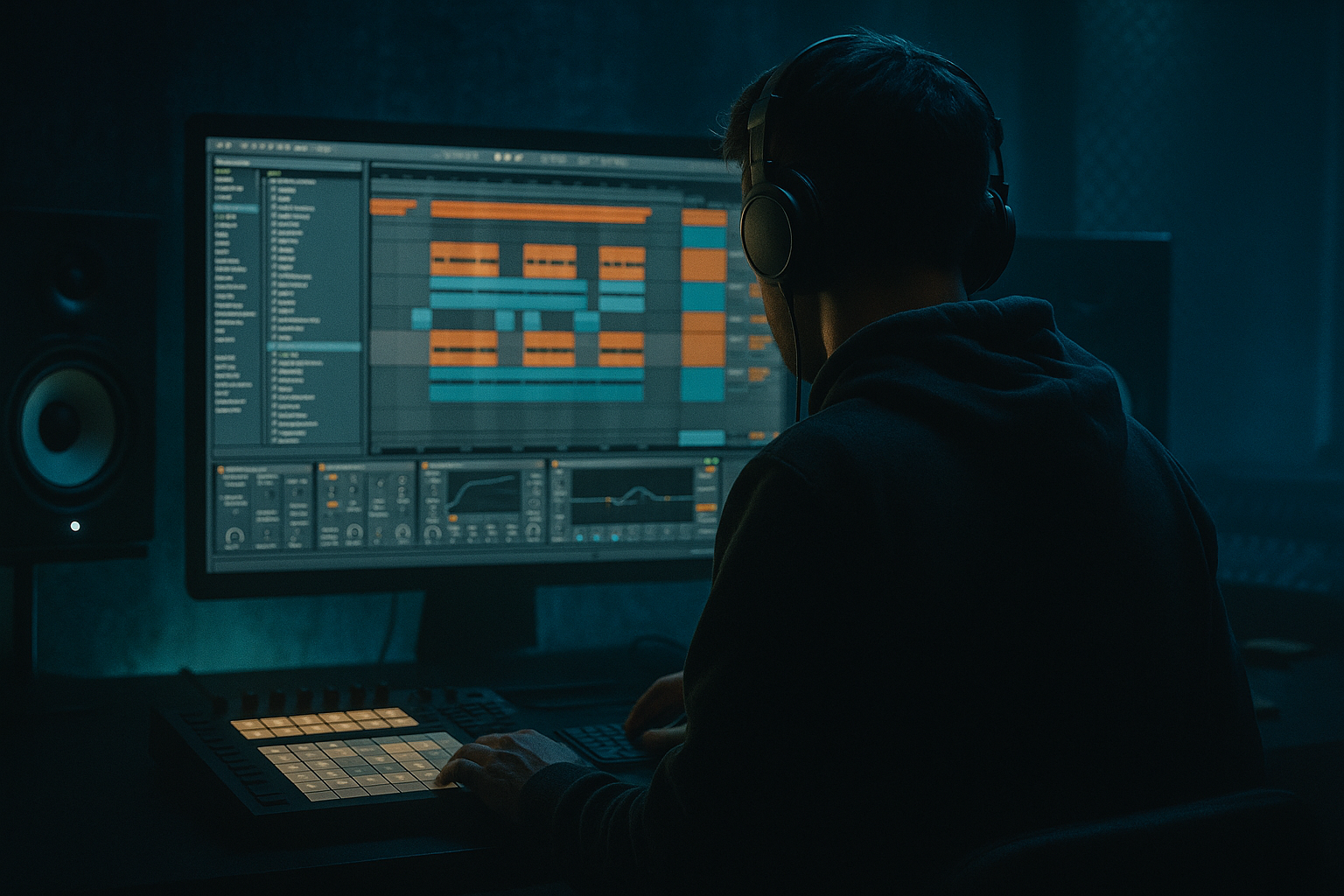
Main tutorial
```markdown
Volume Automation for Groove (Modern Control + Vintage Tone) 🎛️🔥
Ableton Live | Drum & Bass | Intermediate | Automation
---
1. Lesson overview
Volume automation is one of the fastest ways to inject movement, swing, and perceived loudness into drum & bass—without changing your MIDI or sample choices. In modern DnB, we want tight control (clean transients, consistent subs) but also that vintage “push-pull” feel you hear in jungle and older rollers.
In this lesson you’ll learn how to automate volume in Ableton Live at three levels:
- Clip gain / Clip Envelope (micro groove)
- Track volume & Utility gain (macro groove without messing up your mix)
- Bus-level automation (drum/bass interplay and arrangement energy)
- The drum bus “breathes” around the bass.
- Hi-hats and ghost notes get human micro-dynamics.
- Fills and transitions feel intentional with macro automation.
- The whole thing stays mix-safe using Utility and bus automation (instead of wrecking compressor behavior).
- Drum bus groove
- Bass bus breathing
- Transition lifts/drops
- DRUMS Group
- BASS Group
- MUSIC/FX Group
- MASTER (leave headroom)
- Drum peaks around -6 to -8 dBFS on the Drum Group
- Bass peaks around -8 to -10 dBFS on the Bass Group
- Utility (first in chain) — rename it `DRUMS - AUTO GAIN`
- Saturator (optional)
- Glue Compressor (optional)
- Steps 1,5,9,13 slightly louder
- Steps 3,7,11,15 slightly lower
- Ghost snare hits: -4 to -8 dB relative to main snare
- Ghost kick ticks: -6 to -10 dB, just for momentum
- Beat 1 (kick/snare impact): 0 dB (no boost)
- Just after snare: dip to -0.7 dB for ~1/8 note
- Lead into next hit: return to 0 dB
- Repeat with a slightly different dip around beat 3 for variation
- In verses/rollers: more breathing (-0.6 to -1.2 dB dips)
- In drops: less breathing (-0.3 to -0.6 dB) for maximum punch
- In breakdowns: more movement (up to -1.5 dB dips) for vibe
- Utility first — rename `BASS - AUTO GAIN`
- On snare hits, dip bass group by -0.8 to -2.0 dB
- On kick hits (depending on your kick/sub relationship), dip -0.3 to -1.2 dB
- `SUB` track (20–90 Hz)
- `MIDBASS` track (90 Hz+)
- EQ Eight to split (HP/LP)
- Utility for gain automation per band/track
- Ramp up Utility Gain +0.5 to +1.5 dB over the last 4–8 bars before drop
- Reduce hats by -1 dB for 1 bar, then return (creates breathing)
- Slightly boost the snare +0.5 dB for the fill bar
- Dip bass -1 dB for 1/2 bar to spotlight a drum fill
- Automate break track Utility Gain to push certain break hits:
- Make the snare feel heavier without raising peak level:
- “Shadow groove” on hats:
- Parallel dirt bus with automated send (controlled chaos):
- Use Utility Width automation for darkness + impact (sub-safe):
- Use Utility Gain automation early in chains for predictable results.
- Use Clip Volume envelopes for micro-dynamics (vintage break feel).
- Use bus automation for macro groove and arrangement energy.
- Keep sub consistent; automate midbass more aggressively.
- Add “vintage tone” after your groove moves: Saturator → Glue (subtle, level-matched).
We’ll also shape it into a vintage tone using subtle saturation and glue—without losing punch. 🧱
---
2. What you will build
A tight rolling DnB groove where:
You’ll end with a reusable automation template for:
---
3. Step-by-step walkthrough
Step 0 — Session setup (quick but important) ✅
Tempo: 172–176 BPM
Grid: 1/16 with triplet grid ready (jungle swing lives here)
Create groups:
Gain staging target:
This keeps automation meaningful and avoids clipping when you add saturation later.
---
Step 1 — “Modern control” rule: automate gain before heavy dynamics
If you automate the track fader after compression/saturation, you often change how those devices react (sometimes cool, often unpredictable).
Best practice chain (per track or bus):
1. Utility (for automation)
2. Saturator (optional tone)
3. Glue Compressor (optional glue)
4. Limiter (only if needed for safety; avoid crushing)
✅ Do this now:
On your Drum Group, add:
Why Utility?
Utility’s Gain is stable, automatable, and won’t mess with your mixer fader balances.
---
Step 2 — Micro-groove: clip volume automation for hats & ghost notes 🥁
This is the “vintage” part: old breaks naturally have level variation. We recreate that subtly.
#### A) Hi-hats (or ride) clip envelope
1. Pick your hat loop or programmed hats on a single audio track.
2. Double-click the clip to open Clip View.
3. Open the Envelopes box:
- Device: Clip
- Control: Volume
4. Draw subtle movement:
- Downbeat hats: 0 dB
- Offbeats: -1 to -2.5 dB
- Occasional ghost hits: -3 to -6 dB
DnB pattern idea (16ths):
This creates that rolling “ts-ts-ts” with forward motion.
#### B) Ghost snare / ghost kick level nudges
For ghost hits, don’t rely only on velocity—use clip volume automation too.
Tip: If you’re using Drum Rack, velocity often changes sample tone (great), while volume automation changes level (clean). Use both.
---
Step 3 — Macro-groove: automate the Drum Group “breath” (the roller move) 🌊
Now we create a subtle rhythmic pump that makes the groove feel alive without heavy sidechain.
1. On DRUMS Group → Utility → automate Gain
2. Press A to show Automation lanes.
3. Choose automation target:
- `DRUMS - AUTO GAIN` → Gain
#### Draw a 1-bar “breathing” curve (start subtle)
At 174 BPM, try this as a starting point:
Goal: You should feel groove, not hear obvious volume automation.
✅ Arrangement use:
---
Step 4 — Bass vs drums interplay: automate bass bus dips (instead of over-sidechaining) 🧬
For modern DnB, we want the sub stable, but we still need the drums to read clearly.
On BASS Group, add:
Now automate:
This is the “manual sidechain” approach—more intentional than a compressor, and very genre-authentic when done subtly.
Tip for sub safety:
Split bass:
Automate the MIDBASS more than the SUB. Keep SUB automation tiny (or none).
Stock devices to do this cleanly:
---
Step 5 — Add “vintage tone” without losing control: saturation + glue AFTER automation
Once your volume automation gives groove, you can “print” that feel into tone.
On DRUMS Group chain (after Utility):
1. Saturator
- Mode: Analog Clip
- Drive: 1–4 dB
- Soft Clip: On
- Output: reduce to match level (don’t accidentally get louder)
2. Glue Compressor
- Attack: 3 ms (let transients through)
- Release: Auto or 0.1–0.3 s
- Ratio: 2:1
- Threshold: aim 1–3 dB GR on loud sections
- Makeup: off unless you need it
This combo gives a “breakbus” vibe—more density, less sterile.
---
Step 6 — Arrangement automation: energy shaping across 16/32 bars 🚦
Now we use volume automation like an arranger.
#### A) Pre-drop lift (classic DnB tension)
On MUSIC/FX Group or DRUMS Group:
Then hard reset at the drop.
Keep it tasteful—DnB drops hit hardest when headroom is preserved.
#### B) Drop micro-variation (avoid loop fatigue)
Every 8 bars, do one of these:
#### C) Jungle-style “break emphasis”
If you’re using a break layer:
- Amen “chop accents” +0.5 dB
- Ghost notes stay down
This mimics old sampling dynamics while staying mix-safe.
---
4. Common mistakes ⚠️
1. Automating the track fader post-processing
Changes compressor/saturator input relationships unexpectedly. Use Utility Gain early in the chain.
2. Going too deep with dips/boosts
If you’re dipping -3 to -6 dB on buses, it’ll sound like obvious pumping (unless that’s your goal). Start under -1.2 dB.
3. Wrecking the sub with automation
Sub should be consistent. Automate midbass more than the sub.
4. Forgetting to level match after saturation
Louder sounds “better,” which tricks decisions. Always match output levels.
5. Over-quantized automation shapes
Perfect triangles can sound mechanical. Add slight asymmetry—DnB groove is controlled, not robotic.
---
5. Pro tips for darker/heavier DnB 🖤
Automate a tiny dip right before the snare on the Drum Group (like -0.5 dB for 20–40 ms) then return to 0 at the snare. Psychoacoustically, the snare pops harder.
Use clip envelope volume to create a repeating 2-bar dynamic pattern:
- Bar 1 hats slightly louder overall
- Bar 2 hats slightly lower overall
This makes the loop feel longer and moodier.
Create a return track `DIRT`:
- Saturator (Drive 5–10 dB, Soft Clip on)
- Auto Filter (LP around 6–10 kHz to keep it dark)
- Glue Compressor (heavier GR is fine here)
Then automate Send amount from drums/breaks:
- More dirt in fills and transitions
- Less dirt in the main drop for clarity
On midbass bus, automate Width:
- Verse: 70–90%
- Drop moments: 100–120% (only if mono compatibility is okay)
Keep sub track at 0% width (mono).
---
6. Mini practice exercise 🧪
Goal: Build a 16-bar roller with audible groove improvement without changing MIDI notes.
1. Make a simple drum pattern:
- Kick on 1 and 3 (or a 2-step variant)
- Snare on 2 and 4
- 16th hats
2. Add a bass (sub + midbass).
3. Do three automations:
- Hat clip volume envelope: offbeats -2 dB, random ghosts -4 dB
- Drum Group Utility Gain: dips -0.8 dB after snares
- Midbass Utility Gain: dip -1.5 dB on snare hits
4. Add Saturator + Glue on Drum Group and level-match.
5. Export two versions:
- No automation
- With automation
6. Compare at the same loudness. Listen for:
- More forward motion
- Clearer snare placement
- Bass sitting “under” drums instead of fighting
---
7. Recap ✅
If you want, tell me your current drum structure (break layer vs clean hits, 2-step vs roller, tempo) and I’ll suggest an automation curve blueprint for your exact groove. 🎚️
```

