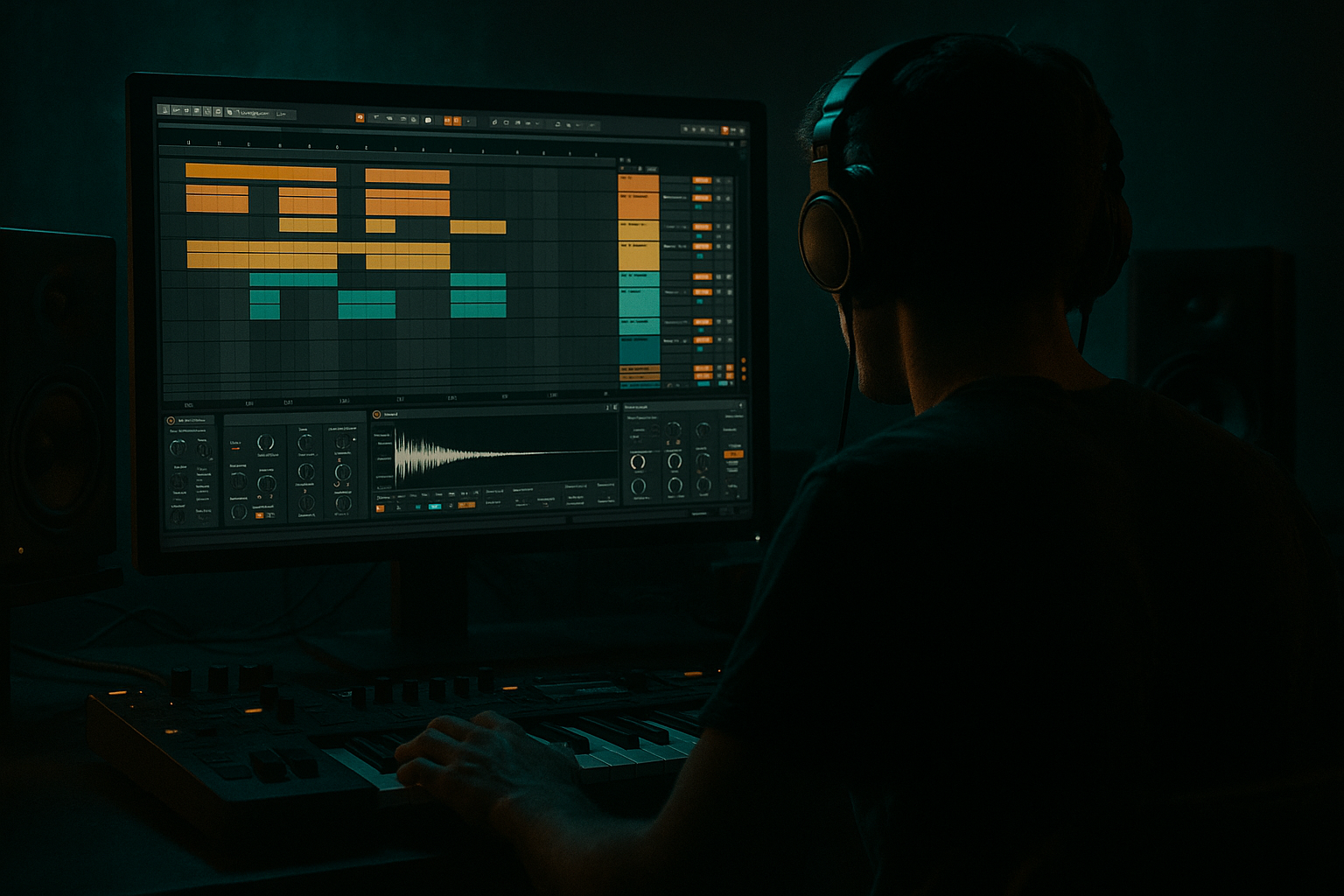
Main tutorial
```markdown
Volume Automation for Groove Masterclass (170 BPM) — Ableton Live (Intermediate) 🔥🥁
1) Lesson overview
Volume automation is one of the fastest ways to make 170 BPM drum & bass feel alive. At this tempo, tiny changes (even 0.5–2 dB) can create forward motion, accent the swing, and turn a static loop into a rolling, human groove.
In this lesson you’ll learn how to:
- Use clip gain, track volume automation, and Utility gain automation the right way
- Create micro-dynamics in breaks, hats, ghosts, and bass without wrecking your mix
- Build classic DnB movement: 2-step punch, ghost-note shuffle, pre-drop tension, and phrase energy
- Avoid common traps like pumping the master or flattening transient impact
- Tight kick/snare foundation
- Ghost-note/snare detail that “talks”
- Hats and rides that breathe using small volume moves
- A bass layer that ducks and surges rhythmically (without overcompressing)
- Arrangement-level automation: build → release → sustain → variation
- Kick: 1.1, 1.3 (optional extra kick at 1.4.3 for energy)
- Snare: 1.2, 1.4 (the anchors)
- Closed hats on 1/8 or 1/16 (depending on your vibe)
- Drop a break (Amen-style or tight funk break) and high-pass it later.
- Kick peak around -8 to -6 dB
- Snare peak around -8 to -6 dB
- Hats and break lower (often -14 to -10 dB depending on brightness)
- Clip Gain (Clip Volume envelope)
- Utility device (Gain automation)
- Track Volume automation (Mixer fader)
- Accents: +1.0 dB on key off-beats
- Ghost hats: -2.0 to -4.0 dB
- Random tiny variation: ±0.5 dB per few hits
- Put Utility on the ghost track.
- Automate Gain:
- Automate Utility Gain on the break track, not the mixer.
- For a 16-bar loop:
- On the DRUMS Group, add a Utility at the end of the chain.
- Automate Utility Gain:
- Bars 1–4: establish groove (slightly restrained)
- Bars 5–8: add intensity (hats up a touch, ghosts more present)
- Bars 9–12: peak roll (break slightly louder, rides more open)
- Bars 13–16: variation + pre-reset tension (small dip before bar 1)
- Hats group Utility Gain: +0.5 to +1 dB at bar 5
- Break Utility Gain: gradual +1 dB by bar 9
- Ghosts: +0.5 dB in bars 9–12
- Overall drums: tiny pre-drop dip -1 dB last beat
- Keep the kick/snare stable, animate the “air”
- Automate distortion amount instead of volume (paired with subtle volume moves)
- Use Utility for “intensity lanes”
- Create pre-drop vacuum
- Don’t brighten—position
- Groove at 170 BPM comes from micro-dynamics and phrase dynamics, not just swing settings.
- Use:
- Keep most moves subtle: 0.5–2 dB is the sweet spot.
- In rolling DnB, keep kick/snare steady and animate the supporting layers for motion.
---
2) What you will build
A 16-bar rolling DnB drum groove at 170 BPM with:
Deliverable: a loop that feels like it’s being performed, not repeated. 🎛️
---
3) Step-by-step walkthrough
Step 0 — Session setup (fast + clean)
1. Set tempo to 170 BPM.
2. Create these tracks:
- DRUMS (Group)
- Kick
- Snare
- Hats
- Break (optional but recommended)
- Perc/Ghosts
- BASS (Group)
- Sub
- Mid/Reese
- MUSIC/FX (optional)
3. Turn on Arrangement View (Tab) and enable automation view: press A.
> Why Arrangement? Because we’re shaping phrases, not just looping. 🧠
---
Step 1 — Build a solid starting groove (so automation has meaning)
Kick/Snare pattern (classic DnB 2-step):
Hats:
Optional break layer:
Keep levels sensible before automation:
---
Step 2 — Decide: clip gain vs track volume vs Utility (important!)
Use the right tool for the job:
#### ✅ Best practice choices
Use for note-to-note dynamics inside a clip (ghost notes, hat accents).
Use for musical automation that you might want to move/copy easily, and to avoid messing with mixer balance.
Use for bigger arrangement moves (drop impact, breakdown fades), but be careful: it changes your whole gain staging into effects on that track.
Rule of thumb:
Micro-groove = Clip Gain / Utility
Macro-arrangement = Track Volume
---
Step 3 — Micro-groove: hats that swing at 170 🥁✨
Let’s make hats feel like they’re pushing and pulling.
1. Click your Hat MIDI clip.
2. In the MIDI Note Editor, adjust Velocity first:
- Downbeats slightly stronger
- Off-beats slightly softer
- Add occasional accents every 2 bars
3. Now add Clip Envelope for volume:
- In Clip View, open Envelopes
- Choose Mixer → Track Volume (or better: put Utility on the hat track and automate Utility Gain inside the clip if you want cleaner control)
Suggested hat accent pattern (starting point):
Workflow tip:
Turn on Draw Mode (B) and draw little steps. Then Cmd/Ctrl+Drag points for fine tuning.
---
Step 4 — Ghost notes: snare groove that talks 🥊
Ghost notes are where the “rolling” lives.
1. Add a ghost snare sample (short, tight) on a new Perc/Ghost track.
2. Program hits around:
- Just before 2: 1.1.4 or 1.1.3.3
- Between 2 and 4: 1.3.2, 1.3.4
3. Set them low first (like -18 to -12 dB peak depending on your drum bus).
Now automate their loudness in phrases:
- Bar 1–2: -1.5 dB
- Bar 3–4: 0 dB
- Bar 5–8: tiny waves 0 → -1 dB → 0 (every 2 bars)
This creates subtle conversation without changing the main snare.
---
Step 5 — Break layer: animate the funk without losing punch 🧬
If you’re using a break:
1. Insert EQ Eight on Break:
- High-pass around 120–200 Hz (depending on how much low end you want)
- Optional dip around 3–6 kHz if it fights your snare crack
2. Add Glue Compressor lightly:
- Ratio 2:1
- Attack 10 ms
- Release Auto
- Aim for 1–3 dB GR
Now the automation:
- Bars 1–4: -2 dB (support)
- Bars 5–8: -1 dB (lift)
- Bars 9–12: 0 dB (full roll)
- Bars 13–16: -0.5 dB + add a small dip before the loop resets (-1.5 dB on the last 1/2 bar)
This makes the break feel like it’s performing and prevents ear fatigue.
---
Step 6 — The drop trick: automate into impact (without slamming the master) 🚀
For the last 1 bar before the drop (or bar 16 → bar 1 loop):
- Start of bar 16: 0 dB
- Last beat before drop: -1 to -2 dB
- Drop hit: back to 0 dB
This creates a psychoacoustic “suction” so the drop feels bigger—without pushing into clipping.
Optional: pair with reverb throws, but keep this lesson focused on volume.
---
Step 7 — Bass groove automation: breathe with the drums (no overcompression) 🔊
Instead of smashing your bass with sidechain until it disappears, use gentle volume shaping.
1. On Mid/Reese track, add:
- Utility
- (Optional) Saturator
- (Optional) Auto Filter for movement
2. Automate Utility Gain with a repeating groove shape:
- On each snare hit: dip -1 to -2 dB (very quick)
- On the spaces after snare: return to 0 dB
3. Keep automation curves fast but not clicky (tiny ramps help).
Pro move:
If you have a sustained reese, automate -0.5 to -1 dB on bar 2 and 4 of each 4-bar phrase to add “breathing” and make your drums feel more forward.
---
Step 8 — Arrangement-level energy: 16-bar “rolling story” 📈
A common DnB structure inside a drop phrase:
Practical automation targets (small moves!):
---
4) Common mistakes ❌
1. Automating the Master Volume
You’ll destroy your gain staging and confuse limiting/compression. Automate groups or Utility instead.
2. Too much range
If you’re moving hats by 4–6 dB constantly, it’ll sound like a bad DJ mix. Most groove automation lives in 0.5–2 dB.
3. Over-automating everything
Groove needs contrast: automate one or two key elements (hats + break, or ghosts + bass), not all at once.
4. Clicking from hard automation edges
Add tiny ramps, or automate Utility instead of clip volume on audio with sharp transients.
5. Using automation to fix bad sample choice
If the snare doesn’t smack, automation won’t save it. Start with solid sounds.
---
5) Pro tips for darker/heavier DnB 🖤
Dark rollers feel powerful because anchors are consistent. Move hats, breaks, rides, ghosts—not the main snare.
Use Saturator or Pedal on the reese, then tiny volume automation to keep perceived loudness controlled.
Create a Utility at the end of: Hats Group, Break Track, Bass Mid. Automate those like “energy faders.”
Last half-bar before impact: dip tops (hats/break) by -1.5 dB, keep sub steady. Makes the drop feel heavier.
In dark DnB, you often want movement without adding harsh top end. Volume automation gives motion while staying weighty.
---
6) Mini practice exercise (15 minutes) ⏱️
1. Make a 4-bar loop of your drums at 170.
2. Add Utility to:
- Hats track
- Break track (or a shaker loop if no break)
- Ghost/percs track
3. In Arrangement View, duplicate to 16 bars.
4. Create this automation:
- Hats Utility Gain: 0 dB (bars 1–4) → +0.7 dB (bars 5–12) → +0.3 dB (bars 13–16)
- Break Utility Gain: -2 dB (bars 1–4) → -1 dB (bars 5–8) → 0 dB (bars 9–12) → -0.5 dB (bars 13–16)
- Ghost Utility Gain: add a 2-bar wave: 0 → -1 → 0 → -1 (repeat)
5. Bounce a quick export and listen on low volume.
If the groove still “rolls” quietly, you nailed it.
---
7) Recap ✅
- Clip gain/velocities for hit-level feel
- Utility Gain automation for clean, copyable energy moves
- Track Volume automation mainly for bigger arrangement shifts
If you want, tell me your subgenre (liquid, jungle, dark roller, neuro-ish) and whether you’re using a break, and I’ll suggest a specific 16-bar automation map and device chain for your drum bus. 🥁
```

