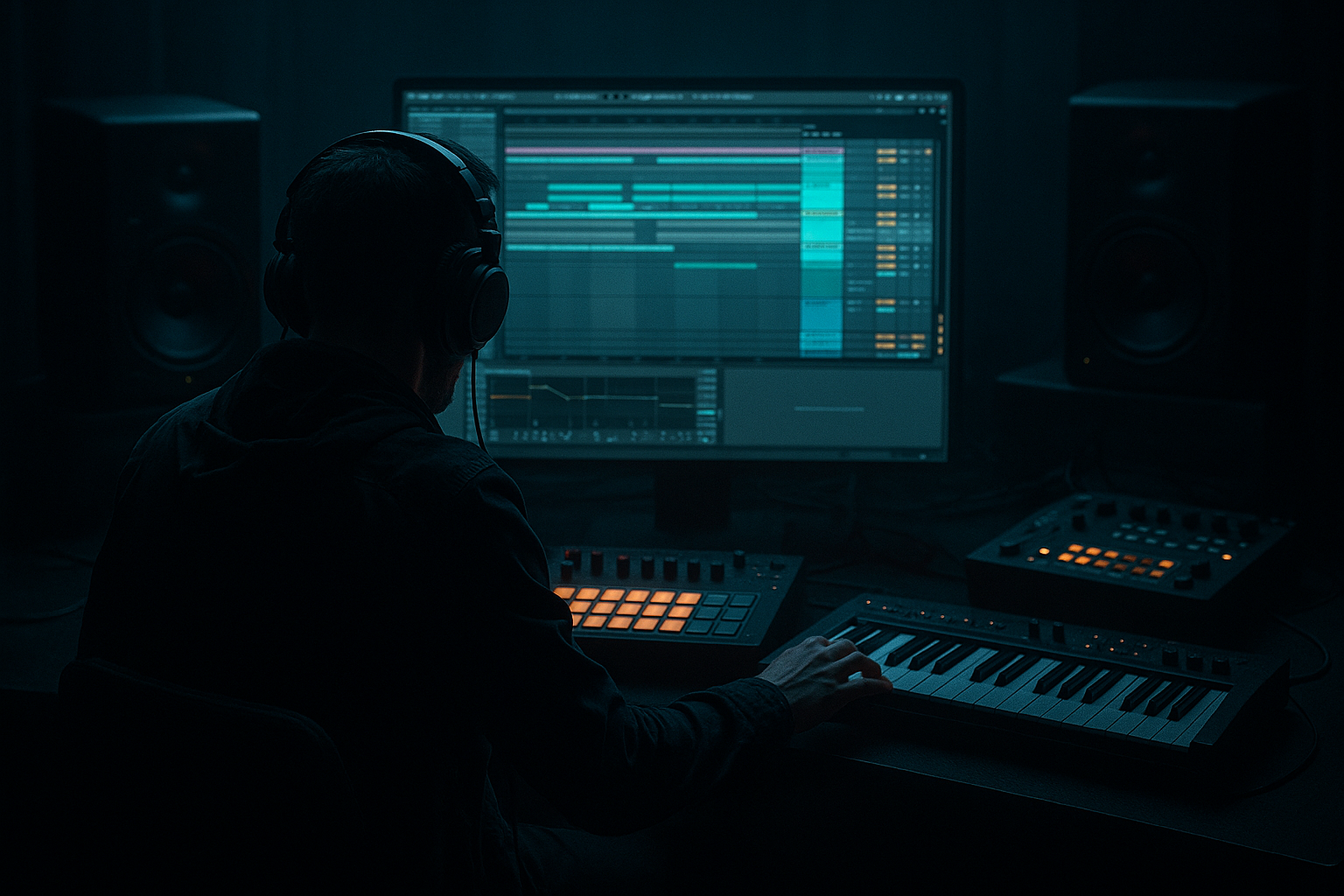
Main tutorial
```markdown
Volume Dips for Phrase Punctuation (DnB in Ableton Live) 🎛️🥁
1. Lesson overview
In drum & bass, energy management is everything. You can have the nastiest reese and tightest breaks, but if your arrangement doesn’t breathe, the drop won’t hit as hard.
This lesson is about using volume dips (tiny, intentional level reductions) to punctuate phrases, highlight fills, set up transitions, and make your drop feel bigger—without relying on cheesy risers or over-the-top FX. We’ll do it cleanly with Ableton Live automation, Utility, and a couple of smart routing tricks.
You’ll learn where to dip, how much, and how to keep it punchy in a rolling/jungle context. ⚡
---
2. What you will build
By the end, you’ll have a DnB arrangement (8–32 bars) where:
- The end of every 8/16-bar phrase is punctuated with a tasteful dip
- The drop impact feels louder even if your meters don’t change much
- You’ve got two reliable methods:
- You’ll use stock devices: Utility, Auto Filter, EQ Eight, Saturator (optional)
- Micro dip for punctuation: -0.8 to -1.8 dB
- Noticeable “breath” dip: -2 to -4 dB
- “Fake stop / impact” dip: -6 dB (use sparingly)
- Bar 8 → 9, 16 → 17, 24 → 25, etc.
- The bar before a drop section change
- Last 1/2 bar before a fill
- Last 1 beat before a snare rush / break edit / bass stab
- Dip slightly at bar 8.4 (last beat of bar 8)
- Dip a bit more at bar 16.3–16.4 (right before the phrase repeats or transitions)
- Start dip: last 1/8 or 1/4 note before the phrase ends
- Lowest point: right at the end (e.g., bar 8.4.4)
- Return to 0 dB: on the downbeat of the next bar
- Ramp down over 1/8
- Hold briefly (optional)
- Snap back on the downbeat
- Dip earlier, return hard at the downbeat.
- Start at bar 16.2
- Lowest at 16.4
- Back to 0 dB at 17.1
- `BASS Utility Gain`: dip -1 to -2 dB
- `MUSIC Utility Gain`: dip -2 to -4 dB
- Keep drums steady so the groove anchors the listener 🔩
- Punchy one-shot kick/snare
- Plus a breakbeat layer
- Add Auto Filter
- Filter type: Lowpass
- Slope: 12 or 24 dB
- Automation: pull cutoff down briefly (e.g., from 18 kHz → 6–10 kHz) in the last 1/8–1/4 note
- Add EQ Eight
- Automate a gentle bell cut around 200–500 Hz (mud zone) by -1 to -3 dB right before the downbeat
- Add more breakpoints to create a smooth ramp
- Keep dips musically aligned:
- For neuro/tech rollers, start with tight dips:
- For jungle, slightly longer works:
- Let drums lead the phrase punctuation
- Use dips to spotlight reese “answers”
- Automate reverb throws into the dip
- Pair with a tiny saturation bump after the dip
- DnB-friendly dip blueprint
- Volume dips are arrangement punctuation—they create contrast so your drop hits harder.
- Use Utility to automate clean, predictable dips.
- Place dips at 8/16-bar boundaries, before fills, and before section changes.
- Choose between:
- Enhance dips with subtle filter/EQ moves for extra drama without wrecking levels.
1) Master/group dip (big-picture punctuation)
2) Selective dip (only drums, only music, only bass, etc.)
Think: rolling neuro-ish groove, or jungle breaks + bass, with clean phrase “breaths.” 😤
---
3. Step-by-step walkthrough
Step 0 — Prep your session (DnB-friendly routing)
Goal: Make dips easy and controlled.
1. Group your main elements:
- DRUMS group (kicks, snares, hats, breaks)
- BASS group (sub, reese, mid bass)
- MUSIC/FX group (pads, stabs, risers, impacts)
2. Create a PRE-MASTER track:
- Make a new Audio Track named `PREMASTER`
- Route each group’s Audio To → PREMASTER
- Then set `PREMASTER` Audio To → Master
✅ Why: you can dip the whole record without touching the true Master (useful for mastering chain consistency).
---
Step 1 — The cleanest “volume dip” device: Utility
On your `PREMASTER` track:
1. Add Utility
2. We’ll automate Gain for dips.
Typical DnB dip ranges (start here):
📌 Rule of thumb: if the groove feels like it collapses, you dipped too far or too long.
---
Step 2 — Place dips at phrase punctuation points (arrangement logic)
DnB phrases often land in 8s and 16s.
Common targets:
Practical example (16-bar drop loop):
---
Step 3 — Draw automation like a producer (not like a robot)
1. Press A to show Automation.
2. On `PREMASTER`, choose Utility → Gain.
3. Create a dip shape:
#### A) Quick “breath” dip (most common)
Suggested shape:
Suggested amount: -1.5 dB for rolling DnB.
#### B) “Pull-back then punch” (bigger impact)
Timing suggestion:
Suggested amount: -2.5 to -4 dB depending on density.
🧠 Why it works: you’re creating a short contrast window so the downbeat feels louder—even at the same LUFS.
---
Step 4 — Keep drums slamming: do selective dips (not always full mix)
Sometimes dipping the whole premaster steals punch from the kick/snare. For DnB, try selective punctuation:
#### Option 1: Dip everything except drums (common in rollers)
1. Put Utility on:
- `BASS` group
- `MUSIC/FX` group
2. Automate dips there instead of on `PREMASTER`
Settings to try:
#### Option 2: Dip just the drum break layer (jungle trick)
If you’ve got:
Automate a small dip on the break group before fills so the one-shots pop through on the phrase turn.
---
Step 5 — Add “psychoacoustic punctuation” (optional but powerful)
Volume dips are great, but in heavier DnB you can make them feel more dramatic without big level changes.
On `PREMASTER` or `MUSIC/FX` group, automate one of these alongside a small volume dip:
#### A) Auto Filter “air pull”
Pair it with only -1 dB Utility dip and it’ll still feel like a moment.
#### B) EQ Eight “mid scoop dip”
This can make the next hit feel clearer and heavier.
---
Step 6 — Make it groove: use curved automation & musical lengths
Ableton automation is line-based, but you can fake curves:
- 1/8, 1/4, 1/2 bar are your friends in DnB
- 1/8 note dip is often enough
- 1/4–1/2 bar dip can feel like classic tape/console movement
---
4. Common mistakes 🚫
1. Dipping too far
- If you’re doing -6 dB every 8 bars, it becomes a gimmick and kills momentum.
2. Dipping the sub at the wrong moment
- If the sub vanishes right on the downbeat, the drop can feel smaller.
3. Automation clicks
- Super sharp dips on full-spectrum material can click, especially on sustained bass.
- Fix: slightly lengthen the ramp (a few ms) or dip earlier.
4. Fighting your compressor/limiter
- If you have heavy bus compression/limiting, dips might “bounce back” weirdly.
- Fix: automate pre your limiter (PREMASTER), not on the final Master after mastering devices.
5. Random dip placement
- Dips should support phrasing: 8/16 bar structure, fills, call/response—not arbitrary moments.
---
5. Pro tips for darker/heavier DnB 😈
- In dark rollers, try dipping music + bass while leaving drums stable. The groove stays menacing.
- Example: At bar 8, dip everything slightly, then hit a single distorted reese stab on bar 9.1. It feels huge.
- Right before the dip, send a snare hit into a Return reverb (Hybrid Reverb works great), then dip the dry mix slightly—reverb tail becomes the “glue” between phrases.
- On `PREMASTER`, automate Saturator Drive up by +0.5 to +1 dB on the downbeat after the dip (subtle!).
- This can make the return feel “angrier” without actually raising peak level.
- Every 8 bars: -1.5 dB for 1/8
- Every 16 bars: -2.5 dB for 1/4 + slight lowpass pull
---
6. Mini practice exercise 🎯
Goal: Program a 16-bar drop that breathes.
1. Build a basic loop:
- Kick + snare (2-step)
- Hats/shakers
- Reese mid bass + sub
- One stab or pad
2. Arrange it for 16 bars with a small fill at bar 16.
3. Add Utility on `PREMASTER`.
4. Automate:
- Dip -1.5 dB for the last 1/8 note of bar 8
- Dip -3 dB for the last 1/4 note of bar 16
5. Duplicate the drop to 32 bars and adjust:
- On bar 24, try a selective dip: only `MUSIC/FX` to -3 dB, keep drums steady
6. Export a quick bounce and listen on low volume:
- You should still feel the phrases turn and the downbeats pop.
---
7. Recap ✅
- PREMASTER dips (whole mix punctuation)
- Selective dips (often better for heavy/rolling DnB)
If you want, tell me your style (jungle, dancefloor, neuro, minimal rollers) and what your drop arrangement looks like (bars/sections), and I’ll suggest exact dip placements and amounts for your track. 🎚️
```

