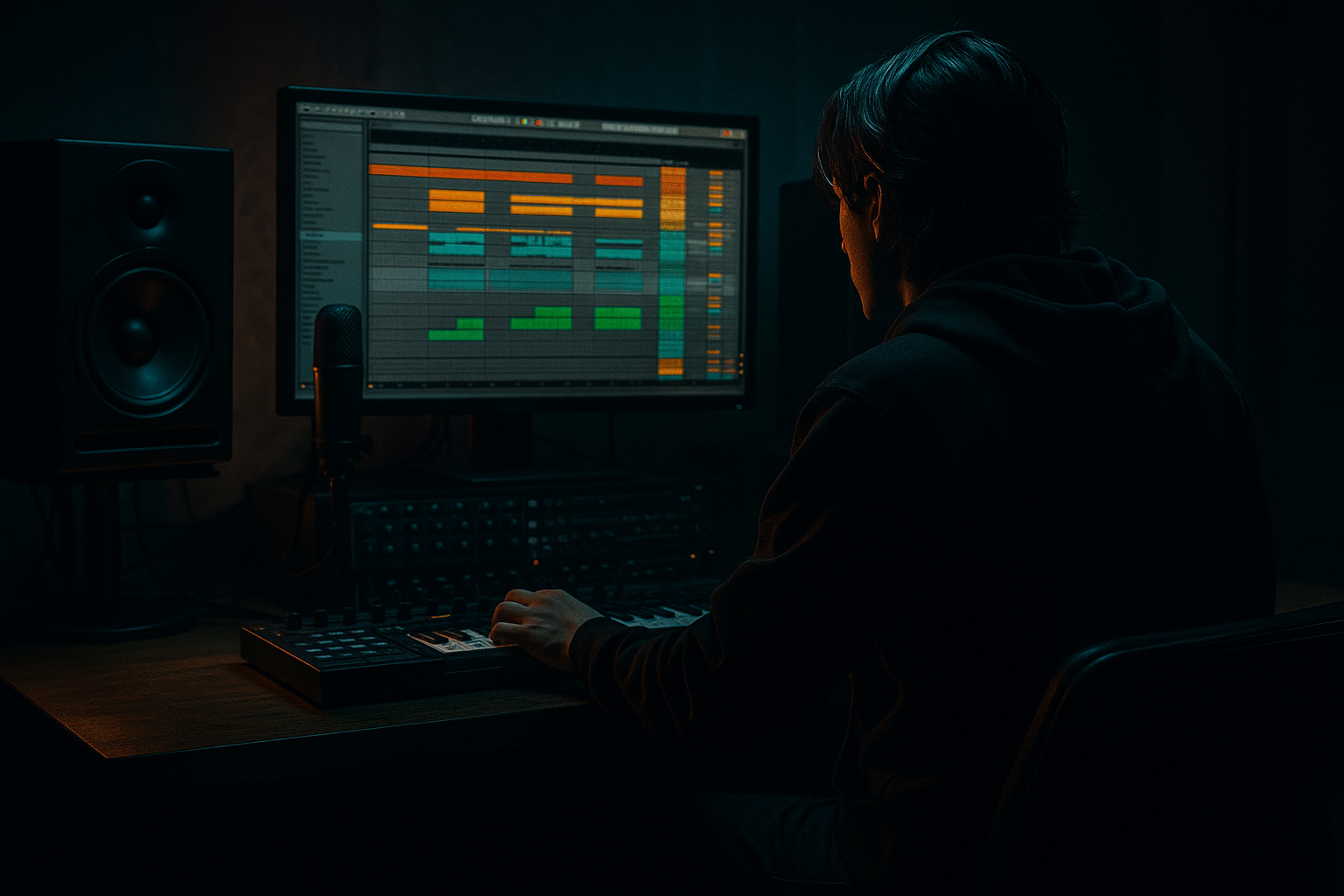
Main tutorial
Lesson Overview
A warehouse chop carve session is one of the most effective ways to give a jungle / oldskool DnB vocal that sunrise-set emotional pull without making it soft or cheesy. The goal here is to take a raw vocal phrase — preferably a spoken line, soulful fragment, or rave-adjacent one-liner — and turn it into a set of rhythmic chops, ghosted repeats, and tonal slices that sit inside a rolling DnB arrangement.
In Ableton Live 12, this technique is especially powerful because you can move fast between warped audio editing, Simpler resampling, envelope shaping, and automation without leaving the session. For DnB, vocals are not just “topline” material; they can act like percussion, hooks, atmosphere, and tension all at once. In a warehouse / sunrise context, the vocal should feel like it’s coming through dust, fog, and light beams — emotional, but still functional in a heavy mix.
Why this matters in DnB:
- Vocals help define the identity of the drop or breakdown.
- Chopped phrases create call-and-response with drums and bass.
- Edited vocal movement gives you energy without clutter.
- A sunrise-style emotional vocal can lift an otherwise dark roller into a memorable journey.
- A main vocal phrase cut into short rhythmic chops
- A few longer emotional sustains for sunrise lift
- A call-and-response pattern between vocal chops and drums
- A layered treatment using EQ Eight, Compressor, Saturator, Reverb, Delay, and Auto Filter
- A resampled vocal texture that can be used as a hook, riser, or transition element
- An arrangement section that feels like a warehouse open-up moment before or after a drop
- A 2–4 bar vocal motif that repeats with variation
- Chops that lock to the snare and offbeat hats
- A ghostly tail or reverb bloom that fills the air without washing out the groove
- A vocal that can sit over a jungle break loop, sub pulse, and restrained reese bass
- Intro atmosphere
- Pre-drop tension
- Drop vocal hooks
- Breakdown emotion
- DJ-friendly phrasing for mix-in / mix-out sections
- Over-chopping until the phrase loses identity
- Too much reverb making the vocal disappear
- Chops not aligned with the break
- Leaving harsh sibilance untreated
- Putting vocal and bass in the same frequency lane
- Making the vocal too polished for jungle / oldskool character
- Using the same chop pattern for the whole track
- Print a “dark version” and a “sunrise version” of the vocal
- Use parallel grit
- Automate the filter like a rave light
- Mono the low mids
- Use echo throws on phrase endings
- Let one chop be imperfect
- Resample with the return effects printed
- Use call-and-response with the reese
- Start with a vocal that has character, space, and rhythm potential.
- Chop it so it locks to the break and supports the groove.
- Use stock Ableton tools like Warp, Simpler, EQ Eight, Compressor, Saturator, Echo, Reverb, Auto Filter, and Utility.
- Keep the vocal emotionally open but rhythmically tight.
- Resample and re-edit to get that warehouse / jungle sample texture.
- Arrange the vocal with clear 8-bar and 16-bar movement for DJ-friendly DnB structure.
- Use contrast: dry vs wet, short vs long, dark vs sunrise.
This lesson focuses on building a warehouse-style vocal chop session that can live inside jungle oldskool DnB: dusty breaks, deep sub, restrained reese movement, and emotional but controlled vocal phrasing. 🌀
What You Will Build
You’ll create a vocal chop instrument and arrangement section that includes:
Musically, the result should feel like:
You’ll end up with a practical template for creating:
Step-by-Step Walkthrough
1. Choose the right vocal source and prepare it for chopping
Start with a vocal that has character, not polish. For this style, you want something that sounds like it could exist in a warehouse system at 5:30am: spoken fragments, soulful ad-libs, rave line-outs, or a chopped acapella with some grit.
In Ableton Live, drag the vocal onto an audio track and immediately check:
- The timing feels usable against your project BPM
- The phrase has at least 3–6 strong syllables or moments
- There’s enough room between words to create chops
Set Warp to a mode that suits the source:
- Complex Pro for full vocal phrases
- Beats if the vocal is already rhythmic and percussive
- Texture if you want smeared, atmospheric fragments
Useful starting moves:
- Warp the vocal to the grid, then manually clean up any obvious timing drift
- Consolidate the best phrase into a clean 2-bar or 4-bar region
- Turn on Loop so you can audition chops against the groove
For DnB, keep the vocal phrase tight enough to function rhythmically. A long, drifting vocal can be beautiful, but it needs a clear place in the arrangement. Think: emotion inside the grid, not floating outside it.
2. Slice the vocal into performance-ready pieces
Right-click the vocal clip and use Slice to New MIDI Track if you want maximum flexibility. For this style, slicing by transients or 1/8 notes can be a fast starting point, but the real win is manually choosing slices that have musical meaning.
If you keep it on audio, you can still:
- Duplicate the clip
- Cut regions manually
- Use clip gain and fades to shape each chop
If slicing to Simpler, try:
- Slice by transient
- Load the resulting instrument into a MIDI track
- Keep one-shot mode so each slice triggers cleanly
Good chop selection for sunrise emotion:
- A strong opening consonant
- A breath or half-word for tension
- A vowel-heavy sustain for lift
- A short tail for a rhythmic pickup
Aim for 4–8 usable slices first. You’re building a vocal kit, not trying to preserve the full sentence. In jungle and oldskool DnB, chopped vocals often work because they create a rhythmic illusion — the listener feels the phrase, even when the full words are partially hidden.
3. Build a 2-bar vocal groove that answers the breakbeat
Now place your chops so they interact with the drums, not just sit on top. In DnB, vocals often work best when they respond to the snare or fill the gaps between break hits.
Program a 2-bar MIDI pattern or arrange audio clips so the vocal lands:
- Before the snare for anticipation
- Just after the snare for bounce
- On offbeats with short tails
- At the end of a bar to set up the next phrase
Try this structure:
- Bar 1: short chop on beat 1, second chop on the “and” of 2
- Bar 2: longer sustain into the snare, then a cut-off phrase on the last offbeat
Use Groove Pool if your break has swing. Pull the vocal groove slightly toward the break’s timing rather than forcing dead-grid quantization. A subtle groove amount around 15–40% is often enough.
Why this works in DnB: the drums are already doing a huge amount of rhythmic work. When the vocal phrase locks into the break’s push-pull, it sounds like part of the original performance instead of an add-on. That makes the track feel tighter and more “record-like.”
4. Shape each chop with clip envelopes, fades, and tiny timing shifts
The difference between a rough chop and a premium one is usually in the micro-editing. Use clip fades and timing nudges to make each slice feel intentional.
In Ableton:
- Add small fades to remove clicks at chop boundaries
- Nudge slices slightly ahead or behind the grid for feel
- Shorten some chops aggressively so they act like percussion
- Let one or two chops ring longer for emotional contrast
Useful timing ideas:
- Push a chop slightly early if you want urgency
- Lay a chop slightly late for a laid-back halftime pull
- Cut off the tail right before the kick or snare to make room
If a phrase feels too obvious, don’t abandon it — trim it. A single syllable or vowel can become the signature hook. Oldskool jungle arrangement often thrives on partial information: the ear fills in the rest.
For extra control, use:
- Auto Filter automation on the phrase or each key chop
- Clip Gain to emphasize the most musical syllables
- Utility to adjust the vocal level before effects
5. Build a vocal effects chain that sounds warehouse-ready, not washed out
Create a vocal return or insert chain on the chop track using stock devices. A strong starting chain:
- EQ Eight
- Compressor
- Saturator
- Echo or Delay
- Reverb
- Auto Filter
- Optional Utility
Suggested settings:
- EQ Eight: high-pass around 120–180 Hz to clear sub space; dip harshness around 2.5–5 kHz if the vocal bites too hard
- Compressor: light glue, about 2:1 ratio, with slow-ish attack and medium release
- Saturator: subtle drive around 2–6 dB, with Soft Clip on if needed
- Echo/Delay: synced 1/8 or 1/8 dotted, feedback around 15–35%
- Reverb: short to medium decay, around 1.2–2.8 s, low-cut the reverb so it doesn’t cloud the mix
- Auto Filter: automate a slow open from darker to brighter during transitions
Keep the wet signal under control. For a warehouse sunrise vibe, the vocal should sound like it is inside the room, not floating in a dreamy pop atmosphere. Use delay throws on phrase endings, not on every word.
A smart DnB move is to use a Return track for reverb and delay, then automate send amounts. That lets the vocal stay dry and present during the groove, while expanding only in selected moments.
6. Resample your best vocal moment into a new texture
Once your chops are working, resample a short section into audio. This is a classic DnB workflow because it lets you turn an edited idea into a new sound object.
Route the vocal track to a new audio track set to Resampling or record the Master output carefully if your session is organized.
Resample:
- The best 1-bar chop pattern
- A phrase with reverb/delay tail
- A filtered vocal swell
Then re-edit the resampled audio:
- Reverse a tail into a new transition
- Slice the resample into micro-grains manually
- Apply Warp markers to shape the timing
- Use Fade shapes to create smoother atmosphere
This is especially useful for oldskool / jungle vibes because the texture becomes more “sample-based” and less cleanly modern. You can use the resampled vocal as:
- An intro bed
- A pre-drop countdown
- A breakdown pad
- A switch-up layer over the break
7. Arrange the vocal so it supports the DnB structure
Now place the vocal in a real arrangement, not just a loop. Think in terms of 8-bar and 16-bar phrases, because DnB DJs and dancers respond strongly to that structure.
A strong arrangement example:
- Intro 16 bars: filtered vocal fragments, distant reverb, break ambience
- Bars 17–32: bring in main chop motif with drums and sub
- Drop 1: keep the vocal sparse; use only key words or syllables
- Breakdown: open up the full emotional phrase with more reverb
- Second drop: reintroduce the chop pattern with variation and more grit
- Outro: strip it back to a few echoing words for mix-out
For a sunrise set emotional arc, the vocal can move from:
- dark and hidden
- to clear and human
- to wide and luminous
Use automation to evolve the vocal:
- Open a low-pass filter during buildup
- Increase delay feedback into a transition
- Widen the vocal in the breakdown, then tighten it for the drop
- Fade the low end of the vocal as the bass enters
Keep DJ-friendliness in mind. Leave space for mix transitions. In DnB, a clean intro/outro with a recognizable vocal texture is often more useful than a wall of effects.
8. Make the vocal talk to the drums and bass
The vocal should interact with the rhythm section, not fight it. If you already have a break and bassline in place, carve the vocal to complement them.
Practical moves:
- Sidechain the vocal lightly to the kick or drum bus with Compressor if needed
- Use EQ Eight to reduce conflict around the vocal’s most crowded frequencies
- Keep the vocal mono-friendly in the low mids
- Let the bass occupy the sub; let the vocal sit above it
For a jungle / oldskool DnB setup:
- The break often has strong midrange energy
- The bass may be a moving reese or a low, rolled sub
- The vocal should avoid clutter in the 200–500 Hz zone if the break is dense
If your vocal has a strong rhythmic consonant, you can use it like a percussion hit. If it has a long vowel, use it as a lift between snare hits. That contrast is the secret: short = rhythm, long = emotion.
Common Mistakes
- Fix: keep at least one recognizable syllable or contour that anchors the hook.
- Fix: use send automation or lower decay; high-pass the reverb return so the low mids don’t blur.
- Fix: shift the vocal to answer the snare or offbeat hats instead of landing randomly.
- Fix: tame 5–9 kHz with EQ Eight or reduce the level of overly sharp slices manually.
- Fix: carve the vocal low mids, keep sub clean, and check the balance in mono.
- Fix: add light Saturator drive, small timing imperfections, and a more sample-like edit style.
- Fix: vary the rhythm every 8 or 16 bars with one cut, one sustain, or one reverse tail.
Pro Tips for Darker / Heavier DnB
- Dark version: filtered, narrower, more distorted
- Sunrise version: wider, brighter, more delay/reverb bloom
- Duplicate the vocal, distort the copy with Saturator or Pedal, then blend it quietly underneath for warehouse edge.
- Slowly open Auto Filter into the breakdown, then slam it down before the drop for tension.
- Use Utility to keep the vocal centered below the warmth zone so the bass and drums stay stable.
- A short, tuned delay throw can make one word become the signature moment without cluttering the whole mix.
- A slightly messy breath, cut, or tail can make the vocal feel human and underground instead of over-edited.
- This gives you a more “hardware sample” feel, great for jungle-inspired textures and transitions.
- Let the vocal answer the bass movement in gaps, especially around bar endings and turnaround points.
Mini Practice Exercise
Spend 10–20 minutes making a mini sunrise vocal loop:
1. Find one vocal phrase with 4–8 usable words or syllables.
2. Warp it to your project BPM and slice it into at least 5 pieces.
3. Build a 2-bar pattern where the vocal answers the snare.
4. Add EQ Eight high-pass around 150 Hz, then a little Saturator drive.
5. Send just the last word or syllable into Delay and Reverb.
6. Resample the result into audio.
7. Reverse one tail and place it before a bar change.
8. Loop it against a jungle break and sub for 8 bars.
9. Mutate one chop every 2 bars so the loop evolves.
10. Export the loop or save it in a rack for later use.
Goal: by the end, you should have a vocal hook that feels like it belongs in a real DnB tune, not just a looped sample.
Recap
If you do this well, the vocal stops being just a layer and becomes part of the track’s identity — a proper DnB moment with atmosphere, weight, and memory.

