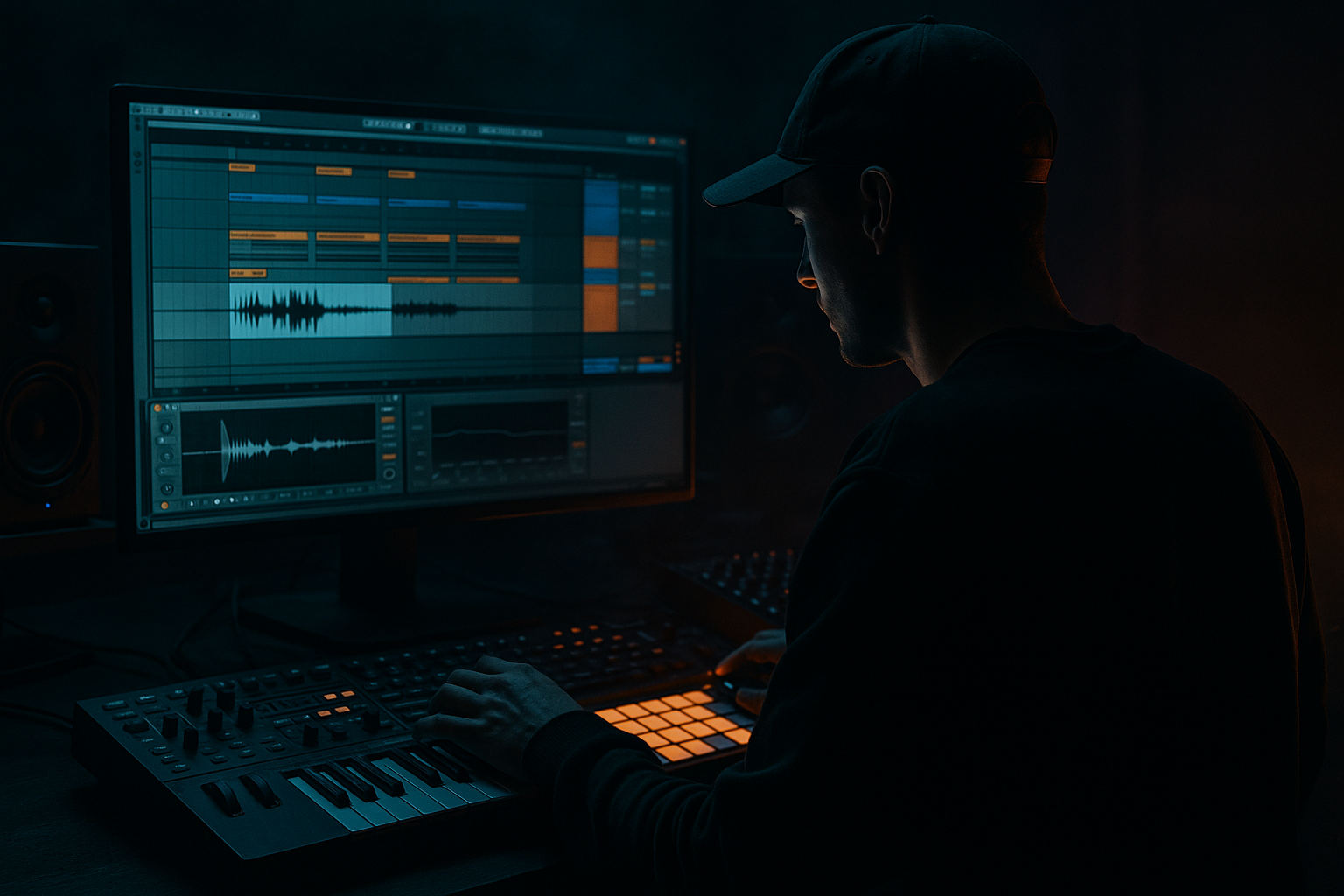
Main tutorial
Warehouse Jungle Top Loop: Rebuild and Arrange in Ableton Live 12
1. Lesson overview
In this lesson, you’ll build a warehouse-style jungle top loop in Ableton Live 12 and turn it into a usable arrangement element for a drum and bass track. We’re focusing on the top loop layer: the gritty percussion, shuffles, metallic hits, vocal fragments, and texture that sit above your kick, snare, and sub.
This is especially useful in darker DnB, jungle revival, halftime-intro sections, and rolling warehouse rollers. The goal is to make a loop that feels:
- energetic but controlled
- raw but polished
- rhythmic enough to drive the track
- spacious enough to leave room for bass and drums
- a 2-bar jungle top loop
- built from break slices, hats, percussion, and vocal texture
- processed with Ableton stock devices
- arranged into a 16-bar intro/drop section
- with movement from variation, automation, and fills
- a chopped Amen-style break or any dusty breakbeat
- closed hats, shakers, ride hits, rimshots, metallic foley
- short vocal snippets, crowd noise, radio chatter, or spoken-word fragments
- vinyl crackle / room noise / industrial ambience
- Drum Rack
- Simpler
- Audio Effect Rack
- EQ Eight
- Saturator
- Drum Buss
- Auto Filter
- Echo
- Hybrid Reverb
- Gate
- Compressor
- Utility
- optional: Roar if you want extra bite
- Tempo: 170–174 BPM for classic jungle energy, or 174–176 for modern DnB
- Time signature: 4/4
- Create these tracks:
- Amen-style material
- Think-style break
- any old-school break with a strong hat/snare texture
- one noisy break layer
- one clean hat layer
- one percussion layer
- one vocal texture layer
- busy 16th-note motion
- syncopated offbeat hats
- ghost notes
- small fills at the end of bar 2
- closed hats on offbeats and quiet 16ths
- shaker ghost hits between main accents
- rim or wood hits on unexpected syncopations
- break slices scattered to create push and pull
- hat on C1
- shaker on D1
- rim on E1
- break slice accents on F1 and up
- vocal chop on a separate pad
- main hits around 90–110
- ghost hits around 35–70
- occasional accents around 115–127
- Start with 10–30% groove amount
- Use more swing on hats and shakers
- Keep more important hits like vocal chops or key accents slightly tighter
- transient attack preserved
- slightly shortened decay
- maybe some filtering
- EQ Eight
- Saturator
- Drum Buss
- closed hats
- noisy shaker
- very short open hat accents
- metallic ticks or foley
- chopped spoken-word syllables
- crowd shouts
- “yeah”, “move”, “come on” style fragments
- reversed whispers
- tiny call-and-response bits
- EQ Eight
- Gate
- Echo
- Hybrid Reverb
- Auto Filter
- a missing hat
- a reversed break hit
- a vocal one-shot
- a 16th-note fill
- a tiny delay throw
- Bar 1: foundational groove
- Bar 2 beat 4: quick fill or pickup
- Last 1/8 before loop restarts: short vocal stab or snare drag
- duplicating the MIDI clip
- editing only the second bar
- or using separate clips for A/B variation
- duplicate the bus
- distort the duplicate
- high-pass it heavily
- blend underneath
- filtered top loop
- no full bass yet
- vocal texture introduced sparingly
- automate a low-pass filter opening slowly
- full hats and break texture
- add one extra vocal chop
- increase energy with small fills
- full top loop
- hardest version of the break
- vocal stabs doubled
- minimal delay throws on selected hits
- remove one hat layer
- add a reverse crash or snare pickup
- change one vocal phrase
- automate filter or reverb send for one bar only
- Auto Filter cutoff
- Echo feedback
- Reverb send level
- Utility width
- Saturator drive for build intensity
- does the loop mask the snare crack?
- are hats fighting with the ride or cymbals?
- is the vocal chop stepping on the snare transient?
- EQ Eight to carve space
- sidechain compression if needed, triggered by the snare or kick
- volume automation on specific hits rather than over-processing everything
- chain clanks
- machine hiss
- warehouse room tone
- metallic impacts
- distant crowd noise
- chopped short
- band-passed
- lightly distorted
- drenched in short metallic space
- Saturator before Echo
- or Roar with subtle drive
- then Auto Filter to animate the tone
- Drum Buss for edge
- Compressor carefully
- avoid over-softening the top loop
- add Saturator
- add Redux very subtly if you want digital bite
- high-pass heavily
- blend in quietly
- high-pass filter rising
- echo feedback increasing slightly
- reverb send increasing
- final bar mute on one element for impact
- does it groove without the bass?
- does it feel dark and warehouse-like?
- does bar 2 create anticipation?
- rhythmic movement
- textural grit
- careful layering
- controlled vocal chops
- arrangement variation
- Simpler for slicing
- Drum Rack for performance and layering
- EQ Eight for space
- Saturator and Drum Buss for grit
- Auto Filter for movement
- Echo and Hybrid Reverb for atmosphere
- Utility for width control
- a MIDI programming guide
- a track-building template for Ableton Live 12
- or a step-by-step rack chain for dark jungle vocals
We’ll rebuild the loop from scratch in Ableton Live 12 using stock devices, then arrange it so it evolves across a track instead of just repeating endlessly. ⚡
---
2. What you will build
By the end, you’ll have:
Core sound sources
You can use:
Ableton devices we’ll use
---
3. Step-by-step walkthrough
Step 1: Set up your project
Start with:
1. Kick/Snare
2. Top Loop
3. Bass
4. Atmos/Vox
5. FX returns for reverb and delay
Even though this lesson is about the top loop, you need the kick and snare in place so you can make the loop sit correctly in the groove.
---
Step 2: Choose your source material
You have two good options:
#### Option A: Rebuild from break slices
Use a dusty break like:
Drop it into Simpler in Slice mode:
1. Drag the break onto an audio track
2. Right-click and choose Slice to New MIDI Track
3. Slice by:
- Transient for performance control
- or 1/8 if you want consistent loop construction
This gives you MIDI-triggered slices you can rearrange into a new top loop.
#### Option B: Layer individual percussion
Build the loop from:
This is often better for modern DnB because it gives you more control over stereo width and frequency balance.
---
Step 3: Build the rhythmic skeleton
Open a new MIDI clip on your Top Loop track and program a 2-bar pattern.
A good warehouse jungle top loop usually has:
#### Example pattern idea
Think of it like this:
If you’re using Drum Rack, place:
Keep the velocity varied. Jungle top loops die quickly if everything hits at the same volume.
#### Velocity tips
In the MIDI editor:
This creates a more human, warehouse-rattling feel.
---
Step 4: Add swing and groove
A top loop in jungle lives or dies by groove.
#### Using Groove Pool
1. Open the Groove Pool
2. Drag in a groove like:
- MPC 16 Swing
- a light swing 54–58%
- or a groove extracted from a break
Apply it lightly.
You want movement, not drunken timing.
#### Best practice
If the kick and snare are hard-locked, allow the top loop to float around them.
---
Step 5: Layer the break texture
Now make the loop feel authentic.
#### In Simpler or Drum Rack:
Use a break loop layer with:
Add processing:
- high-pass around 180–250 Hz
- cut muddy low-mids around 300–500 Hz
- tame harshness around 6–9 kHz if needed
- Drive: 2–6 dB
- Soft Clip: On
- Drive: subtle, around 5–15%
- Crunch: low to moderate
- Boom: usually off or very subtle for top loops
The break layer should feel like dust and attitude, not dominate the mix.
---
Step 6: Add hats and shakers for forward motion
For warehouse jungle, the top end should shimmer and skitter.
Use a separate MIDI lane or Drum Rack pads for:
#### Processing chain for hats/shakers
A clean, practical chain:
1. EQ Eight
- HP at 250–400 Hz
- gentle dip if shrill around 8–10 kHz
2. Saturator
- Drive: 1–3 dB
3. Auto Filter
- subtle HP or band movement if you want evolution
4. Utility
- reduce width if it’s too wide
- or use width around 110–130% for the shaker layer only
Keep hats crisp and slightly dry if your bass is huge.
Too much reverb here makes the drop cloudy fast.
---
Step 7: Add vocal texture, not lead vocals
Since the category is Vocals, the “warehouse jungle top loop” is a great place to use vocal fragments as percussion.
Think:
#### How to process vocal chops
Put the vocal chop in Simpler or an audio track and process with:
- HP around 150–300 Hz
- notch harsh resonances if needed
- tighten tails and create rhythmic stutters
- 1/8 or dotted 1/8 for space
- low feedback so it doesn’t wash out
- short room or warehouse-like space
- Decay around 0.4–1.2s
- keep low cut fairly high
- automate cutoff for tension and release
#### Practical vocal trick
Slice a vocal phrase into 3–6 parts and place them rhythmically like percussion.
A vocal chop becomes part of the drum groove when it’s short, timed tightly, and mixed like a texture.
---
Step 8: Create movement with micro-variation
A loop that repeats unchanged sounds amateur fast.
In bar 2, introduce:
#### Simple variation ideas
You can do this by:
This is key in DnB, where the loop should feel relentless but never static.
---
Step 9: Process the whole top loop bus
Route all top-loop elements to a group track called Top Loop Bus.
Suggested bus chain:
1. EQ Eight
- remove unnecessary low end
- tame harsh areas
2. Compressor
- light glue only
- Ratio: 1.5:1 to 2:1
- slow-ish attack to preserve transients
3. Saturator or Roar
- for density and grit
4. Utility
- control width and mono compatibility
If the loop is still too thin, add a very subtle parallel layer:
That gives you aggressive presence without clogging the mix.
---
Step 10: Arrange it like a real DnB track
Now let’s turn the loop into arrangement material.
#### 16-bar structure example
Bars 1–4: Intro
Bars 5–8: Build
Bars 9–12: Drop A
Bars 13–16: Drop variation
#### Arrangement automation ideas
Use automation on:
This gives the warehouse loop a live, evolving feel, like it’s being driven by the room itself 🏭
---
Step 11: Make room for the kick and snare
Top loops often clash with the core drum pattern.
Check:
Use:
A good top loop enhances impact. It should never weaken the drum spine.
---
4. Common mistakes
1. Too much low end in the top loop
Top loops should usually be high-passed.
If the break layer has too much low end, it will fight the kick and sub.
Fix: HP the loop around 180–300 Hz, depending on the source.
2. Over-quantized groove
If every hit lands exactly on the grid, the loop loses jungle character.
Fix: use swing, micro-timing, and velocity variation.
3. Too much reverb
Big reverb can sound cool in solo but ruins clarity in a drop.
Fix: use short rooms, send-based reverb, or automate it only in transitions.
4. Vocal chops treated like lead vocals
If the vocal is too long or too prominent, it can pull attention away from the rhythm.
Fix: trim it down, process it like percussion, and keep it rhythmic.
5. Repeating the same 1-bar loop forever
This makes the arrangement feel loop-based instead of track-based.
Fix: create A/B variants, fills, filter changes, and bar-end movement.
---
5. Pro tips for darker/heavier DnB
Use industrial textures
Layer in:
These can sit quietly under the top loop and add atmosphere without obvious melody.
Push vocal fragments through distortion
For darker DnB, vocals often work better when:
Try:
Keep transients sharp
Use:
Sharp transient energy helps the track feel aggressive even when the arrangement is sparse.
Parallel grime layer
Duplicate the top loop bus and on the duplicate:
This is a great trick for warehouse pressure without losing clarity.
Automate tension before the drop
Before a drop, automate:
That “room opening” effect is perfect for jungle/DnB tension.
---
6. Mini practice exercise
Exercise: Build a 2-bar warehouse jungle top loop
Do this in Ableton Live 12:
1. Pick a break or percussion loop
2. Slice it into a Drum Rack
3. Program a 2-bar MIDI clip
4. Add:
- one break slice layer
- one shaker layer
- one vocal chop layer
5. Apply a groove from the Groove Pool
6. Process each layer with:
- EQ Eight
- Saturator
- optional Echo on the vocal chop
7. Create a second version of the loop with:
- one missing hit
- one fill at the end
- one automation change
Challenge
Export the loop and ask:
If yes, you’re on the right track. If not, reduce clutter and strengthen the rhythmic accents.
---
7. Recap
A strong warehouse jungle top loop is all about:
In Ableton Live 12, the most useful tools for this are:
The big idea:
Don’t just make a loop. Make a driving top-end engine that supports the kick, snare, and bass while giving your track that cold warehouse jungle pressure. 🔥
If you want, I can also turn this into:

