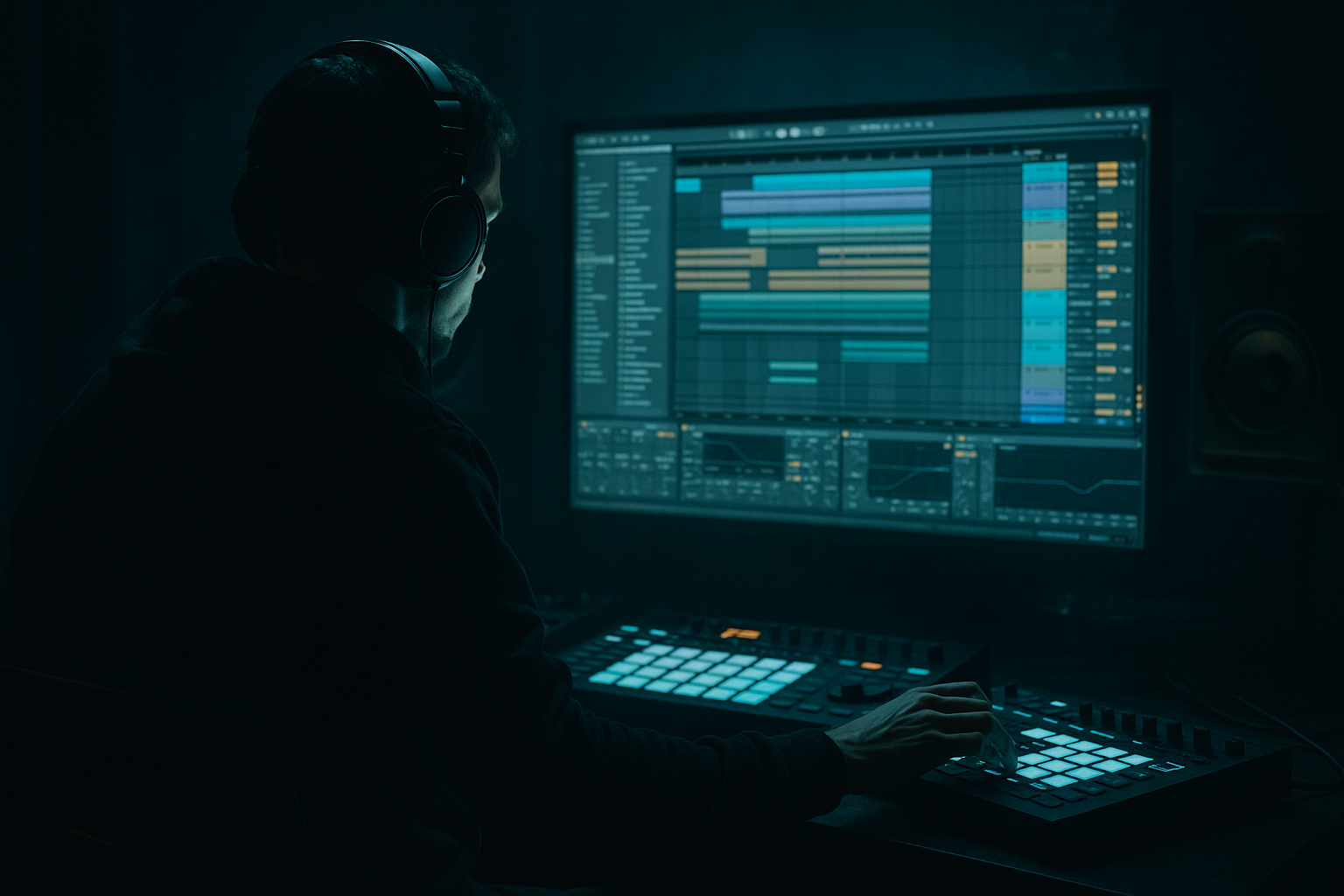
Main tutorial
```markdown
Warm Sine + Texture Layer Bass (DnB in Ableton Live) 🎛️🔥
1. Lesson overview
In drum & bass, the “warm sine” bass is the glue: it fills the low end smoothly without fighting the kick. The magic is adding a controlled texture layer on top so it cuts through busy drums and break edits while staying clean and weighty.
This lesson shows you a beginner-friendly Ableton Live stock workflow to build a two-layer bass:
- Sub/Warm sine layer = pure, stable low-end
- Texture layer = midrange grit, movement, and audibility on smaller speakers
- Sub: round, consistent, mono, warm (club-ready)
- Texture: lightly distorted, filtered, dynamic, sidechained
- Together: one instrument you can write proper DnB patterns with (think rollers / minimal jungle modern vibe)
- A Bass Group with two chains
- Macro-like controls (simple to tweak)
- A pattern idea that works at 172–176 BPM
- Drop Operator
- Use only Oscillator A
- Waveform: Sine
- Algorithm: the default is fine (just keep it simple)
- Drive: `2.0–5.0 dB` (start at 3 dB)
- Soft Clip: `ON`
- Output: adjust so it’s not louder than before (aim consistent level)
- HP (high-pass): OFF or very gentle (you usually don’t HP the sub)
- Add a small dip if muddy:
- Optional: tiny presence if needed (often not on sub):
- Bass Mono: `ON` (if available in your Live version) or:
- Width: `0%` (keep sub mono)
- Gain: use this to match level later
- Grid: 1/16
- Key: try F minor (classic DnB-friendly)
- Notes: `F1` (sub range), with occasional `G1` or `D#1` for movement
- Rhythm (16th steps):
- Enable Sidechain
- Audio From: your Kick track (or a Kick Group)
- Start settings:
- Osc A: Sine or Triangle
- Add some harmonics with subtle shaping:
- Drive: `6–12 dB` (start ~ 8 dB)
- Soft Clip: `ON`
- Filter type: Lowpass 24 dB
- Cutoff: around 250–800 Hz (start 500 Hz)
- Resonance: `10–20%` (just a hint)
- Add movement:
- High-pass: ON
- Optional presence:
- Width: `120–160%` (optional)
- If it gets messy, pull width back.
- If boomy: small dip 120–200 Hz
- If boxy: small dip 250–400 Hz
- Drive: `1–3 dB`
- Soft Clip: `ON`
- Leave default, just ensure no wild peaks.
- SUB plays full pattern
- TEXTURE filtered down (Auto Filter cutoff ~250–350 Hz)
- Let drums and breaks take spotlight
- Open TEXTURE filter (cutoff ~500–900 Hz)
- Slightly increase texture saturation (1–2 dB)
- Add small variation: one extra note or a held note at bar 8 for turnaround
- Texture layer has low end (you forgot to high-pass it). Result: muddy, weak sub.
- Too much distortion on sub. A little saturation = warmth; too much = flub and loss of fundamental.
- Stereo sub. Makes low end unstable in clubs. Keep sub mono.
- Over-wobbling. DnB rollers often want subtle movement, not huge LFO swings.
- Ignoring kick relationship. Without sidechain (or at least arrangement spacing), it won’t punch.
- Add controlled “metallic” grit (texture only):
- Make it meaner with subtle pitch movement:
- Use a “mid punch pocket”:
- Sidechain the texture harder than the sub:
- You built a clean, mono warm sine sub using Operator + Saturator + Utility.
- You added a separate mid texture layer that’s high-passed, gently modulated, and slightly wider.
- You used sidechain compression to make it groove with the kick.
- You learned a simple DnB arrangement approach: tease → open up → tiny variations.
---
2. What you will build
A rolling DnB bassline that sounds like:
You’ll end with:
---
3. Step-by-step walkthrough
Step 0 — Project setup (fast + practical)
1. Set tempo to 174 BPM.
2. Create a MIDI track called: `BASS (Group)`
3. Inside it, we’ll add two MIDI tracks:
- `SUB (Sine)`
- `TEXTURE (Mid)`
> Tip: Select both tracks → Cmd/Ctrl+G to group them into one Bass Group for easy level control.
---
Step 1 — Build the SUB (Warm Sine) 🫧
On `SUB (Sine)`:
#### A) Instrument: Operator (stock)
#### B) Add warmth and control (stock chain)
Add devices after Operator in this order:
1) Saturator
2) EQ Eight
- Bell at 200–300 Hz, `-2 to -4 dB`, Q ~1.2
- Bell at 700–1.2k, `+1 dB` (only if you’re missing definition)
3) Utility
✅ Goal: a smooth low end that’s loud but not flabby.
---
Step 2 — Write a classic rolling bass MIDI pattern 🥁
Create a 1-bar clip on the Bass Group (or on SUB track) and set:
Simple roller pattern idea (1 bar):
- Hits on: 1, 1e, 2&, 3, 3a, 4&
(If that’s confusing, just place 5–7 short notes per bar and listen for bounce.)
Note length: start with 1/16 to 1/8 notes.
Velocity: keep fairly consistent (sub shouldn’t “randomly jump”).
> Jungle/DnB trick: try a small “call and response” every 2 bars—bar 2 slightly different rhythm.
---
Step 3 — Add groove using sidechain (so kick hits clean) 🫀
On the Bass Group (or on each layer), add:
Compressor (Ableton stock)
- Ratio: `4:1`
- Attack: `5–15 ms` (lets transient through a touch)
- Release: `60–120 ms` (match your kick/bounce)
- Lower Threshold until you get 2–5 dB gain reduction on kick hits
✅ Goal: bass breathes around the kick like proper rollers.
---
Step 4 — Build the TEXTURE (Mid) layer 🎚️
On `TEXTURE (Mid)`:
#### A) Instrument: Operator (or Wavetable)
Option 1 (simple): Operator
- In Operator, increase Drive (inside Operator) slightly if available, or do it with Saturator next.
#### B) Shape it into “audible bass”
Add devices after the instrument:
1) Saturator
2) Auto Filter
- LFO: `ON`
- Rate: `1/8` or `1/4` (sync)
- Amount: small (so it “wobbles” a bit, not dubstep)
- Phase: try 0° first
3) EQ Eight (crucial for layering!)
- Set HP at 120–180 Hz (start 150 Hz)
This ensures the texture layer doesn’t fight the sub.
- Gentle bell boost around 700 Hz – 1.5 kHz if it needs more “hearability”
4) Utility
Keep sub mono, but texture can be wider.
✅ Goal: texture gives definition on phones/laptops, while sub stays clean.
---
Step 5 — Glue both layers together (tight + controlled) 🧩
On the Bass Group, add:
1) EQ Eight (light tidy)
Keep moves small: `-1 to -3 dB`.
2) Saturator (very gentle)
This makes the combined bass feel “finished.”
3) Limiter (safety, not loudness)
---
Step 6 — Arrangement idea (DnB-friendly)
Make an 8-bar loop:
Bars 1–4 (Intro / tease):
Bars 5–8 (Drop / main):
> Classic roller feel: keep bass consistent, make interest through filter automation, drum variation, and small fills.
---
4. Common mistakes ❌
---
5. Pro tips for darker/heavier DnB 🖤
- Try Pedal (stock) after Saturator on texture:
- Mode: OD or Distortion
- Drive: low (start 10–20%)
- Tone: adjust to avoid harsh top
- Then EQ Eight to tame 2–5 kHz if it bites.
- In Operator: add a tiny Pitch Env (short decay) on texture for a “plucky” edge.
- Keep it subtle so it stays roller, not jump-up lead.
- Boost texture slightly around 250–400 Hz if your mix allows (this helps on small speakers).
- But watch mud with vocals/snares.
- Sub: 2–4 dB GR
- Texture: 4–7 dB GR
This keeps the groove clean while letting the texture “pump” rhythmically.
---
6. Mini practice exercise 🎯
1. Build the two-layer rack exactly as above.
2. Write two different 2-bar patterns:
- Pattern A: mostly F1 with one passing note
- Pattern B: more syncopation (more 16th notes)
3. Automate Texture Auto Filter cutoff:
- Bars 1–4: 250 → 450 Hz
- Bars 5–8: 450 → 800 Hz
4. Bounce/export a 16-bar idea and check on:
- Headphones (sub feel)
- Laptop speakers (texture audibility)
Goal: hear the bass clearly even when the sub isn’t audible.
---
7. Recap ✅
If you want, tell me what sub note/key you’re writing in and what kick style you’re using (punchy 2-step vs break-heavy), and I’ll suggest a bass rhythm that locks perfectly to it.
```

