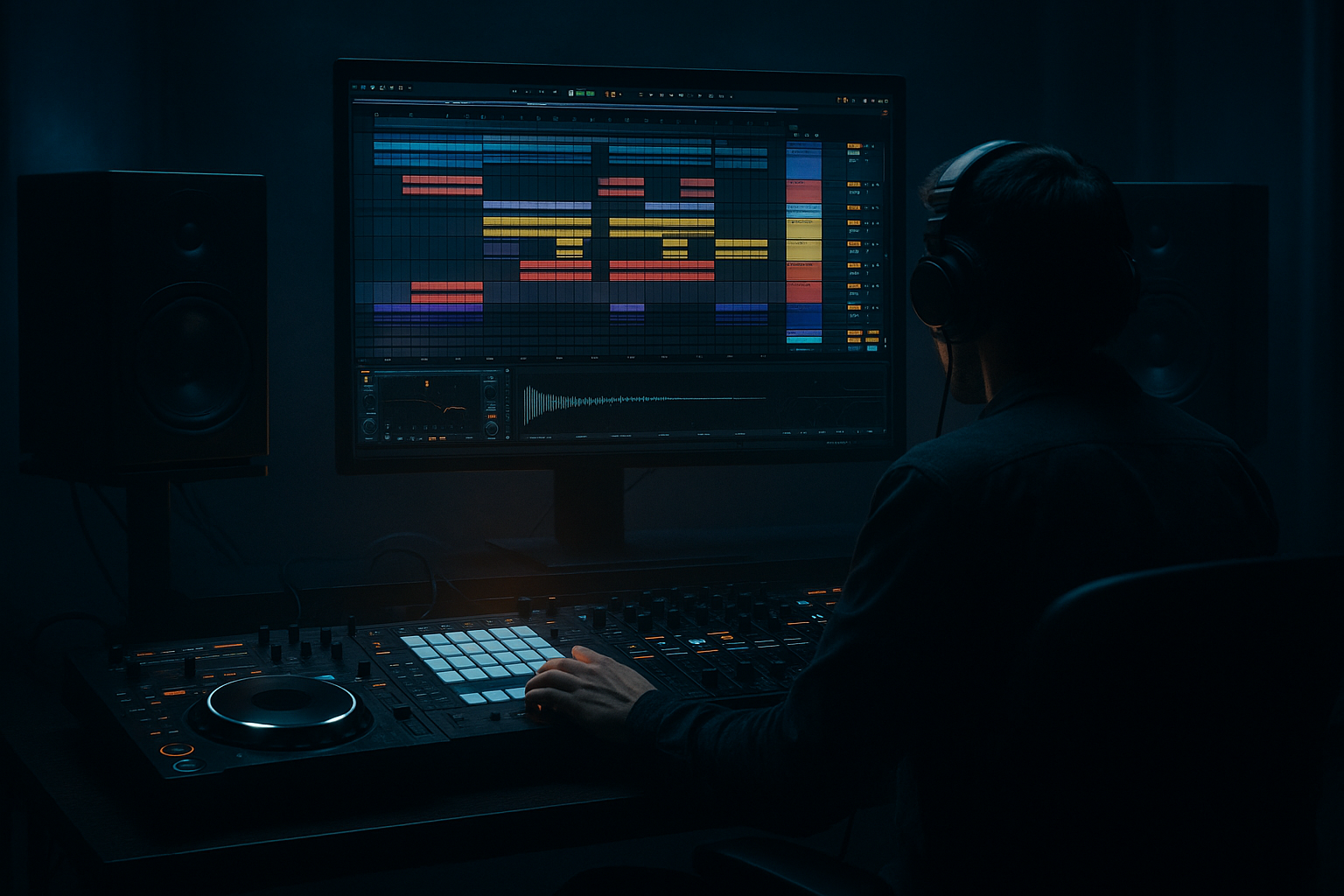
Main tutorial
Lesson Overview
In this lesson you’re learning how to warp a breakdown in Ableton Live 12 so it lands with jungle / oldskool DnB tension, not generic “sped-up vocal” energy. The goal is to take a breakdown phrase, atmospheric stem, vocal stab, or musical chord loop and make it stretch, breathe, and snap into a DJ-friendly transition that feels native to DnB: restless, rhythmic, slightly unstable, and ready to slam back into the drop.
This technique lives in the breakdown-to-drop lane of a DnB track. Think: 8, 16, or 32 bars before the drop, a tension section in the second half of a tune, or a stripped-back passage where you need the arrangement to feel alive without adding more drums or bass yet. In jungle and oldskool DnB especially, warped audio can become part of the percussion: chopped vocal syllables, pitched atmospheres, stretched amen fragments, reese swells, and ghostly stabs that create motion while leaving room for the eventual impact.
Why it matters musically and technically: DnB breakdowns often need to do three jobs at once — keep momentum, control energy, and set up the drop with drama. If the warp is sloppy, you get flamming transients, smeared low mids, or a breakdown that feels glued to the grid in a dead way. If it’s done well, the listener should feel forward motion even when the drums pull back. The result should sound like the breakdown is leaning into the next section, not just sitting there.
This works best for jungle, oldskool, roller-adjacent DnB, darker atmospheric DnB, and any club track that benefits from chopped musical tension. By the end, you should be able to hear a warped breakdown that still has groove, still reads clearly on headphones and club systems, and still leaves enough space for the drop to hit hard.
What You Will Build
You’ll build a breakdown loop that has:
- a warped musical phrase or texture that moves with a broken, human feel
- a jungle-leaning rhythmic pulse created through warp placement and audio chopping
- enough midrange grit and motion to feel alive without masking the bass or kick/snare impact
- a polished, mix-ready transition that can sit in an arrangement as an 8- or 16-bar lead-in
- If you want menace, don’t just darken the tone — remove information in stages. Start with a fuller phrase, then thin the mids, then narrow the stereo image, then cut the tail right before the drop. That progressive stripping creates pressure.
- For a more underground jungle feel, try a slightly unstable warp relationship between the breakdown phrase and the drums. Not sloppy — just enough push-pull to feel sampled and alive.
- Use short, dirty echoes instead of huge reverbs when you want weight. A restrained Echo return can keep the groove close to the listener without turning the section into fog.
- If the breakdown is fighting the snare, carve a small dip around the snare’s key presence area in the warped material rather than boosting the snare endlessly. This keeps the transition punchy without overhyping it.
- A great darker DnB breakdown often has one thing happening in the low mids and one thing happening above it. Keep the roles separate: one layer for body, one for air, one for movement.
- If the warping makes the phrase too clean, resample the best 1–2 bars and reintroduce it with a more broken presentation. Oldskool character often comes from reusing a printed moment, not endlessly tweaking the live clip.
- Mono-compatibility note: keep the main emotional phrase, especially anything that carries the hook, mostly centered. Put width into the support layer, not the core. That preserves club translation and helps the drop land harder.
- Use one audio source only: vocal, pad, stab loop, or break-derived atmospheric stem.
- Use no more than three stock devices on the track.
- Choose either a tight rhythmic chop approach or a smeared atmospheric approach — not both.
- Keep the breakdown’s low end filtered so it doesn’t fight the drop.
The finished result should feel like a breakdown that is haunted, rhythmic, and pressure-filled, not washed out or over-processed. It should be clean enough to survive in a real arrangement, with the low end controlled, the stereo image disciplined, and the timing flexible enough to support a drop. If it’s working, you’ll hear a breakdown that creates anticipation even when the drums are sparse — the groove should feel implied through the warp, not forced by extra processing.
Step-by-Step Walkthrough
1. Choose source material that can actually survive warping
Start with a breakdown element that has character and clear transient or harmonic identity. Good candidates in DnB are:
- a vocal phrase with natural rhythm
- a piano or pad loop with sustained movement
- a chopped amen-derived atmospheric layer
- a synth stab sequence with a few strong accents
Avoid sources that are already overly compressed into flat mush, or material with deep sub-bass content that you don’t want to smear. For jungle and oldskool flavour, sources with transients, noise tails, and midrange detail warp better than ultra-clean modern stems.
In Ableton, drag the audio into Arrangement or Session and make sure the clip is long enough to phrase over 8 or 16 bars. If the source is a full musical loop, choose a section that has a clear “question” and “answer” shape. That makes the warp feel intentional rather than repetitive.
What to listen for: the source should still sound interesting when isolated at lower volume. If it only works when loud, it probably won’t carry a breakdown.
2. Set the clip to the right warp mode before you move anything
Open the clip and turn Warp on. Now choose the warp mode based on the source:
- Beats for percussive breaks, vocal chops, and rhythmic slices
- Complex or Complex Pro for pads, atmospheres, vocals, and full musical material
- Tones for monophonic sustained material when the pitch character matters
For jungle/oldskool DnB, the best starting point is usually:
- Beats for anything drum-like or chopped
- Complex for lush breakdown beds that need to stretch without sounding granular in a bad way
Then set the transient loop mode or slice behavior conservatively. If you’re warping a break or vocal hit, keep the transients sharp enough to preserve articulation. If you’re warping an atmospheric phrase, let the time-stretch breathe.
Why this works in DnB: the genre depends on rhythmic clarity even when the texture is murky. A breakdown that’s too smeared kills the DJ-friendly momentum.
3. Find the musical anchor points and lock them to the grid
Don’t warp the whole clip by dragging blindly. Find the most important musical moments first:
- the first strong downbeat
- a vocal phrase start
- a chord stab
- a break hit that can act like a “ghost kick” reference
Place the first anchor on the correct bar line, then check the next major accent against the grid. In an 8-bar tension section, it often helps to anchor only the strongest few points and allow the in-between material to flex.
If the phrase is meant to feel oldskool, a tiny amount of grid tension is good. You want the breakdown to feel slightly hand-played or sample-driven, not mechanically locked. Nudge anchors by a few milliseconds if needed so the groove breathes with the drums later.
What to listen for: when you loop 2 bars, the phrase should pull forward into the next bar instead of landing stiffly on it. If the phrasing sounds glued and lifeless, you’ve probably over-quantized the warp.
4. Decide: A) tight rhythmic chop or B) smeared atmospheric tension
This is your first creative fork.
A) Tight rhythmic chop
- Use warp anchors more aggressively
- Keep transients crisp
- Great for jungle stabs, chopped vocal hooks, and break-derived breakdowns
- Feels energetic, syncopated, and more percussion-like
B) Smoothed atmospheric tension
- Use fewer anchors
- Let the audio stretch more between points
- Great for pads, reverse textures, long vocal phrases, and dark midrange beds
- Feels wider, more cinematic, and more suspenseful
In a real DnB arrangement, A is better when the breakdown is driving toward an aggressive drop. B is better when you need space, dread, and a longer build. Both are valid; the right choice depends on whether the drop needs a rhythmic launch or a foggy pressure build.
5. Shape the breakdown with simple stock-device processing before adding extra movement
Put a cleanup chain on the warped audio so it sits like a DnB element rather than a random loop. A practical stock chain:
EQ Eight → Saturator → Auto Filter
Suggested starting moves:
- EQ Eight: high-pass around 120–250 Hz if the source has rumble; lower it only if the material is truly a bass feature
- cut a little mud around 250–500 Hz if the warp has boxiness
- tame harshness around 2.5–5 kHz if transients get brittle
- Saturator: drive lightly, often around 2–6 dB, to help the clip read on smaller systems
- Auto Filter: use a low-pass or band-pass sweep during the build, often moving from around 10–14 kHz down toward 2–6 kHz depending on how dark you want the breakdown to become
Keep the processing subtle enough that the warp movement remains the feature. If the chain is doing too much, the breakdown starts sounding processed rather than produced.
Stop here if the source already feels like it is “talking” in rhythm. If it does, don’t keep adding devices just because you can.
6. Use warp to create motion across 8 or 16 bars, not just a static loop
A good DnB breakdown evolves in bars, not seconds. Shape the phrase so each 2-bar segment has a small change:
- bars 1–2: establish the motif
- bars 3–4: add a slight pitch drift or filter opening
- bars 5–6: thin the texture or increase stretch tension
- bars 7–8: strip back for the pre-drop cue
In Ableton, this can be done by adjusting warp markers, clip gain, and automation on the clip filter or device filter. Keep the movement small but obvious. The point is not to turn the breakdown into a synth demo; it’s to create a clear phrase arc that tells the dancer the drop is coming.
For a jungle feel, try a slightly more unstable midsection: let one phrase stretch a little longer, then pull the last hit early. That “humanized” instability is part of the oldskool tension.
Arrangement example: an 8-bar breakdown can start with a warped vocal phrase plus a filtered break ghosting underneath, then open into a wider 4-bar lift, then close down hard in the final 2 bars before the drop.
7. Add a rhythmic support layer so the warp feels like part of the track
Don’t let the warped breakdown float alone in the void. In DnB, it should interact with the existing drums or imply them.
Two useful stock-device approaches:
Chain 1: warped audio + rhythmic emphasis
- Audio track with warped breakdown
- Add Gate if the source has long tails and you want broken, twitchy rhythm
- Add Echo very subtly for depth, with short delay times and restrained feedback
- Add Drum Buss only lightly if you need extra snap or harmonic pressure
Chain 2: warped audio + darker, heavier tension
- EQ Eight
- Saturator
- Redux very carefully if you want a grimier, more fractured texture
- Auto Filter for movement
Use only as much degradation as the track can handle. In darker DnB, some grit is welcome, but overdoing bit reduction can erase the sense of scale.
Check the breakdown in context with your drums: does it leave enough room for the snare to still feel like the loudest emotional event? If not, back off the midrange or narrow the stereo width.
8. Use automation to make the warp feel intentional
Automation is where the breakdown becomes a transition rather than a loop. Automate one or two parameters max — not seven. The best candidates are:
- filter cutoff
- warp-related clip timing or anchor movement
- device dry/wet on Echo
- Saturator drive
- reverb send amount if the breakdown needs to expand before it collapses
A practical build:
- start with a darker, narrower tone
- open the filter gradually over 4 or 8 bars
- increase delay/reverb slightly in the final 1–2 bars
- then cut them off right before the drop for contrast
The mix trick here is the “air then absence” move: let the breakdown widen and bloom, then pull it away so the drop feels bigger. That contrast is what makes the drop hit in a club.
What to listen for: the automation should feel like it’s guiding your body to the drop, not announcing itself as an effect.
9. Commit the most interesting warp movement to audio when it stops being a decision
Once the breakdown phrase has the right shape, resample or freeze the exact working idea into audio only if you’re done making timing choices. This is especially useful when you’ve created a perfect warped phrase and want to chop it like a jungle sampler later.
Commit this to audio if:
- the warp movement is now part of the arrangement
- you want to slice one hit into fills or reverses
- the timing is right and further tweaking is just slowing you down
Once printed, you can slice the result into 1-bar or half-bar pieces and repurpose the best moments as transition fills, fake-outs, or pre-drop stabs. This is very DnB: the most useful breakdowns often become future drum-fill material.
Workflow efficiency tip: rename the printed clip immediately with the bar range or function, such as “warp_break_8bar_build” or “vocal_drift_pre_drop.” That saves time when you revisit the project.
10. Test the result against the drop, not in isolation
This is the moment that matters. Loop the last 8 bars of the breakdown and the first 2 bars of the drop together. Put the kick, snare, and bass back in. Now listen for:
- does the warped material create anticipation without masking the snare?
- does the final breakdown hit leave enough space for the drop sub to land cleanly?
- does the transition feel like a DJ would trust it in a mix?
If the breakdown is too dense, reduce the low mids or pull down the return levels. If it feels too polite, increase rhythmic contrast: shorten the final phrase, add a reverse hit, or let one warped vocal tail run right up to the drop edge.
Successful result: the breakdown should feel like it is spiraling toward the drop, with enough groove to stay musical and enough space for the drop to feel like a release.
Common Mistakes
1. Warping a full musical stem with the wrong mode
- Why it hurts: pads, vocals, and breaks all react differently; the wrong mode makes the phrase smear or pump unnaturally.
- Fix: use Beats for rhythmic material and Complex / Complex Pro for sustained musical material.
2. Over-anchoring every transient to the grid
- Why it hurts: the breakdown loses the loose, sample-based motion that gives jungle and oldskool DnB character.
- Fix: anchor the key hits only, then leave smaller details slightly free so the phrase breathes.
3. Letting low-end content ride through the breakdown
- Why it hurts: the bass muddies the transition and competes with the drop’s sub entry.
- Fix: high-pass the breakdown material with EQ Eight around 120–250 Hz where appropriate, and check the phrase in context with bass.
4. Making the breakdown too wide and washed out
- Why it hurts: exaggerated stereo can feel impressive alone but collapses the mono center and weakens club impact.
- Fix: keep the main phrase more centered; use width mainly on delays, reverbs, or higher textures, and mono-check the core element.
5. Using too much saturation or bit reduction
- Why it hurts: the breakdown turns brittle and loses the emotional shape of the warp.
- Fix: back off Saturator drive or Redux until the texture still feels dark but remains readable.
6. Building tension with multiple effects all at once
- Why it hurts: too many moving parts make the build feel unfocused and reduce the actual drop contrast.
- Fix: choose one main motion driver — filter, delay, or warp movement — and let the others support quietly.
7. Ignoring the phrase length
- Why it hurts: a warped loop that doesn’t respect 8- or 16-bar phrasing feels like an edit, not a musical section.
- Fix: arrange the warp in clear blocks and check the final bar before the drop for a deliberate lift or strip-back.
Pro Tips for Darker / Heavier DnB
Mini Practice Exercise
Goal: Build an 8-bar warped breakdown that can lead into a jungle-leaning DnB drop.
Time box: 15 minutes.
Constraints:
Deliverable: A fully looped 8-bar breakdown with at least one clear automation move and one final-bar pre-drop gesture.
Quick self-check: Loop the last 4 bars into the drop. If the snare still feels like the biggest punch in the section and the breakdown makes the next section feel inevitable, you’ve got it.
Recap
Warping a breakdown for jungle / oldskool DnB is about more than time-stretching audio. You’re shaping phrase tension, rhythmic feel, and drop anticipation. Choose the right warp mode, anchor only the important moments, and keep the movement musical rather than over-processed. Build the phrase over 8 or 16 bars, automate one or two key parameters, and always check the result in context with drums and bass. If the breakdown feels haunted, rhythmic, and clean enough to let the drop explode, you’ve nailed the job.

