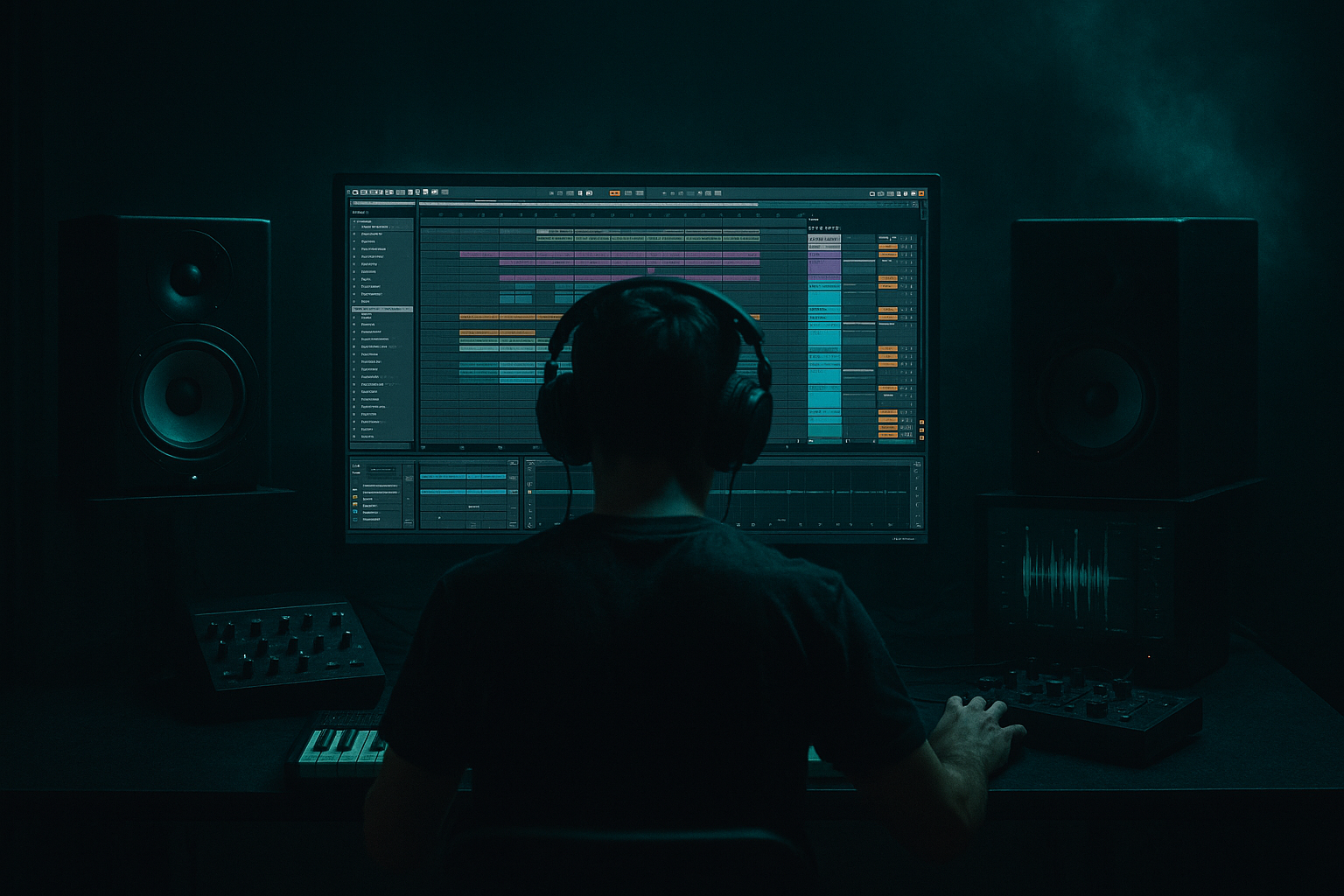
Main tutorial
Lesson Overview
This lesson is about taking a darkside intro loop and warping it into a roller-ready momentum bed that feels timeless in a jungle / oldskool DnB context inside Ableton Live 12. The goal is not to make the intro “bigger” in a generic way — it’s to make it swing forward with pressure, so when the drums and bass arrive, the track already feels like it has a pulse and a destination.
This technique lives right at the front of a DnB tune: the intro, first 16–32 bars, and pre-drop tension zone. In darker DnB and jungle-influenced rollers, that section has to do three jobs at once: establish atmosphere, imply groove, and leave enough negative space for the drop to feel like a release rather than a jump cut. If the intro is static, the track feels like it starts from zero. If it’s overworked, the drop has nothing left to say.
Musically, this matters because the best dark intros in DnB do not just “sound dark” — they move like a DJ tool. Technically, the lesson focuses on Warp mode, transient preservation, loop alignment, micro-timing, and audio commitment so the intro keeps its identity while locking to the grid and the drums. The style target is especially strong for oldskool jungle-flavoured rollers, moody half-lit DnB, and darker club intros where menace comes from motion, not from endless density.
By the end, you should be able to hear a dark intro that:
- breathes in 8- or 16-bar phrases,
- sits confidently against breaks and sub,
- has controlled swing without sloppy flam,
- and feels like it is already dragging the listener toward the drop.
- a darker, worn-in sonic character rather than glossy modern polish,
- a subtle forward pull that works under breakbeats and bass,
- a role as either the main intro motif or a supporting tension layer before the drop,
- and a level of polish where it can sit in an arrangement without sounding like a placeholder.
- Use asymmetry in the phrase, not just in the sound. A slightly longer tail on bar 4 or 8 can create the feeling that the loop is pulling against the grid, which reads as tension in dark rollers.
- Let the midrange carry the menace. In many club systems, the emotional weight of a dark intro sits around 250 Hz to 2 kHz. If that range is too hollow, the intro may sound pretty but not threatening.
- Keep the sub absent until it matters. The psychological impact of a sub entrance is stronger if the intro is already creating pressure without it. Save the low end for the moment the groove fully commits.
- Use resampling to “age” the loop. Printing a processed version and lightly re-warping it can introduce small imperfections that feel like sample-era instability — very effective for jungle-adjacent intros.
- Make one element behave like a ghost of the drums. A filtered stab or chopped tail that answers the snare on off-beats can create subconscious forward motion without adding another full percussion part.
- Do mono checks after every big tonal move. Dark intro layers often rely on stereo texture, but the club impact lives in the center. If the loop still feels defined in mono, you are in the right zone.
- Use contrast, not constant heaviness. The heaviest intros are often the ones that leave air around the most important hits. A small gap before the snare or drop makes the next event hit harder.
- Use only one source loop.
- Use only stock Ableton devices.
- You may use at most 3 processing devices after warping.
- No extra harmony layers.
- A 16-bar intro that includes at least one automation arc, one warp decision, and one context check with drums.
- Bounce or resample the final version if it feels more playable that way.
- Does it still feel interesting with the drums in?
- Can you hear the snare clearly?
- Does the intro feel like it is building pressure rather than just getting louder?
- In mono, does the groove still make sense?
A successful result should feel like a shadowy opening scene that is rhythmically alive, not just ambient.
What You Will Build
You will build a warped intro loop from a dark pad, stab, vocal fragment, or atmospheric synth phrase and turn it into a timeless roller momentum layer. The finished result should have:
In practical terms, the finished loop should feel like a looped fragment with intentional drift, not a static pad. It should be clean enough to survive arrangement and DJ-style playback, but rough enough to feel like jungle / oldskool DNA. If you mute the drums for a second, the loop should still have movement. If you bring the drums back in, it should immediately click into the pocket instead of fighting the groove.
Step-by-Step Walkthrough
1. Choose source material that already contains motion, not just harmony
Start by auditioning a dark loop, stab, vocal slice, field texture, or synth phrase that has at least one of these: a decay tail, a rhythmic envelope, a transient edge, or an internal pitch movement. In Ableton, drag it straight into an audio track and immediately zoom to the waveform.
You are looking for a source that feels like it can survive being looped over 8 or 16 bars without turning into wallpaper. In a DnB context, a one-chord drone is usually too inert unless it has strong internal movement. A short phrase, haunted chord stab, or detuned atmospheric hit works better because the repetition becomes hypnotic instead of boring.
Why this works in DnB: jungle and dark roller intros often rely on repeating fragments that create tension through inevitability. The loop becomes a hook, but the groove comes from the way it sits between the drums, not from chord changes alone.
What to listen for: if the source already has a natural “lean” into the next hit, it will warp into momentum more easily. If it feels flat and boxy, you’ll have to manufacture motion later with more processing.
2. Set Warp deliberately before you touch anything else
Turn Warp on and choose the warp mode based on the source:
- Complex Pro for tonal material, vocals, pads, or harmonically rich atmospheres.
- Beats for percussive fragments, chopped break textures, or stabby material with clear transients.
- Tones if the source is mostly monophonic and pitch-stable.
- Texture if you want a smeared, grainy, unstable atmosphere.
For dark intros, Complex Pro is often the safest starting point for tonal loops, but don’t use it automatically. If the source has sharp transients and you want the oldskool edge to remain, Beats can preserve attack better.
Then set the Seg. BPM by ear so the source stretches naturally against your project tempo. In a DnB session around 170–175 BPM, a 32-bar atmospheric loop may need a sensible original tempo reference or a careful warp marker layout. Don’t chase perfect mathematical alignment if it destroys the vibe.
A versus B decision:
- A: tight warp — lock the loop exactly to the grid for a cleaner, more contemporary roller feel.
- B: relaxed warp — allow slight internal smear for a more haunted jungle feel.
Choose A if the intro must sit with precise break edits. Choose B if the loop’s personality is in its instability.
3. Place the loop against a simple drum reference immediately
Before heavy processing, create a minimal reference: a kick on 1, a snare on 2 and 4, plus a stripped break or ghosted break pattern. You are not mixing the whole track yet — you are checking whether the intro actually works in context.
Loop 4 or 8 bars and drag the source so the strongest transient or phrase start lands where the groove wants it. In darker DnB, the intro often works best when its main gesture answers the snare, not when it simply starts on bar 1 and stays static.
If the loop feels late, nudge it slightly earlier; if it feels like it’s stepping on the snare, push it back a hair. Small moves matter. In DnB, a few milliseconds can decide whether a loop feels like pressure or clutter.
What to listen for: the intro should feel like it is “riding” the drum pocket, not floating above it. If the snare loses authority, the loop is too busy or too loud in the wrong band.
4. Use warp markers to create swing, not just correction
Add warp markers at the key phrase points — usually the first transient, a mid-phrase change, and the tail of the loop. The aim is not to quantize every event. The aim is to bend the loop into a more musical DnB phrase shape.
For a darkside roller intro, try:
- slightly compressing the first bar so the loop arrives with intent,
- allowing the middle to breathe,
- and tightening the final hit or tail so it resolves before the phrase repeats.
Keep the movement subtle. A tiny stretch can be enough to make the loop “nod” in time. Overdoing it will make the motion feel artificial and destroy the oldskool character.
A useful workflow move here is to duplicate the clip first and keep one version untouched. That way you can compare the raw loop against the warped version without second-guessing yourself later.
Stop here if the loop already has the right phrase motion after warping. In many cases, the raw warp pass is enough, and further processing will only flatten the personality.
5. Shape the intro with a stock-device chain that preserves menace
A strong stock chain for this kind of intro is:
- EQ Eight
- Saturator
- Auto Filter
- Utility
Start with EQ Eight and clean out unnecessary low-end. For an intro layer that will sit over drums and sub later, roll off everything below roughly 80–140 Hz depending on the source. If the loop has muddy low mids, dip around 200–400 Hz with a narrow or medium bell cut. If it has brittle hash, soften a region around 3–6 kHz instead of boosting top end.
Then add Saturator with modest Drive, often somewhere around 2–6 dB as a starting range. Use it to thicken harmonics and bring the loop forward, not to crush it. In dark DnB, saturation is often the difference between “moody” and “present.”
Next, use Auto Filter to automate movement. A slow low-pass opening from roughly 300 Hz to 8–12 kHz across 8 or 16 bars can make the intro feel like it’s waking up. If the source is more rhythmic and stabby, try a band-pass or gentler resonant motion instead.
Finish with Utility to check stereo width. If the intro is going to live under drums and bass, keep the core mono-friendly. If the source is wide, pull it in until the center feels stable.
Mix-clarity note: check the intro in mono while the drums play. If the vibe collapses completely, the width is doing too much of the work.
6. Choose your movement strategy: atmosphere push or rhythmic chop
This is the main creative fork.
Option A: Atmosphere push
- Keep the clip as a long phrase.
- Use Auto Filter automation, maybe subtle chorus-like smear if the source already supports it via warp mode.
- Let the loop breathe across 8 or 16 bars.
- Best for eerie, cinematic, darkside tension.
Option B: Rhythmic chop
- Slice the audio into shorter pieces manually or via transient-based chopping.
- Reorder a few fragments so the groove syncs to the break.
- Accent the off-beats or use call-and-response between a stab and a tail.
- Best for jungle-leaning momentum and oldskool roll energy.
If the track needs more urgency before the drop, choose B. If the track needs more dread and scale, choose A. Both can be authentic; the difference is whether the intro should pulse or haunt.
A useful trick for B is to leave one or two fragments slightly late so the loop feels human and dub-influenced, not grid-locked. Keep the kick/snare reference on while you do this.
7. Build phrase-level automation over 8 or 16 bars
Now turn the loop into arrangement material. In Ableton, automate:
- filter cutoff,
- reverb send amount if you are using Return tracks,
- clip gain or track volume for subtle lifts,
- and occasional utility width changes.
A practical 16-bar intro arc might look like this:
- Bars 1–4: filtered and distant
- Bars 5–8: harmonic detail starts to emerge
- Bars 9–12: motion becomes obvious
- Bars 13–16: tension peaks, then leaves space for the drop
You can also automate slight gain dips before key snare hits so the loop bows to the groove. Don’t automate everything constantly — pick 2 or 3 musical turns and make them count.
What to listen for: the listener should feel anticipation build without the loop becoming louder just for the sake of it. Good intro automation creates forward pull; bad automation just creates clutter.
8. Cross-check against the drums and bass before committing
Bring in the real break and sub or bass idea early, even if it is rough. The intro is not finished until it works with the track’s rhythmic engine.
In DnB, the most common problem is that an intro sounds great soloed but masks the snare, clouds the kick, or fights the sub entrance. Check:
- whether the loop leaves room for the snare transient,
- whether the sub entrance still feels huge,
- and whether the intro creates tension without stealing the downbeat.
If the break is busy, reduce intro density. If the bass line has a lot of syncopation, simplify the loop so the two parts interlock rather than compete. The intro should feel like it is leaning into the groove, not running alongside it.
If your intro layer is still broad and complex at this point, commit it to audio with its automation baked in. That frees you to edit the waveform like a performance object instead of an endless MIDI-style idea.
9. Use resampling if the loop needs one more layer of identity
If the warped intro still feels too clean, resample it into a new audio track. Then process the printed version with a second stock chain such as:
- Drum Buss for transient weight and grit,
- Redux for subtle lo-fi bite,
- EQ Eight to re-carve,
- Utility to mono the low end if needed.
For Drum Buss, keep the warmth and drive tasteful. You want dirt around the edges, not a smashed wash. If the intro is too polite, a small amount of drive and crunch can make it feel like it came from old tape, VHS, or a battered sampler — which suits jungle heritage beautifully.
This is also the stage where you can chop the printed audio into two versions:
- one long evolving intro,
- one short stinger or turnaround fill.
That gives you arrangement flexibility later without rebuilding the whole idea.
10. Make the intro DJ-friendly and arrangement-aware
A serious DnB intro should work in a set. That means the beginning and end of the phrase should be usable. Keep the first few bars readable and the final few bars clean enough to let the drop enter with authority.
A strong arrangement example:
- Bars 1–8: intro loop filtered and sparse
- Bars 9–16: break layer and bass hint enter
- Bars 17–24: tension peaks with the loop opening up
- Bars 25–32: pre-drop strip-down and final phrase cue
- Drop lands on a clean downbeat with the intro’s tail cut or transformed
If the loop repeats too obviously, change one element on the second 8 or 16 bars: filter position, one chop, one reverse tail, or one last-hit silence. That tiny variation keeps the roller momentum alive without sounding busy.
Workflow efficiency tip: once the intro works, duplicate the track and create a “thin” version and a “full” version. You can then mute or automate between them across sections instead of rebuilding new layers for every arrangement idea.
Common Mistakes
1. Over-warping the loop until the soul disappears
- Why it hurts: the intro becomes clinically in time but loses the worn, haunted feel that gives jungle and oldskool DnB character.
- Fix: reduce the number of warp markers, choose a more appropriate warp mode, and keep the phrase nudges minimal. Compare against the original clip.
2. Leaving low-end in the intro layer
- Why it hurts: it clouds the kick and bass later, and the intro feels huge soloed but collapses in the full mix.
- Fix: use EQ Eight to high-pass the intro layer, usually somewhere in the 80–140 Hz region, depending on the source. Check the transition with the bass active.
3. Making the intro too wide
- Why it hurts: width can sound dramatic in solo, but in mono the intro loses punch and distracts from the central groove.
- Fix: use Utility to reduce width or keep the core mono-compatible. If necessary, split the intro into a mono low-mid center and wider air only above it.
4. Automating too many things at once
- Why it hurts: the intro becomes motion for motion’s sake, and the listener stops feeling a clear direction toward the drop.
- Fix: choose 2–3 automation moves max per section, then make them musically obvious. Let the phrase breathe.
5. Letting the intro mask the snare
- Why it hurts: in DnB, the snare is structural. If the intro steals its impact, the whole roller loses backbone.
- Fix: reduce 2–5 kHz content, move the clip timing slightly, or create a small dip in volume around snare hits.
6. Not checking the loop with drums early
- Why it hurts: what sounds hypnotic alone can become cluttered and flat once the break is in.
- Fix: bring in a minimal drum reference as soon as the warp is set, then refine the intro in context.
7. Printing too late
- Why it hurts: endless non-committed tweaking keeps the idea floating and slows arrangement decisions.
- Fix: once the movement is right, commit the intro to audio and edit the result like an arrangement element.
Pro Tips for Darker / Heavier DnB
Mini Practice Exercise
Goal: turn one dark loop into a 16-bar intro that feels like it is dragging the track forward.
Time box: 15 minutes.
Constraints:
Deliverable:
Quick self-check:
Recap
A darkside intro becomes timeless in DnB when you warp it with intention, preserve its personality, and make it move inside the drum pocket. Keep the source loop musically alive, use warp markers to create phrase motion, shape it with restrained stock processing, and check it against the break and bass early. Commit when the movement works. In this style, the best intro is not the one with the most effects — it is the one that already feels like the track is rolling before the drop even lands.

