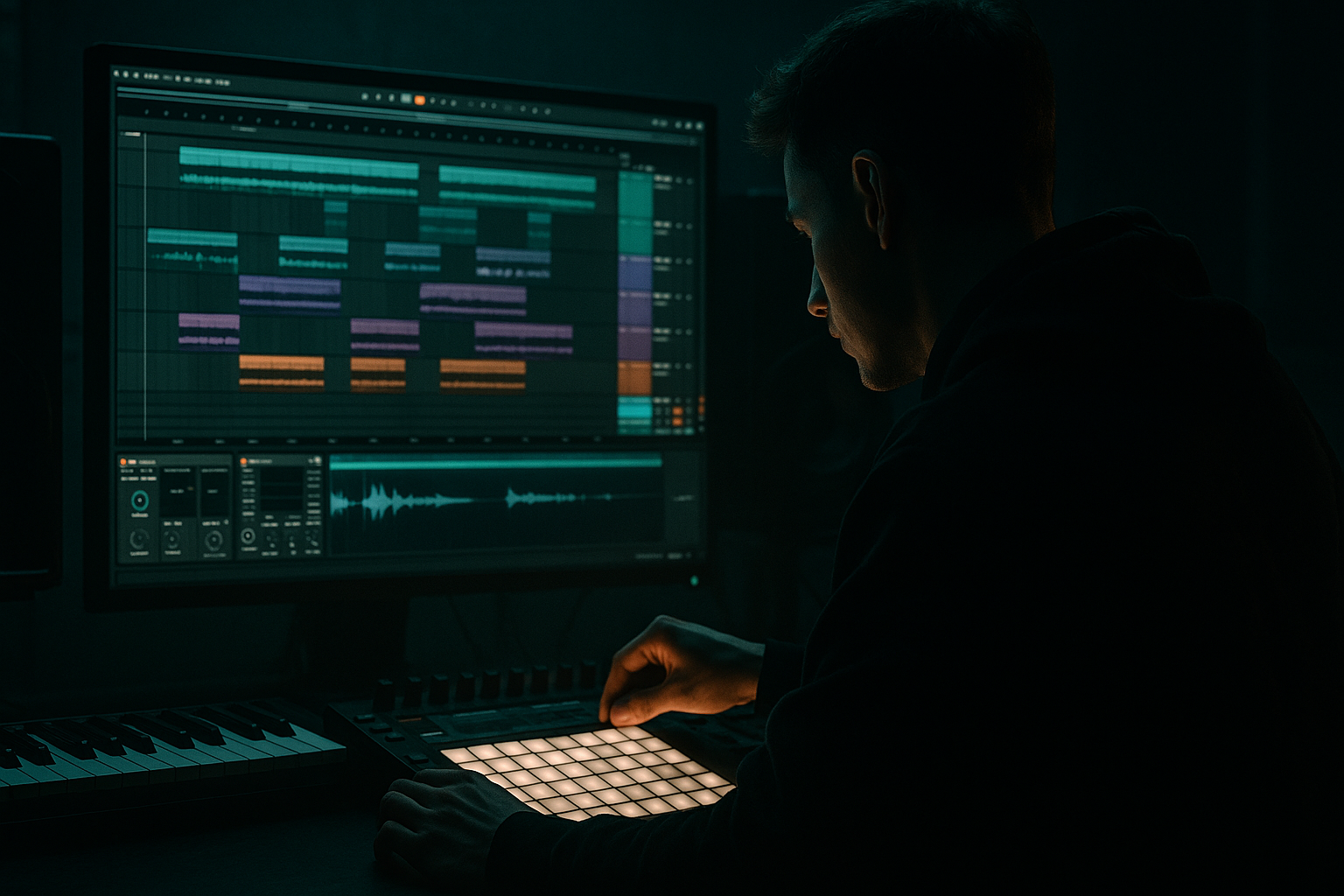
Main tutorial
Warp an Amen-Style Switch‑Up with Crunchy Sampler Texture in Ableton Live 12 (Beginner DnB Arrangement) 🥁⚡
1) Lesson overview
In this lesson you’ll take an Amen-style break (or any classic jungle break), warp it cleanly, then create a switch‑up fill that sounds like it was resampled off an old sampler: crunchy, fast, and intentional. The focus is arrangement—how to make your break flip energy going into a drop, 2nd phrase, or turnaround.
You’ll learn:
- How to choose the right Warp mode for breaks
- How to create a switch‑up (1–2 bars) that still feels like it belongs
- How to add crunch + sampler vibe using stock devices
- How to place it in a DnB arrangement so it hits hard 🎯
- A tight, warped Amen loop (main groove)
- A 1-bar switch‑up at the end of bar 16 (or bar 8) using stutters, pitch hits, and resample-style crunch
- A device chain that creates “old sampler / crunchy” texture without killing punch
- Bars 1–15: main loop
- Bar 16: switch-up fill
- Bar 17: drop/phrase restart
- Over-warping the break → it sounds phasey or watery
- Crushing too hard with Redux → hats turn into sand
- Switch-up doesn’t feel like the same drummer
- Fill is busy but not impactful
- Low end gets messy
- Layer a tight modern snare under the Amen snare (very common in neuro/techy rollers):
- Make the switch-up “pitch down” into the drop:
- Add distortion in parallel, not fully inline:
- Gate the reverb for that tight dungeon vibe:
- Use darker cymbal texture:
- Warp breaks for DnB with Beats mode first, keep warp markers minimal.
- Build a switch-up by slicing, repeating, and reordering—then add one or two pitch moments.
- Get crunchy sampler texture using stock devices: Redux → Saturator → Drum Buss → EQ Eight.
- Make it land in the arrangement with automation (filter sweep, reverb throw, and a tiny gap).
- If you want maximum authenticity: resample the switch-up and slice it in Simpler.
---
2) What you will build
A 16-bar rolling drum section (typical DnB phrasing) with:
---
3) Step-by-step walkthrough
A) Session setup (DnB-friendly)
1. Set tempo: `170–175 BPM` (try 174 BPM).
2. In Arrangement View, create:
- Audio Track 1: `BREAK MAIN`
- Audio Track 2: `BREAK SWITCH-UP` (you’ll build the fill here)
3. Turn on the metronome, set 1 Bar count-in if you like.
---
B) Import and warp your Amen-style break correctly
1. Drag your Amen loop (or any break) into BREAK MAIN.
2. In Clip View:
- Enable Warp
- Set Seg. BPM (Ableton estimates it). Don’t trust it blindly—confirm with your ears.
3. Find the true downbeat:
- Zoom in to the first transient (usually the first kick).
- Right-click that transient → “Set 1.1.1 Here”
4. Fix bar length:
- If it’s a 1-bar break: make sure it ends exactly at `2.1.1`
- If it’s a 2-bar break: ends at `3.1.1`
- Drag the clip end or check the loop brace.
5. Choose a Warp Mode (important):
- Start with Beats mode
- Settings:
- Preserve: `Transients`
- Envelope: `10–25 ms` (lower = tighter/crunchier, higher = smoother)
- If it starts sounding “clicky” or thin, try:
- Complex Pro for smoother time stretch (less punchy, but safe)
- Or keep Beats and adjust envelope
DnB rule of thumb:
✅ Beats mode = punch & snap (often best for breaks)
✅ Complex Pro = smoother but can soften transients
---
C) Lock the groove: micro-warp only if needed
If the break drifts or feels late:
1. Turn on Warp Markers only where necessary:
- Put a marker on major hits (kick/snare), not every hat.
2. Nudge the snare to land nicely on 2 and 4 (in 4/4 DnB counting):
- Snare often lands around `1.2` and `1.4` in a 1-bar loop (depending on the break)
3. Keep edits minimal—too many markers = “over-warped” phasey break.
---
D) Duplicate to create your switch-up lane
1. Duplicate the main break clip from `BREAK MAIN` onto `BREAK SWITCH-UP`.
2. Decide where the switch-up happens:
- Classic: last bar before a drop or bar 16 in a 16-bar phrase.
3. In Arrangement, keep `BREAK MAIN` running, and place your `BREAK SWITCH-UP` clip only on the switch-up bar (mute the main break there).
Arrangement move (very DnB):
---
E) Build the Amen-style switch-up (1 bar) with fast edits ✂️
We’ll do 3 quick techniques that scream jungle/DnB:
#### Technique 1: Slice and reorder (fast classic)
1. Click the switch-up clip, zoom into bar 16.
2. Use Split (`Cmd/Ctrl + E`) on key transients:
- Split around a snare, a kick, and a hat run
- Make ~6–10 slices (don’t go crazy yet)
3. Rearrange slices:
- Move a snare earlier for a “rush”
- Repeat a hat slice 2–4 times for a stutter
4. Add a tiny gap before the final hit:
- Leave 1/16 or 1/32 silence before the last snare/kick → creates tension.
#### Technique 2: Stutter the last 1/2 bar (roll-up energy)
1. Take the last half-bar (`16.3.1 to 17.1.1`) and split into 1/16 chunks.
2. Repeat 2–3 chunks rapidly.
3. Optional: fade each tiny slice:
- Add quick fades to avoid clicks (drag clip fade handles).
#### Technique 3: Pitch “tape hit” moments (sampler vibe)
1. Select one snare slice (or a whole 1/8 section).
2. In Clip View, enable Pitch changes:
- Try -3 to -7 semitones on one hit for weight
- Try +3 to +7 semitones on a tiny hat slice for tension
3. Keep it tasteful: 1–3 pitch moments per bar is enough.
---
F) Add crunchy sampler texture (stock device chain) 🧱
Put this chain on BREAK SWITCH-UP (or on a Drum Buss return if you want it shared).
#### Device Chain (in order)
1. Redux (bit depth + sample rate crunch)
- Downsample: `2.0–6.0` (start at 3.0)
- Bit Reduction: `10–14 bits` (start at 12)
- Dry/Wet: `20–40%` (start at 30%)
- Goal: audible grit without turning to white noise.
2. Saturator (weight + harmonics)
- Drive: `2–6 dB` (start at 4 dB)
- Turn on Soft Clip
- Optional: Analog Clip mode for bite
- If it gets harsh, reduce Drive and let Redux do less.
3. Drum Buss (punch + smack)
- Drive: `5–15%`
- Crunch: `10–25%`
- Boom: off or subtle (`0–10%`)—breaks can get woofy fast
- Transients: `+5 to +20` if you lost attack from warping/crunch
4. EQ Eight (clean the mess)
- High-pass: `30–45 Hz` (breaks don’t need sub)
- Slight dip if muddy: `200–350 Hz` by `-2 to -4 dB`
- Small tame if harsh: `6–9 kHz` by `-1 to -3 dB`
Workflow tip: Map a Macro (or just automate) Redux Dry/Wet and Drum Buss Crunch—turn it up only during the fill. That’s the “switch-up gets nasty” moment 😈
---
G) Make it arrangement-ready with automation (this is the secret sauce)
Switch-ups feel big because the bar before the drop changes the rules.
Automate these on bar 16:
1. Filter sweep (Auto Filter on the drum bus)
- Add Auto Filter on your drum group (or just the break).
- Mode: Low-Pass
- Start bar 16 at around 12–18 kHz, sweep down to 3–6 kHz by the end of the bar.
- Add a little Resonance: `10–20%` (don’t whistle).
2. Reverb “throw” on the last snare
- Create a Return Track with Reverb:
- Decay: `1.2–2.5s`
- Pre-Delay: `10–25 ms`
- High-pass inside reverb (or EQ after): cut below `200 Hz`
- Send ONLY the final snare slice (automation spike).
3. Tiny gap before the drop
- Remove the last 1/16 before bar 17.
- Or fade out the last hit quickly.
- The silence makes the drop feel louder than it actually is.
---
H) Optional: The “Sampler Resample” method (extra authentic) 📼
If you want that proper crunchy resampled feel:
1. Create a new Audio Track: `RESAMPLE PRINT`
2. Set its input to Resampling (Audio From → Resampling).
3. Solo `BREAK SWITCH-UP` and record 1–2 bars.
4. Now process the recorded audio:
- Use Simpler (drag the recording into Simpler)
- Mode: Slice
- Slice by: `Transient`
- Now you can play/retrigger slices like an old-school chopped break.
This is how you get that “it’s been through a box” vibe.
---
4) Common mistakes (and quick fixes)
✅ Use fewer warp markers. Warp only the main hits.
✅ Lower Downsample, or reduce Dry/Wet to ~20–30%.
✅ Reuse slices from the same break; keep ghost notes/hats consistent.
✅ Add a micro-silence before the drop, and automate one strong effect (filter or verb throw).
✅ High-pass the break at 30–45 Hz and avoid heavy “Boom” on Drum Buss.
---
5) Pro tips for darker/heavier DnB 🖤
Use a Drum Rack one-shot snare, low-pass it around `8–10 kHz`, and blend quietly.
Automate clip pitch down -2 semitones across bar 16 for a sinking feeling.
Put Saturator/Overdrive on a Return track and send the switch-up into it.
Reverb → Gate (or Auto Filter + sidechain-style shaping) so it doesn’t wash out.
After crunching, dip `10–12 kHz` slightly to avoid “shiny” tops.
---
6) Mini practice exercise (10 minutes) ⏱️
1. Pick any Amen-style loop.
2. Warp it using Beats / Transients / Envelope 15 ms.
3. Create a 1-bar switch-up:
- Must include one stutter (1/16 repeats)
- Must include one pitch edit (-5 semitones on a snare slice)
- Must include one silence gap (1/16 before the downbeat)
4. Add Redux at 30% wet + Drum Buss Crunch 15% on switch-up only.
5. Arrange it as: 15 bars main + 1 bar switch-up + drop restart.
Bounce a quick loop and listen: does bar 16 feel like a “warning shot” before the next phrase?
---
7) Recap ✅
If you want, tell me what style you’re aiming for (jungle 94, modern rollers, neuro, dancefloor) and I’ll suggest a switch-up pattern that fits that sub-genre and a 16-bar arrangement template.

