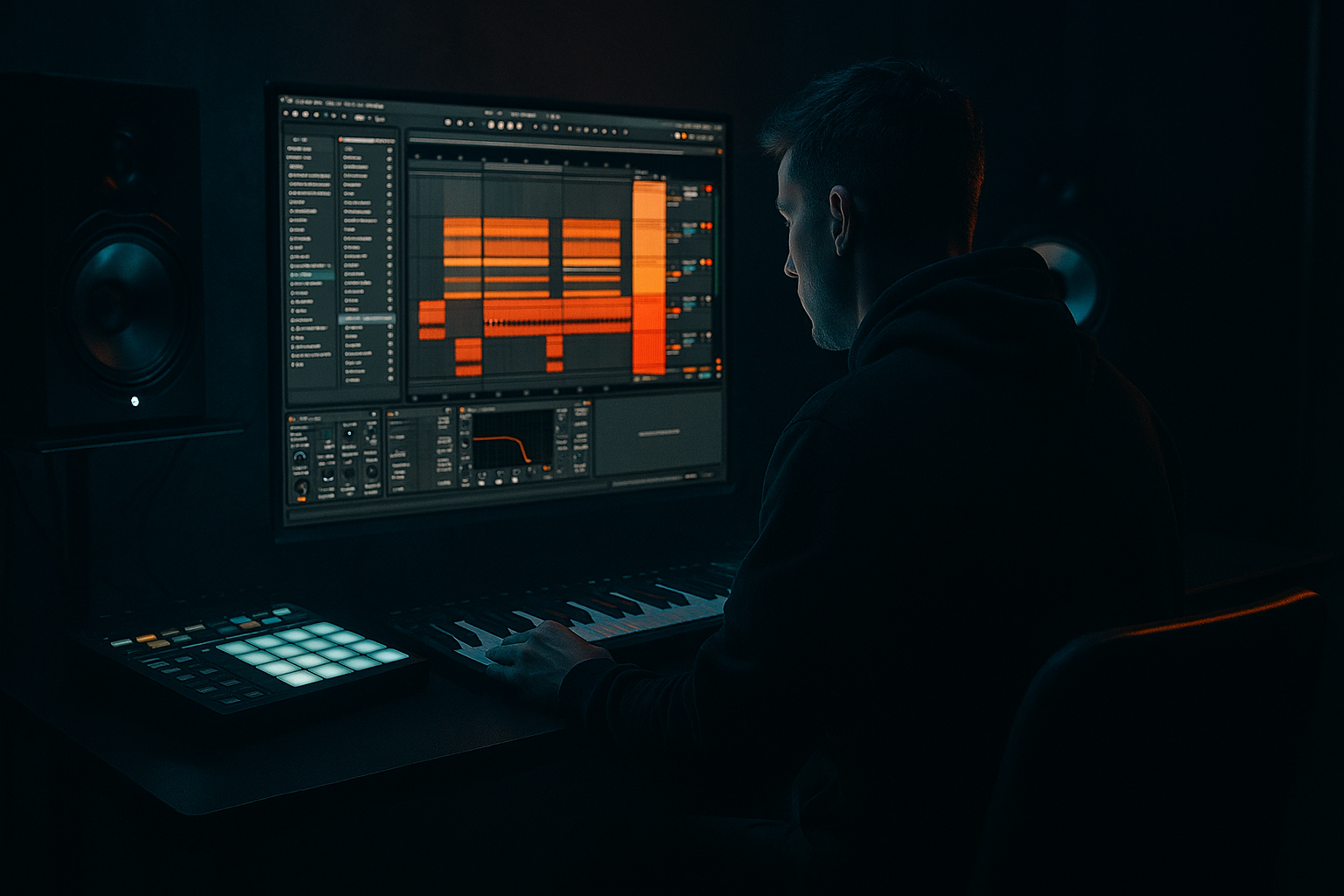
Main tutorial
```markdown
Warp Jungle Drum Bus for Sunrise Set Emotion (Ableton Live 12) 🌅🥁
Category: Risers
Skill level: Beginner
Goal: Turn a jungle/drum & bass drum bus into an emotional, uplifting “sunrise” riser using Warp-style time movement, filtering, saturation, space, and tension.
---
1) Lesson overview
In rolling DnB and jungle, a “riser” doesn’t always need to be a synth sweep. One of the most authentic ways to build hype is to make the drums themselves evolve—like they’re stretching, breathing, and opening into the drop.
In this lesson you’ll create a Warp Jungle Drum Bus Riser in Ableton Live 12 by:
- Resampling your drum bus
- “Warping” its feel (without destroying the groove)
- Automating filter, reverb, width, and saturation for a sunrise lift
- Printing a clean transition into your drop
- Starts tight, filtered, distant
- Gradually becomes brighter, wider, and more “alive”
- Peaks right before the drop with a controlled wash + transient snap
- Slams into the drop with zero flab / mud
- Warp Mode: `Complex Pro`
- Formants: 0 (neutral to start)
- Envelope: ~80–120 (higher = smoother, less transient bite)
- In the clip’s Envelopes box:
- Draw automation like this over 16 bars:
- Filter Type: Clean (or OSR if you want more character)
- Mode: Highpass (HP) at the start
- Start (Bar 1): HP at 200–350 Hz
- End (Bar 16): HP down to 30–60 Hz (but don’t let sub dominate—this is a riser)
- Add a gentle Lowpass (LP) feel using Auto Filter in Bandpass or switch to LP:
- Keep low-end out early so the drop’s sub feels huge.
- Mode: Soft Sine or Analog Clip
- Drive: 2–6 dB
- Soft Clip: On
- Output: trim so it’s not wildly louder
- Bars 1–12: 2–3 dB
- Bars 13–16: 5–7 dB (but watch harshness)
- Drive: 5–20%
- Crunch: 0–10% (sunrise = keep it tasteful)
- Boom: 0–15% (use carefully; this can fight your actual drop sub)
- Transients: +10 to +30 near the end (to bring snap back after warping)
- Algorithm: Plate or Hall
- Decay: 2.5–6s
- Predelay: 10–25 ms
- High Cut: 7–10 kHz (avoid fizzy hats)
- Low Cut: 200–400 Hz (keep it clean)
- Wet: automate from 5% → 25–40%
- Width: automate from 80–100% → 130–160%
- Bass Mono: On (if available) or keep width automation gentle below 200 Hz
- Last 1/2 bar: Width briefly dips to 70–90%
- Amount: 10–25%
- Rate: 1/4 or 1/8
- Phase: 0° (this becomes volume tremolo)
- Shape: Sine
- Bars 1–12: 10–15%
- Bars 13–16: 20–30%
- Bars 1–8: filtered drums, light saturation, small room/plate
- Bars 9–12: pitch rising + reverb growing + slight widening
- Bars 13–15: more transient snap + heavier saturation + pulsing
- Bar 16: quick pre-drop cut (silence or tiny fill), reverb tail chopped
- Drop: full drums + bass hits clean
- Swap Hybrid Reverb for shorter, dirtier space:
- Add Redux (subtle):
- Use Roar (Ableton Live 12) on the riser bus:
- Add a notch sweep EQ (Auto Filter or EQ Eight):
- More aggressive “time pull”:
- Resampled your drum bus for safe experimentation ✅
- Used Warp + pitch automation to create rising tension ✅
- Automated filter, saturation, reverb, and width for sunrise emotion ✅
- Cut space right at the drop for maximum impact ✅
This is perfect for those golden-hour / euphoric moments in a set—think uplifting pads, emotional chords, but still very drum-forward.
---
2) What you will build
You’ll end with a 16-bar riser (or 8 if you want it tighter) made from your own break/beat, that:
Sound reference vibe: classic jungle tension + modern DnB polish (think rolling hats, crisp snare, emotional uplift).
---
3) Step-by-step walkthrough
Step 0 — Session prep (quick and clean)
1. Set tempo to 170–176 BPM (try 174 BPM).
2. Make sure you have a drum loop or break running (Amen-style, chopped break, or your own drum rack pattern).
3. Route your drums to a Drum Bus Group:
- Select your drum tracks → `Cmd/Ctrl + G` → name it DRUM BUS.
---
Step 1 — Resample the drum bus (your “warp material”) 🎛️
We want a printable audio version we can manipulate hard without messing your main drums.
Option A (fastest): Resampling to audio
1. Create a new audio track named DRUM RISER PRINT.
2. Set its input to Resampling (or “DRUM BUS” if you prefer direct routing).
3. Arm the track and record 8 or 16 bars of your drum groove.
Now you’ve got an audio clip you can warp, stretch, and automate freely.
Pro workflow: Color it differently and keep it above your main drums in arrangement.
---
Step 2 — Warp settings: keep it musical, not glitchy
Click the recorded audio clip → enable Warp.
For a sunrise emotional lift, we want warping that stays smooth:
Why Complex Pro? It’s great for “time-smear” movement and emotional swells. We’ll bring transients back later.
> If Complex Pro sounds too blurry, try Beats mode with:
> - Preserve: Transients
> - Transient Loop Mode: Off
> - Envelope: 40–60
---
Step 3 — Create the actual “warp rise” using clip automation
We’ll make the clip feel like it’s pulling time open toward the drop.
1. Decide your riser length: 16 bars works great for emotional transitions.
2. At the start of the riser, set the clip segment to feel tighter:
- Leave Warp on, but keep it normal pitch (0 st).
3. Toward the end (last 4 bars), we’ll intensify movement:
Method (beginner-friendly): automate clip transposition
- Choose Clip → Transposition
- Bars 1–8: 0 st
- Bars 9–12: ramp to +2 st
- Bars 13–16: ramp to +5 st (or +7 st for more hype)
This mimics rising tension while still feeling “drum-derived.”
Optional “tape lift” vibe: also automate Detune slightly (if available) or add subtle chorus later.
---
Step 4 — Device chain on the DRUM RISER PRINT track (stock devices)
Add this chain in order:
#### 1) Auto Filter (the sunrise opening) 🌄
Also automate brightness:
- Alternative: Keep HP, but add a small Resonance (Q 0.7–1.2) and automate cutoff upward slightly.
Practical DnB move:
#### 2) Saturator (energy + harmonics)
Automate Drive:
#### 3) Drum Buss (punch, controlled dirt)
Automation idea: Increase Transients in the final 2 bars for that “snare wakes up” moment.
#### 4) Hybrid Reverb (the “lift into the sky”) ☁️
Key sunrise trick:
Automate Wet up, then hard cut it right at the drop (or fade it out in the last 1/4 bar).
#### 5) Utility (width + drop impact)
Right before the drop (last beat), do a micro-collapse:
Then at drop: back to 100% (or your normal mix width)
This makes the drop feel wider even if it’s not.
---
Step 5 — Add rhythmic riser motion (simple but effective) 🔥
We’ll create a pulsing “push” without needing complex LFO tools.
Add Auto Pan (yes, even on drums):
Automate Amount:
This gives a breathing feel that works insanely well in liquid/atmospheric DnB.
---
Step 6 — Arrangement: where it sits in a DnB track
A classic sunrise transition layout:
Pre-drop trick (very jungle):
In the final bar, add a 1-beat break stop (mute the riser track for 1 beat) then let the drop slam.
---
Step 7 — Print it (so it’s stable + easy to mix)
Once it sounds right:
1. Freeze the DRUM RISER PRINT track.
2. Flatten it.
3. Now you can do tight edits:
- Fade out the tail
- Clip gain adjustments
- Place it perfectly into the transition
---
4) Common mistakes
1. Too much low end in the riser
Your drop should own the sub. Highpass early, and don’t “Boom” too hard.
2. Reverb masking the snare impact
Big reverb feels emotional, but if you don’t cut it at the drop, you lose punch.
3. Warp mode making hats sound like sandpaper
If Complex Pro gets harsh, reduce high end (EQ), or switch to Beats mode for crisp transients.
4. Making it louder instead of more intense
Intensity = automation + density + brightness + width, not just level.
5. No contrast at the drop
If the riser is already full-spectrum + wide + loud, the drop won’t feel bigger.
---
5) Pro tips for darker/heavier DnB 😈
Want the same technique but more “neuro / dark roller” than sunrise?
- Decay 1–2.5s, darker tone, more predelay, less wet.
- Downsample a tiny bit (very gentle) for grit—don’t crush it.
- Start mild, automate Drive up in last 4 bars.
- Keep low end controlled with Roar’s filtering.
- Slowly sweep a resonant notch downward for eerie tension.
- In clip warping, get more extreme near the end (but print and choose the best bits).
---
6) Mini practice exercise (15 minutes) ⏱️
1. Pick a 2-bar break loop (Amen or similar).
2. Record 8 bars to a resample track.
3. Warp it in Complex Pro.
4. Automate:
- Transposition: 0 → +5 st over 8 bars
- Auto Filter HP: 300 Hz → 60 Hz
- Hybrid Reverb Wet: 5% → 30%, then cut at drop
- Utility Width: 100% → 150%, then dip to 80% right before drop
5. Print and place it before a drop.
6. A/B: mute/unmute the riser to feel if the drop hits harder with it.
---
7) Recap
You built a drum-bus-based riser that feels authentically jungle/DnB:
If you want, tell me your tempo and whether your beat is more Amen/jungle or modern roller, and I’ll suggest exact automation curves and a clean 8-bar transition template for your style.
```

