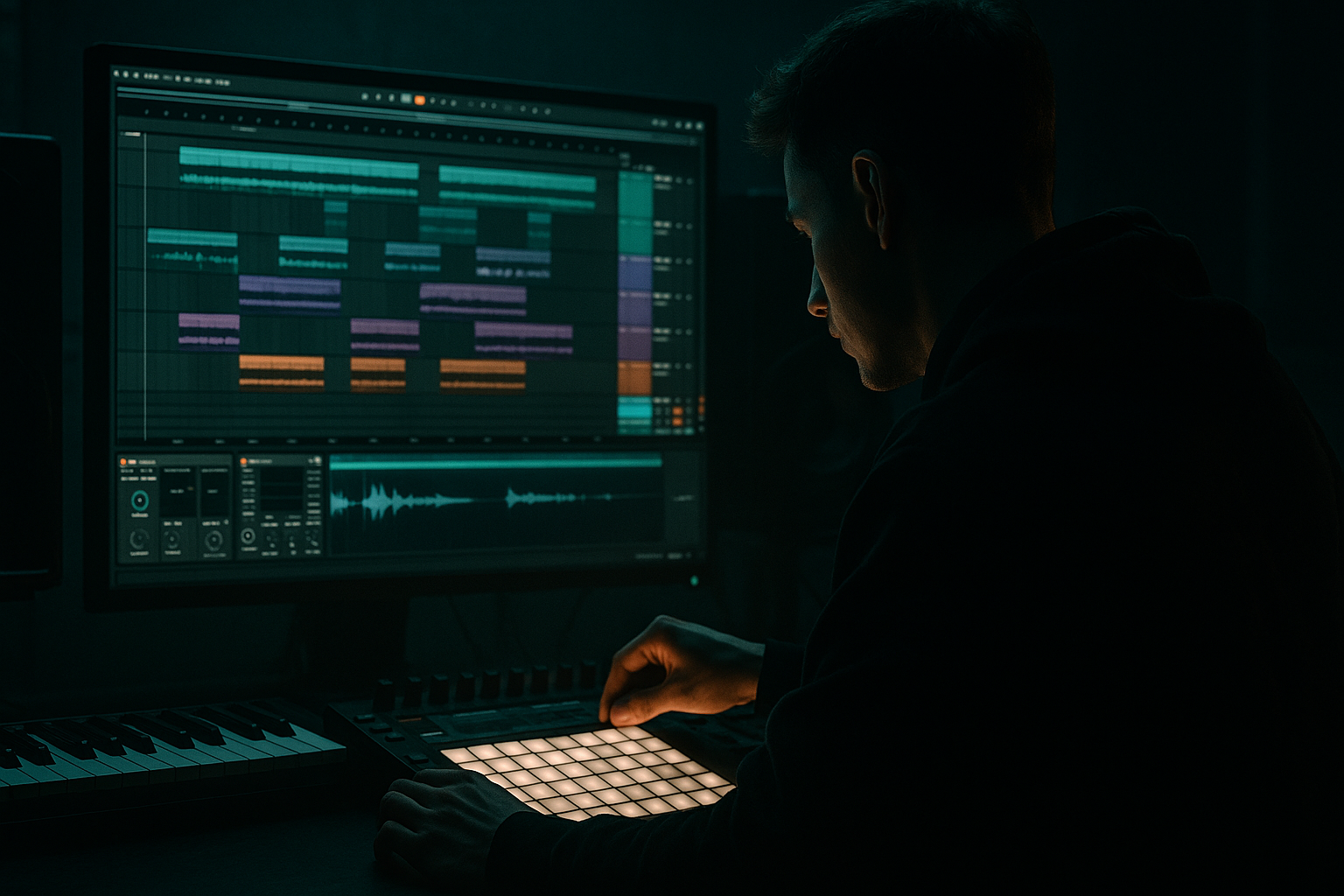
Main tutorial
Lesson Overview
This lesson is about taking an oldskool Drum & Bass impact sound—think jungle stabs, ragged hit layers, dusty breaks, and warped sampler energy—and turning it into something that still hits with modern punch in Ableton Live 12, while keeping the vintage soul intact. The goal is not to “clean up” the character out of it. The goal is to shape it so it slams on today’s systems: club subs, headphones, car systems, and streamed playback.
In DnB, impact sounds do a lot of heavy lifting. They can mark the start of an 8-bar phrase, punctuate a drop switch, or act as a call-and-response tool with the bassline. A great impact in drum & bass is never just a one-shot. It often contains a blend of:
- a punchy transient,
- a low-end thump or sub hit,
- a midrange bark or metallic edge,
- and a bit of warped texture that makes it feel lived-in.
- a tight transient that cuts through dense drums,
- a warped, pitch-bent mid layer for oldskool character,
- a sub-supported body that lands with weight,
- a gritty top layer for bite and presence,
- and automation-ready movement so it can evolve across a 16-bar section.
- the hit at the start of a drop every 8 bars,
- a response stab after a bass phrase,
- a transition hit before a halftime switch,
- or a DJ-friendly intro impact before the full drum edit opens up.
- Making the impact too long
- Over-warping the sample
- Using too much low end in every layer
- Relying on reverb instead of body
- Making it stereo-heavy in the wrong place
- Ignoring context
- Use call-and-response with the bassline
- Resample multiple versions
- Automate filter movement on the grit layer
- Use short feedback delays for menace
- Clip the impact gently
- Let the impact lead into a break edit
- Darken the top without killing presence
- Separate transient, body, and grit for control.
- Keep the core low end mono and short so it works with kick and sub.
- Design the impact for arrangement, not solo mode so it earns its place in the track.
This technique matters because oldskool DnB and jungle often had that raw sampler energy, but modern systems demand tighter transient control, cleaner low-end, and smarter stereo discipline. If you can warp and resample impacts properly, you get a sound that feels authentic and dangerous without losing mix clarity. 🔥
---
What You Will Build
By the end, you’ll create a multi-layered DnB impact hit in Ableton Live 12 that works in a dark roller, jungle rewind moment, or neuro-adjacent drop intro.
It will have:
Musically, this could function as:
The end result should sound like a sample-based jungle weapon that has been re-engineered for modern DnB punch.
---
Step-by-Step Walkthrough
1. Choose the right source material
Start with a source that already has attitude. Good options in Ableton workflow terms:
- a chopped old break hit,
- a vinyl-style stab,
- a short synth brass stab,
- a tom hit,
- or a resampled drum/bass punch from your own project.
For best results, bounce or drag your source into an audio track and trim it down to a short hit, usually 100–400 ms. You want enough tail to feel musical, but not so much that it clouds the next kick or bass note.
If you’re building from a break, try isolating:
- a snare transient,
- a kick body,
- a small bit of room noise,
- or a slice with a natural pitch wobble.
Why this works in DnB: oldskool impacts often came from chopped samples and imperfect playback, which gives them motion and grit. The source doesn’t need to be pristine—it needs character.
2. Warp it with intention, not just correction
Open the sample in Clip View and use Warp deliberately. For impact design, the goal is often to accentuate the weirdness rather than remove it.
Useful warp modes:
- Repitch for classic sampler pitch behavior and a more authentic oldskool bend.
- Complex Pro if the source is tonal and you want controlled stretching without too much aliasing.
- Texture if you want a more grainy, modernized smear.
- Beats if you’re working from a break and want tighter transient slicing.
Try these starting points:
- Set the Clip Transient Loop Mode only if you want a sustained texture; otherwise keep the hit short.
- Pitch the sample down -3 to -7 semitones for a darker impact.
- Nudge warp markers to slightly drag the tail late by a few milliseconds for a more “lazy” jungle feel.
- If the sample has a strong transient, slightly tighten the first warp marker so the hit still punches.
Keep your ears on the transient. If the warp is making it floppy, you’ve gone too far. If it feels rigid, you’ve lost the soul.
3. Build a 3-layer impact inside an Audio Effect Rack
Drop the warped sample onto a track and group it into an Audio Effect Rack with 3 chains:
- Chain 1: Transient
- Chain 2: Body
- Chain 3: Grit / Air
Duplicate the source sample across all three chains, then process each chain differently.
Suggested chain starting points:
- Transient chain: use EQ Eight with a high-pass around 120–180 Hz, then Saturator with Drive around 2–5 dB, and a Drum Buss transient setting lightly up.
- Body chain: use Simpler or Sampler if you want note control, or just EQ the source with a low shelf around +2 to +4 dB at 80–120 Hz if the hit supports it.
- Grit chain: use Auto Filter band-pass, then Redux with a small amount of bit reduction, or Saturator in Hard Curve mode for edge.
Use the Rack’s Chain Volume and Macro knobs for quick balancing. A nice practical range:
- Transient: loudest chain for cut,
- Body: around -3 to -6 dB below transient,
- Grit: tucked in just enough to hear when muted, not dominate.
This layered approach lets you preserve the vintage sample vibe while separating impact from mud.
4. Shape the punch with Drum Buss, Saturator, and transient control
In DnB, the transient needs to land fast and the body needs to get out of the way quickly. Put Drum Buss on the main impact group or rack output and work lightly.
Good starting settings:
- Drive: 5–15%
- Crunch: low to moderate, around 5–20%
- Transient: +5 to +20
- Boom: use carefully, or keep it off if the sample already has low-end
- Boom Frequency: around 50–80 Hz if needed
Then add Saturator after Drum Buss if you need extra density:
- Drive: 1–4 dB
- Soft Clip: on
- Keep output compensated so you’re not fooling yourself with volume.
If the hit needs sharper definition, use Transient shaping via the Drum Buss Transient control rather than over-EQing. That’s usually more musical for DnB impacts.
For darker neuro or rollers, you can also add Erosion very lightly to create high-mid bite, especially on the grit chain.
5. Tighten the low end so it lands with the kick and sub
This is where many impact sounds fail: they sound huge soloed, but they fight the kick and bass in context. Use EQ Eight to carve a disciplined low-end shape.
A strong DnB impact often benefits from:
- a controlled low shelf,
- a narrow cut if there’s boxiness around 200–400 Hz,
- and a high-pass on any non-essential top-layer material.
Suggested moves:
- On the transient/top layers, high-pass between 120–200 Hz.
- On the body layer, keep a focused low bump if needed, but avoid long sub tails.
- If there’s a muddy resonance, cut 250–350 Hz by 2–5 dB with a medium Q.
- If the hit has harsh click, tame 3–6 kHz gently with a narrow-ish cut.
If you want the impact to feel like it has sub, consider creating a separate short sub hit:
- Use Operator with a sine wave,
- trigger a note at the impact point,
- keep the envelope short, about 120–250 ms,
- and tune it to the track root or a strong interval like the fifth.
Keep this sub hit mono and simple. In drum and bass, sub is not decoration—it’s structural.
6. Add movement with resampling and automation
Once the rack feels good, resample it to audio. This is where the sound starts to become personal. Record the impact playing in context, then drag the recorded audio back into a new track.
After resampling, try:
- reversing the tail of one hit for a transition,
- automating pitch down by 1–3 semitones into the impact,
- automating Auto Filter cutoff from open to slightly closed across a bar,
- or automating Reverb send only on one hit per 8 bars.
A useful DnB trick is to create a two-part impact:
- the first hit lands dry and hard,
- the second layer, delayed by a few milliseconds or 1/16 note, carries a warpy tail.
Use Track Delay sparingly or a short Simple Delay on just the grit chain to create movement. A tiny stereo offset can make the hit feel wider, but keep the main attack mono-compatible.
7. Place the impact inside a real arrangement
Now think like a DnB arranger. Don’t design the sound in isolation—design it for a phrase.
Example context:
- 16-bar intro: filtered impact on bar 8 with atmosphere
- Drop 1: full impact on the first downbeat, followed by call-and-response bass
- Bar 9/10 switch-up: impact reappears with half the tail, making room for break edits
- 32-bar section: automated version with more grit and a slightly different pitch for variation
In the Arrangement View, try placing:
- a dry version at the drop start,
- a reversed or filtered version before the next phrase,
- and a degraded version in the breakdown or breakdown-to-drop transition.
Keep intros and outros DJ-friendly by making the impact sound available as a utility tool:
- start with filtered or shortened hits,
- save the full-weight version for the actual drop,
- and leave space for the kick/snare pattern to breathe.
8. Check mono, balance, and spectral clutter
Impacts can sound epic in stereo and messy in mono. Use Utility on the impact group:
- switch Bass Mono or simply reduce width on low layers,
- collapse the low layer to mono,
- and compare your hit in mono against the kick and sub.
Important checks:
- If the impact disappears in mono, your core weight is too dependent on stereo processing.
- If the low-mid area gets crowded, reduce body chain volume instead of over-EQing everything.
- If the impact is harsh against hats or reese bass, tame the 2.5–5 kHz region.
In DnB, clarity is not about making everything clean. It’s about making the important elements legible at speed.
---
Common Mistakes
- Problem: the hit eats the bar and fights the bassline.
- Fix: shorten the clip, reduce release on any synth layer, or cut tail with an envelope.
- Problem: the transient becomes soft or phasey.
- Fix: use fewer warp markers, or switch warp mode. If the sound needs grit, resample instead of stretching endlessly.
- Problem: kick/sub becomes muddy and the impact loses punch.
- Fix: keep only one layer responsible for true low-end weight. High-pass the others.
- Problem: the hit gets wide but not powerful.
- Fix: shape the actual amplitude envelope and saturation first, then add small room space if needed.
- Problem: the impact collapses or smears in mono.
- Fix: keep the core transient and sub mono, and reserve width for upper layers only.
- Problem: the hit sounds great soloed but clashes with drums and bass.
- Fix: audition the sound with kick, snare, and bass looped. In DnB, context is everything.
---
Pro Tips for Darker / Heavier DnB
- Make the impact answer the bass, not compete with it. For example, place the hit on the off-beat after a reese phrase to create tension.
- Render one clean, one crushed, and one pitch-downed version. Use them in different arrangement sections for progression without redesigning from scratch.
- A slow Auto Filter sweep can make a static hit feel alive. For darker rollers, keep the cutoff in the 400 Hz–3 kHz zone and move it subtly.
- A very low mix Echo or Simple Delay on only the top layer can create a ghostly tail. Keep feedback low so it doesn’t wash out the groove.
- A little Soft Clip on Saturator or Drum Buss can give the hit modern density without flattening the transient completely.
- Follow a hit with a chopped amen or halftime fill. That contrast is classic DnB language and makes the impact feel bigger.
- If the sound is too shiny, use EQ Eight to ease off above 8–10 kHz rather than dulling the whole hit.
---
Mini Practice Exercise
Spend 10–20 minutes building three versions of the same impact:
1. Create a single-hit rack from an old break slice or stab.
2. Make one version clean and punchy.
3. Make one version warped and gritty with pitch down and distortion.
4. Make one version dark and wide using subtle filter movement and stereo top-end only.
5. Place all three across an 8-bar loop:
- bar 1: clean version,
- bar 5: gritty version,
- bar 7 or 8: wide transition version.
6. Test each one against a kick, snare, and sub loop.
7. Render the best one to audio and trim the tail so it sits cleanly in the mix.
Goal: by the end, you should have an impact sound that can work in a drop, a switch-up, or a transition without redesigning it.
---
Recap
The key idea is simple: don’t just make an impact sound loud—make it behave like a DnB weapon. Use warping for character, layering for control, saturation for density, and resampling for identity. Keep the low end disciplined, the transient sharp, and the texture alive.
If you remember only three things:
That’s how you get oldskool soul with modern punch in Ableton Live 12.

