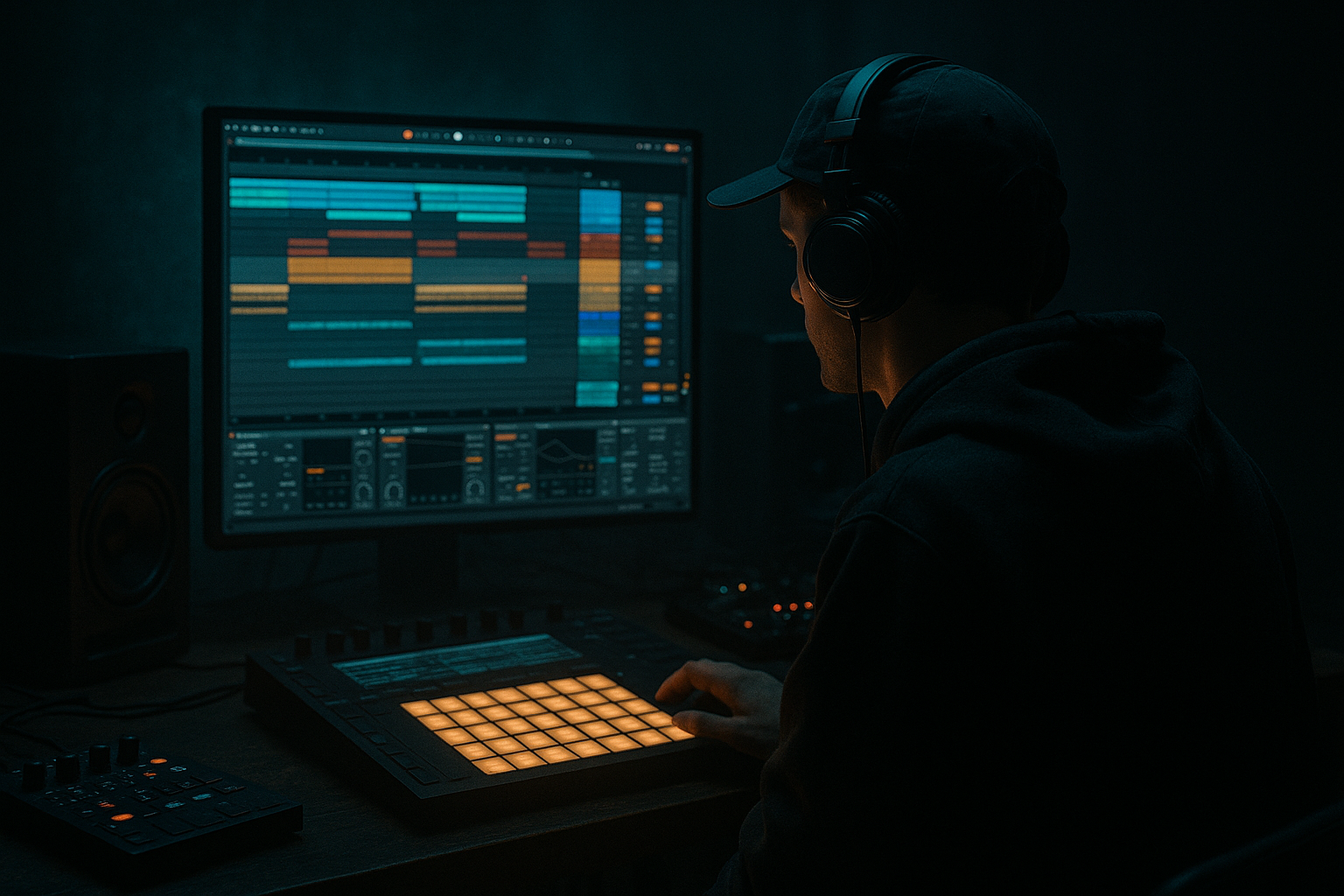
Main tutorial
Lesson Overview
In this lesson, you’ll learn how to make a sub feel wider and more atmospheric using Macro controls in Ableton Live 12 without wrecking the low end. This is a classic jungle / oldskool DnB trick: the true sub stays solid in the center, while the harmonics, texture, and atmosphere around it move wider to create energy, depth, and that “bigger than the speakers” feeling 🎛️
This matters a lot in DnB because the low end has to do two jobs at once:
1. Hold the dancefloor down with mono-compatible sub weight
2. Create vibe and motion so the bassline doesn’t feel flat or static
For beginner producers, the big mistake is usually trying to widen the actual sub with stereo tools. In DnB, that often causes weak low end, phase issues, and poor club translation. The better move is to keep the deep fundamental centered, then use macro-controlled movement on higher bass layers, ambience, and subtle effects to make the whole bass feel wide and alive.
This lesson fits perfectly in Atmospheres because the “widened sub” effect is really about spatial character: a dark wash of harmonics, filtered noise, reverb tails, micro-movement, and delay texture that gives your jungle bassline a bigger emotional footprint without losing punch.
We’ll build a simple Ableton Live 12 chain you can reuse in rollers, jungle, darker liquid, and oldskool-inspired drops.
What You Will Build
By the end, you’ll have a macro-controlled bass rack that does this:
- Keeps the sub fundamental mono and stable
- Adds a wider mid-bass layer for movement and attitude
- Blends in atmospheric stereo texture only when needed
- Lets you perform or automate width, grit, and space from one easy macro setup
- Sounds useful in a jungle-style 2-step or breakbeat drop, especially when paired with chopped breaks and a dark atmospheric pad
- Widening the actual sub
- Too much reverb on the bass
- Overdoing chorus or stereo width
- No separation between sub and atmosphere
- Making the bass too bright
- Forgetting the drums
- Using macros without a clear job
- Add a tiny bit of Saturator drive on the mid layer to create audible harmonics on smaller speakers. Try 2 dB to 5 dB drive.
- Use Auto Filter movement to mimic oldskool synth evolution. Slow sweeps can make a loop feel like it’s breathing.
- Layer a very quiet noise texture or atmospheric pad above the bass and map its volume to the same Atmosphere macro for a unified “bloom.”
- If the track is more neuro or darker roller-inspired, keep the bass movement tighter and more controlled. Use width as a brief accent, not a permanent state.
- For extra grit, use Redux very lightly on the mid chain only. Even a small amount can add bite, but keep it subtle so the bass doesn’t turn harsh.
- Automate width only in fills, intros, and transition bars. This keeps the drop heavy while making the arrangement feel alive.
- Pair the widened bass with break edits and ghost notes. When the drums get busier, simplify the bass macro movement so the mix stays readable.
- one for a dark rollers vibe
- one for a classic jungle/oldskool vibe
- Keep the sub centered and clean
- Widen only the harmonics, texture, and atmosphere
- Use Ableton Instrument Rack macros to control atmosphere and movement
- Automate width and space for phrases, fills, and transitions
- Always check mono compatibility
- In DnB, the best width is the kind that makes the bass feel bigger without losing impact
Musically, the result will feel like an oldskool DnB bassline that starts centered and clean, then blooms outward during sustained notes or switch-ups. Think: sub pressure in the middle, misty harmonics around the edges.
Step-by-Step Walkthrough
1. Start with a simple bass MIDI clip and a centered sub
Create a new MIDI track and load Analog, Operator, or Wavetable. For beginner-friendly sub, Operator is ideal.
- Set Operator to a sine wave.
- Keep the octave low: try C1 to G1 territory depending on your arrangement.
- Write a simple 1- or 2-bar bass pattern using short notes and a few longer held notes for atmosphere.
- Keep velocity fairly even at first.
For DnB, this gives you a stable foundation. You want the sub to feel like the floor under the drums, not a stereo effect floating around.
Why this works in DnB: the kick, snare, and sub need to lock together. If the fundamental is clean and centered, your break edits and percussion can sit on top without low-end confusion.
2. Build a Layered Instrument Rack so you can widen only the non-sub parts
On the bass track, select your instrument and press Cmd/Ctrl + G to create an Instrument Rack.
Now create two chains:
- Chain 1: Sub
- Chain 2: Mid/Atmosphere
Duplicate your instrument if needed, or simpler: keep the same MIDI clip and process each chain differently.
For the Sub chain:
- Leave it dry and mono-friendly
- Add EQ Eight
- Low-pass around 120 Hz to 150 Hz
- Keep this chain clean and central
For the Mid/Atmosphere chain:
- Add Saturator
- Add Corpus very subtly if you want extra body, or skip it for now
- Add Auto Filter
- Add Utility
This split is the core of the lesson: the low-end stays controlled, while the upper character can be widened and animated.
3. Use Macro 1 to control the amount of atmosphere
Map Macro 1 to the following on the Mid/Atmosphere chain:
- Saturator Drive: 0 dB to about 6 dB
- Auto Filter Frequency: around 250 Hz to 1.5 kHz
- Utility Gain: slightly up/down if needed, around -3 dB to +3 dB
- Optional: Dry/Wet of a short Reverb on a send or insert, around 0% to 20%
Name this Macro Atmosphere.
Set the default position to something subtle, like 20%–30%.
That way the bass sounds normal when you’re writing, and you can open it up later for fills, drops, or transition moments.
Beginner tip: don’t try to map too many controls at once if it becomes confusing. Start with 2–3 important parameters and keep it readable.
4. Create width using frequency-safe stereo processing
On the Mid/Atmosphere chain, add Utility and use its Width control carefully.
Suggested settings:
- Start at 100% width for reference
- Increase to around 120% to 140% on the wider chain only
- Do not widen the sub chain
If you want more movement, add Chorus-Ensemble very lightly after the filter:
- Mode: subtle / default chorus style
- Amount: low
- Rate: slow
- Dry/Wet: 5% to 15%
Then map this Chorus Dry/Wet to the same Atmosphere macro, or to a second macro if you want more control.
Keep in mind: the goal is not giant stereo bass. The goal is a wider aura around the bass, especially above the sub region.
Why this works in DnB: jungle and rollers often use a strong mono low end with wide harmonic content above it. This keeps the mix punchy while still sounding big on headphones and club systems.
5. Add a second macro for motion and tension
Create Macro 2 and call it Move.
Map it to:
- Auto Filter Frequency on the Mid/Atmosphere chain
- Filter Resonance slightly
- Chorus Rate or Dry/Wet
- Optional: Delay Dry/Wet if you want a tiny dubby tail
Suggested ranges:
- Auto Filter Frequency: from 300 Hz up to 2 kHz
- Resonance: 0.7 to 1.8 if it’s a simple filter
- Delay Dry/Wet: 0% to 12%
- Chorus Dry/Wet: 5% to 18%
This macro is for automation and performance. Turn it up in the last 2 bars before the drop, or during an 8-bar switch-up so the bass feels like it opens up into the atmosphere.
If your bassline is very short and staccato, keep Move subtle. If you have longer notes in a jungle-style breakdown, you can push it more.
6. Use a return track for space so the bass stays controlled
Instead of putting huge reverb directly on the bass, create a Return track with Reverb or Echo.
For Reverb:
- Decay Time: 1.2 to 2.5 seconds
- Pre-Delay: 10 ms to 25 ms
- Low Cut: around 200 Hz or higher
- Dry/Wet: 100% on the return
For Echo:
- Time: 1/8 or 1/16 dotted depending on groove
- Feedback: low, around 10% to 25%
- Filter out lows using the built-in filters
- Add a bit of saturation if desired
Then send only the Mid/Atmosphere chain into the return, not the sub.
This gives you atmospheric width without washing out the foundation. In oldskool DnB, this kind of space is what makes the bass feel haunted and cinematic.
7. Automate the macros in an arrangement context
Put the lesson into a real track context: imagine an 8-bar intro, then a 16-bar drop, with a 4-bar drum fill at the end of every 8 bars.
Try this arrangement idea:
- Intro: Atmosphere macro low, Move macro almost off
- First drop: Atmosphere at moderate level, Move only on longer notes
- Second 8 bars: raise Atmosphere slightly for extra energy
- Transition/fill: automate Move up for the last 1–2 bars before the snare fill or drop change
- Breakdown or mid-section: widen more on the atmospheric bass layer, then pull it back for the next drop
This is very DnB-friendly because the bassline can evolve over the phrase without needing a completely new sound every few bars.
Musical example: if your break is busy and chopped, use a sustained bass note at the end of a 4-bar phrase and push the Atmosphere macro up there. The bass will “bloom” into the transition while the break keeps the rhythm moving.
8. Check mono compatibility and trim the low end if needed
Add Utility on the master or bass group and use the Mono button briefly to check your mix.
Things to listen for:
- Does the sub disappear?
- Does the wide layer get hollow or phasey?
- Does the kick lose punch?
Fixes:
- Reduce width on the atmospheric chain
- Reduce chorus or delay amount
- High-pass the wide chain a little more aggressively, often 150 Hz to 250 Hz
- Keep the sub chain separate and dry
- Use EQ Eight to carve low mids if the bass feels muddy
A good beginner rule: if the bass sounds exciting in stereo but weak in mono, the width is too much. In DnB, mono compatibility is non-negotiable for the bottom end.
Common Mistakes
- Fix: keep the sub chain mono and dry. Only widen harmonics above the fundamental.
- Fix: use send/return effects and high-pass the return. Keep sub out of the return.
- Fix: start low. A little movement goes a long way in jungle and rollers.
- Fix: split the bass into chains and process them differently.
- Fix: use EQ Eight or Auto Filter to tame harshness. Dark DnB atmosphere should feel deep, not fizzy.
- Fix: always check the bass against the break. The bass should support the groove, not fight the snare or kick.
- Fix: name them clearly, like Atmosphere and Move, so you know what each one does in the arrangement.
Pro Tips for Darker / Heavier DnB
Mini Practice Exercise
Spend 10–20 minutes making your own version of this in Ableton Live:
1. Create a simple 2-bar bass MIDI clip with three notes.
2. Build a 2-chain Instrument Rack: one clean sub chain, one atmospheric mid chain.
3. Map an Atmosphere macro to saturation, filter frequency, and stereo width on the mid chain.
4. Map a Move macro to the filter and a tiny amount of chorus or delay.
5. Write an 8-bar loop with a breakbeat drum pattern.
6. Automate Atmosphere to rise slightly in bars 7–8.
7. Automate Move only on the final note before the loop restarts.
8. Check in mono and remove any low-end wash.
If you want an extra challenge, make two versions:
Then compare how much width each version needs.

