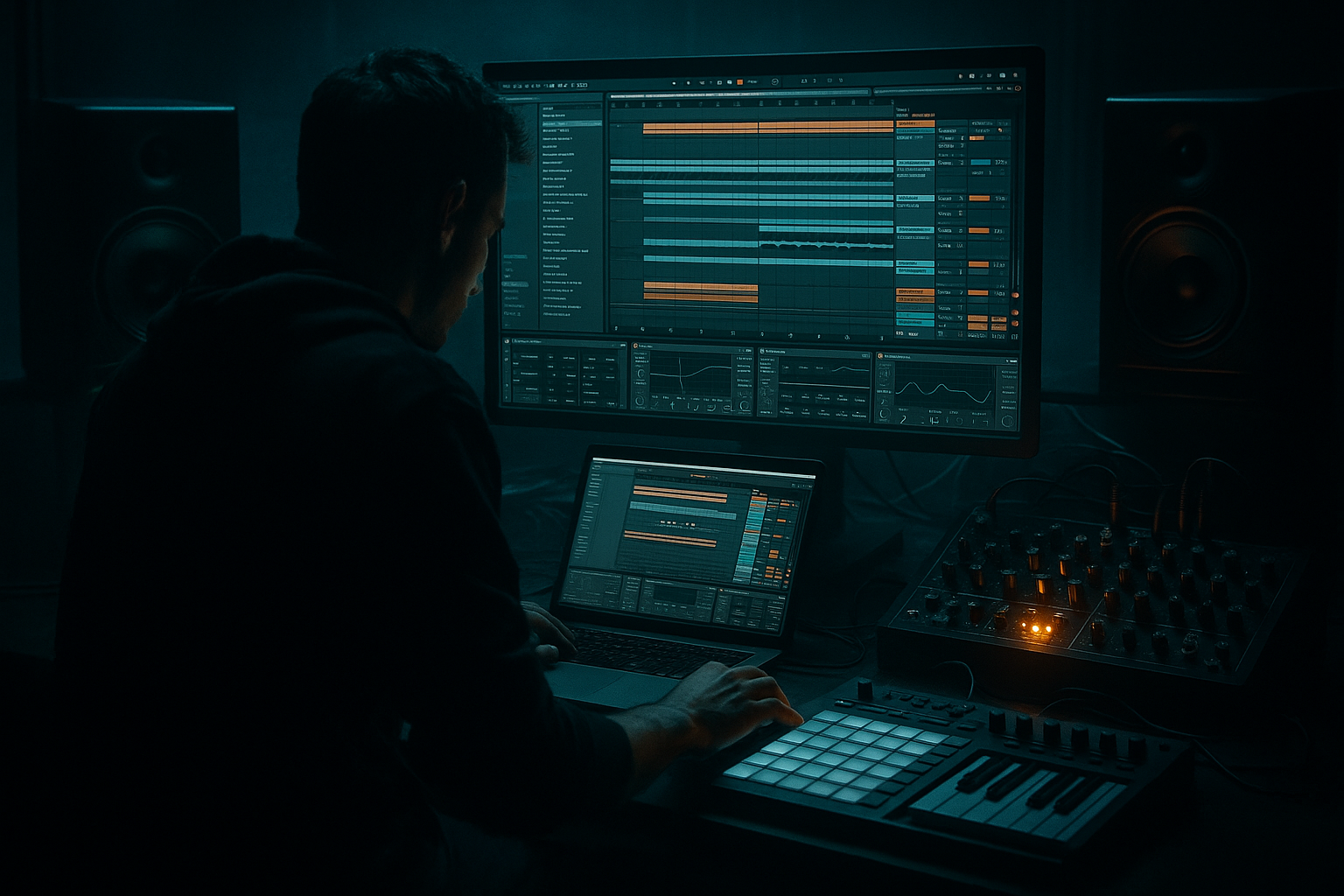
Main tutorial
Widen Oldskool DnB Amen Variation for Warm Tape-Style Grit (Ableton Live 12) 🎛️🥁
1. Lesson overview
In this lesson you’ll take an oldskool Amen break variation and push it into that wide, gritty, “rinsed-to-tape” jungle/DnB space—without losing the punch in mono. The core technique is resampling: you’ll print a few “versions” of the break (center/punch, wide/grit, and crushed-room) and then layer + arrange them like a proper roller.
You’ll do this using stock Ableton Live 12 devices: Drum Rack / Simpler, Saturator, Roar, Echo, Hybrid Reverb, Chorus-Ensemble, Utility, Glue Compressor, Drum Buss, and resampling workflows.
---
2. What you will build
A 3-layer Amen system:
- Amen Core (Mono Punch): tight transient, solid kick/snare center
- Amen Width (Tape Grit + Stereo): widened top/room with tape-style dirt
- Amen Crush Room (Parallel Character): dark, smashed ambience for energy and movement
- `AMEN_CORE`
- `AMEN_WIDTH`
- `AMEN_CRUSH`
- Solo and record each layer separately:
- 2-bar call/response: Bar 1 straight roller, bar 2 add a tiny fill (snare drag / extra ghost)
- Turnaround on bar 4/8/16:
- A/B width automation:
- Widening the low end: If anything under ~150–250 Hz is stereo-heavy, your break loses impact and can phase out in mono.
- Too much chorus: Makes hats “swim” and smears transients. Keep modulation slow and low.
- Over-saturating before EQ: Dirt exaggerates ugly frequencies. Carve first, then saturate, then final shape.
- Crush layer too loud: It should add urgency and room, not sound like a reverb loop taking over.
- Not resampling movement: If you never print a performed pass, your loop can feel static and “plugin-perfect”.
- Make the width darker: Low-pass the width layer around 8–10 kHz and let the core carry the snap. Dark width = bigger, heavier.
- Transient integrity trick: Keep `AMEN_CORE` mono and slightly louder than you think. Wide layers should “wrap around” it.
- Ghost note grit: Push Roar/Saturator until ghost notes become audible texture—then back off 10%.
- Slam fills only: Automate the crush layer up only on bar 4/8 ends. That’s how you get hype without constant wash.
- Reese + Amen relationship: If you’ve got a rolling reese, cut some 200–350 Hz in the reese or the break won’t punch. Let snare body live.
- You built a mono-punch core + stereo tape-grit width + crushed room texture.
- You used stock Ableton devices to create controlled width and warm saturation.
- You resampled performed processing to get authentic movement and character.
- You chopped the resample into a playable Amen kit and arranged it like real jungle/DnB.
Then you’ll resample these layers into new audio and create arrangement-ready variations (fills, stutters, turnarounds) that feel authentic in jungle / rolling DnB.
---
3. Step-by-step walkthrough
Step 0 — Prep: get an Amen that’s already “moving” 🔥
1. Drop your Amen loop onto an audio track.
2. Warp:
- Mode: Beats
- Preserve: Transients
- Turn on Transient Loop Mode if it helps keep the snap.
3. Set project tempo typical to oldskool/roller: 170–174 BPM.
4. Consolidate to a clean loop length:
- Select exactly 2 or 4 bars → Cmd/Ctrl + J.
DnB reality check: If the Amen is too clean, it won’t “take” widening and tape grit the same way. A little grime is good.
---
Step 1 — Create 3 return-style layers using audio tracks (fast + flexible)
Duplicate the Amen track twice so you have:
Group them (`Cmd/Ctrl + G`) as AMEN_BUS.
---
Step 2 — Build the core (mono punch that anchors the groove) 🧱
On `AMEN_CORE`:
Device chain (in order):
1. EQ Eight
- HP filter: 24 dB, around 30–40 Hz (clean rumble)
- Small dip: 250–400 Hz if boxy (–2 to –4 dB, Q ~1.2)
- Optional: tiny presence lift around 3–5 kHz (+1–2 dB) if needed
2. Drum Buss
- Drive: 5–15%
- Crunch: 10–25%
- Boom: 0 (usually let the bass handle sub)
- Damp: adjust so hats aren’t harsh
3. Glue Compressor
- Attack: 10 ms
- Release: Auto (or 0.3s if you want it to pump)
- Ratio: 2:1
- Aim for 1–3 dB gain reduction on peaks
4. Utility
- Width: 0% (yes: hard mono)
- Gain: trim so this layer peaks nicely (leave headroom)
Why: Your width layer can get wild. The core stays centered so the drop still punches in clubs and on mono playback.
---
Step 3 — Build the width layer (tape grit + stereo excitement) 🌪️
On `AMEN_WIDTH`:
A) Carve it so it doesn’t fight the core
1. EQ Eight
- HP filter: 150–250 Hz (get lows out of the width layer)
- Small notch around 200–500 Hz if it clouds the snare body
B) Add “tape-ish” harmonics
2. Saturator
- Type: Soft Sine (warm) or Analog Clip (harder jungle edge)
- Drive: 3–8 dB
- Soft Clip: On
- Output: trim to match level
3. Roar (for that modern “tape/amp” dirt, but controlled)
- Choose a warmer preset as a start (e.g., Subtle Drive style)
- Drive: low to medium (you’re adding hair, not destroying)
- Tone: slightly darker (roll a bit of top if it fizzes)
- Mix: 20–50% (parallel inside Roar keeps punch)
C) Create width without wrecking mono
4. Chorus-Ensemble
- Mode: Chorus
- Rate: 0.15–0.35 Hz (slow)
- Amount: 10–25%
- Width: 120–160%
- Mix: 10–25%
- Keep it subtle—this is “spread”, not seasickness.
5. Echo (micro-stereo slap = classic space)
- Time: 1/64 or 1/32
- Feedback: 0–12%
- Modulation: small
- Filter: HP around 300–600 Hz, LP around 6–10 kHz
- Mix: 5–15%
6. Utility
- Width: 120–170% (start 130%)
- Bass Mono: enable if available (or manually keep lows filtered)
Checkpoint: Hit a mono check (Utility Width to 0% on your AMEN_BUS temporarily). If the snare vanishes, you’ve widened too much or you’re widening too low in frequency.
---
Step 4 — Build the crushed room layer (parallel “rave air”) 🏭
On `AMEN_CRUSH`:
1. EQ Eight
- HP: 250–400 Hz
- Optional LP: 8–12 kHz (keep it dark)
2. Hybrid Reverb
- Algo: Room / Ambience
- Decay: 0.3–0.8s (short! jungle rooms are tight)
- Predelay: 0–10 ms
- Size: medium
- Mix: 30–60% (it’s a dedicated ambience layer)
3. Glue Compressor (smash it)
- Attack: 1–3 ms
- Release: 0.1–0.3s
- Ratio: 4:1 or 10:1
- Push for 5–10 dB GR
4. Saturator
- Drive: 5–12 dB
- Soft Clip: On
5. Utility
- Width: 140–200%
- Gain: keep it quiet. This layer is “felt”, not obvious.
---
Step 5 — Bus it like a record (AMEN_BUS glue + tape feel) 🎚️
On the AMEN_BUS group:
1. EQ Eight
- Gentle HP at 25–35 Hz
- Tiny dip if harsh around 6–8 kHz (depends on source)
2. Roar or Saturator (choose one—don’t stack blindly)
- If Roar: keep it subtle, Mix 10–30%
- If Saturator: Drive 1–4 dB for glue
3. Glue Compressor
- Attack: 10 ms
- Release: Auto
- Ratio: 2:1
- GR: 1–2 dB (light glue)
4. Limiter (optional safety)
- Just catching peaks, not flattening the life.
---
Step 6 — Resample: print variations (this is the lesson’s core) 🧪➡️🎞️
Now you’ll commit each “version” so you can chop, reverse, stutter, and arrange like classic sampled jungle.
Option A: Quick resample to audio
1. Create a new audio track: `AMEN_RESAMPLE`.
2. Set its input to Resampling.
3. Arm it.
4. Solo the AMEN_BUS and record 8–16 bars of your loop while you tweak:
- Slight changes to Chorus amount
- Roar mix
- Echo mix
- Crush layer gain rides
You’ve just “performed” your tape/widening pass. This creates natural movement like older resampled breaks.
Option B: Print stems (recommended)
- `CORE_PRINT`
- `WIDTH_PRINT`
- `CRUSH_PRINT`
This makes later balance and fills much easier.
---
Step 7 — Chop + arrange like oldskool DnB 🧬
1. Take `AMEN_RESAMPLE` and Slice to New MIDI Track:
- Right-click clip → Slice to New MIDI Track
- Slice preset: Transient (or 1/16 if it’s super steady)
2. In the new Drum Rack:
- Put Simpler in One-Shot mode for each slice
- Adjust Start points to tighten kicks/snares
- Add subtle per-pad Pitch tweaks for variation
Arrangement ideas (authentic jungle moves):
- Reverse one slice (Cmd/Ctrl + R on the audio inside Simpler or reverse the clip)
- Add a 1/32 Echo flick at the end
- Verse: width layer –6 dB, less chorus
- Drop: bring width layer up +2–4 dB, slightly more Echo
---
4. Common mistakes ❌
---
5. Pro tips for darker/heavier DnB 🕶️
---
6. Mini practice exercise 📝
Goal: Create 3 resampled Amen variants you can swap in an arrangement.
1. Build the 3-layer system above.
2. Record 16 bars of resample while you:
- automate `AMEN_WIDTH` Utility Width from 120% → 160% across 8 bars
- automate Echo Mix 5% → 12% for the last 2 beats of every 4th bar
3. Print three passes:
- Pass 1: cleaner (less Roar)
- Pass 2: heavier (more Roar + slightly more crush)
- Pass 3: darker (LPF the width layer to ~8 kHz)
4. Slice each pass and program a 32-bar drum arrangement:
- 1–16: pass 1 (intro/roll-in)
- 17–32: pass 2 (drop)
- Use pass 3 for turnarounds/fills
---
7. Recap ✅
If you want, tell me the vibe you’re aiming for (’94 metalheadz roller, ragga jungle, techstep-y darkness, modern foghorn + amen), and I’ll suggest a tighter device chain and automation plan for that specific flavor.

