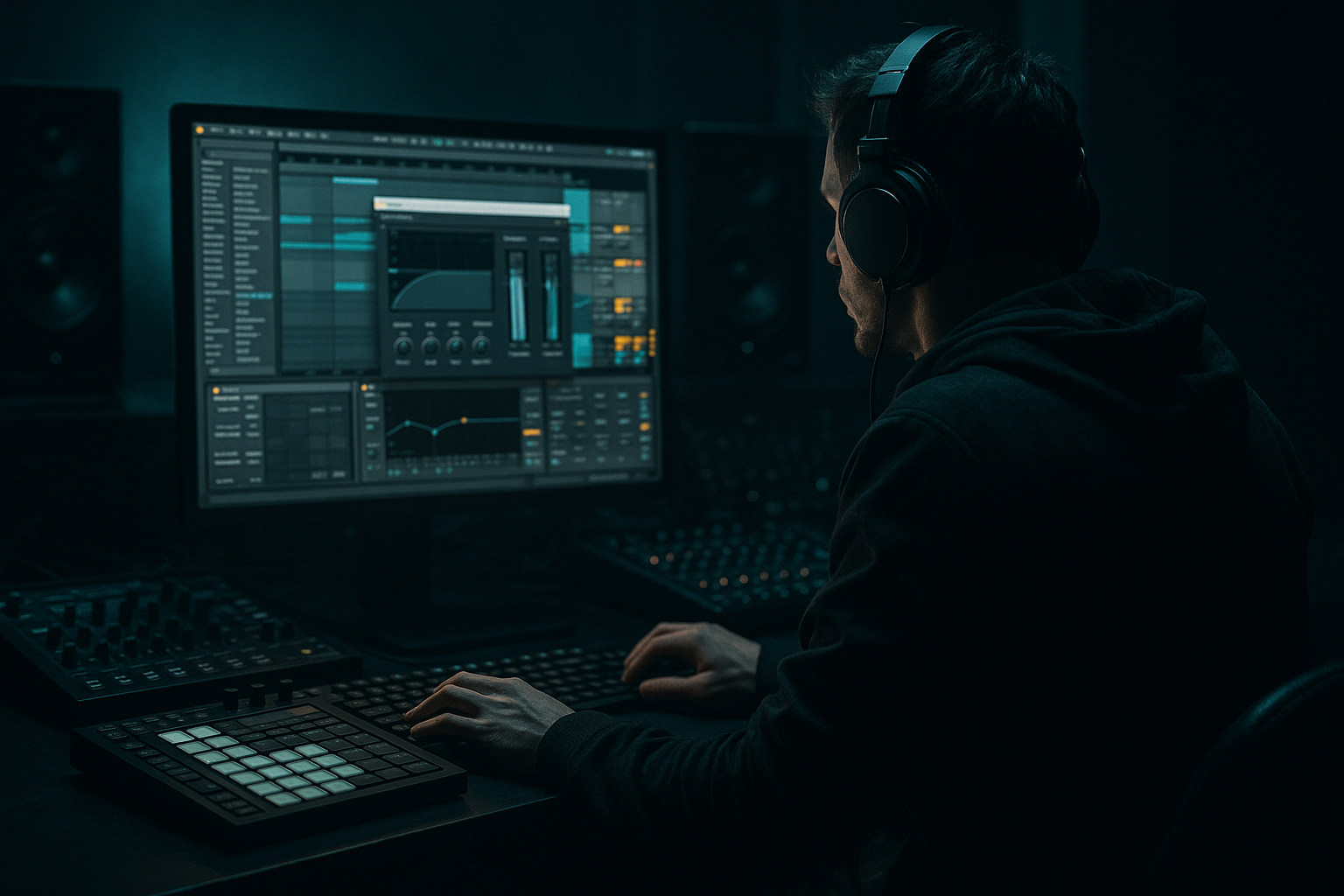
Main tutorial
Lesson Overview
This lesson is about building a drop workflow in Ableton Live 12 that stays punchy, loud enough, and headroom-safe while keeping the raw energy of oldskool jungle, ragga-flavoured DnB, rollers, and darker bass music. The goal is not just “make it hit harder” — it’s to design the drop so it lands with impact without eating the mix before the first bar is even done.
In DnB, that matters because your drop usually has:
- a heavy sub + mid bass relationship
- breakbeat transients that need space
- ragga vocal chops / skank FX / dub-style stabs
- quick arrangement changes that can cause level spikes fast
- a tight breakbeat with ghost notes and chopped edits
- a sub bass foundation that stays mono and controlled
- a ragga vocal call-and-response layer that sits in the gaps
- a mid-bass / reese support layer that adds movement without masking the kick/snare
- FX transitions that signal phrase changes without making the master clip
- a headroom-safe drum/bass balance designed for future arrangement and final mixdown
- Piling too much sub and low-mid bass together
- Letting the break and kick fight for transient space
- Using wide effects on everything
- Over-processing ragga vocals until they lose rhythm
- Automating only volume
- Checking headroom only at the end
- Use saturation to imply loudness
- Keep sub clean, make the midrange ugly
- Resample distortion into audio
- Let the ragga vocal be a rhythmic weapon
- Use tiny drop-out moments
- Keep the reese moving but not everywhere
- Build the drop in layers and phrases, not as one giant loud section.
- Keep sub mono, simple, and controlled.
- Let the breakbeat and snare drive the energy, with bass supporting the groove.
- Use ragga vocals as rhythmic call-and-response, not constant clutter.
- Automate density, filters, and sends instead of just turning everything up.
- Watch headroom from the start so your drop stays punchy, loud, and mixable.
If you build the drop blindly, your master can peak early, your low end can smear, and your break can lose its snap. This lesson shows you how to prepare the drop in sections, control energy with routing and bus gain discipline, and use Ableton stock devices to keep the mix open while the drop still feels aggressive. ⚡
You’ll work with a practical DnB approach: arrange the drop in layers, keep sub in check, use saturation instead of pure level for energy, and automate density rather than just volume.
What You Will Build
You’ll build a 16-bar jungle/DnB drop section with:
By the end, your drop will feel like a proper oldskool DnB switch-up: tense intro, strong first impact, and enough mix space to keep evolving into the next 16 or 32 bars.
Step-by-Step Walkthrough
1. Set up a clean drop framework before adding any sound
In Ableton Live 12, start with a simple arrangement strategy:
- Put the drop at bar 33 or bar 65 so you have a clean build and a DJ-friendly intro.
- Create groups for Drums, Bass, Vocals/Ragga FX, and Atmos/Transitions.
- On the Master, leave headroom from the start. Aim for your loudest drop section to peak around -6 dB to -3 dB before mastering.
Add a Utility on your Master early and turn on Mono temporarily while designing the low end. This helps you hear if your sub and kick relationship is actually solid or just wide and flattering.
Why this works in DnB: fast music exposes bad gain staging immediately. If the first drop already overshoots, every later switch-up will be harder to control.
2. Build the drum core around the break, not around the bass
Start with a classic jungle approach: a breakbeat as the rhythmic engine, then layer your modern kick/snare support.
Use:
- Drum Rack for chopped break slices
- Simpler in Slice mode if you want quick break re-editing
- EQ Eight on the break group
- Compressor or Glue Compressor lightly on the drum bus
Practical settings:
- High-pass the break group around 30–40 Hz to clear useless rumble
- If the break is too boxy, dip 200–400 Hz by 2–4 dB
- Use Glue Compressor on the drum bus with a gentle 2:1 ratio, 1–2 dB gain reduction, slow-ish attack if you want transients to pop
For oldskool flavour, let the break keep some rawness. Don’t over-quantise every slice. Keep a little shuffle and ghost-note messiness so it breathes like real jungle.
Add a supporting kick and snare if needed, but don’t let them fight the break. In many DnB drops, the break provides the character, and the reinforced kick/snare just make the punch obvious on club systems.
3. Program the sub so it supports the groove instead of dominating it
Create a dedicated sub track with:
- Operator or Wavetable
- a simple sine or near-sine waveform
- Utility at the end for mono control
- Saturator before Utility if you need harmonics
Keep the sub brutally simple:
- Low-pass it around 80–120 Hz if you’re layering mid bass above it
- Keep it mono
- Avoid wide effects on the sub channel
- Use short note lengths for bounce, or slightly longer notes for rollers
In oldskool/jungle contexts, the sub often answers the break rather than droning constantly. Try a call-and-response phrasing: let the sub hit on the downbeat, then leave gaps for ragga chops or drum fills.
Concrete programming idea:
- Bar 1: sub hits on 1
- Bar 2: sub answers on 1, then a shorter pickup on 3+
- Bar 3–4: drop out a couple of sub notes to make room for a vocal stab or snare fill
This keeps the drop breathing while still sounding heavy.
4. Design the bass layer with movement, not raw volume
For the mid bass or reese layer, use Wavetable, Analog, or even a resampled bass in Simpler. The job here is not to replace the sub — it’s to create texture, presence, and motion.
Suggested workflow:
- Build a 1-bar reese or ragga-style bass phrase
- Make it slightly different every 4 bars
- Use Auto Filter, LFO, or Shaper-style modulation via Ableton’s stock modulation tools available in Live 12 where appropriate
- Add Saturator or Overdrive for grit, but keep an eye on peaks
Good starting settings:
- Auto Filter low-pass around 120–250 Hz for darker movement
- LFO/modulation amount subtle: enough to move, not wobble uncontrollably
- Saturator Drive around 2–6 dB
- If the bass is too wide, reduce stereo width with Utility or keep the bass mono below 120 Hz
For ragga elements, you can use the bass to “answer” a chopped vocal. Example:
- Vocal says a short phrase on bar 1
- Reese answers with a rising filter move on bar 2
- Drop back to drums-only for half a bar before the next vocal hit
That classic call-and-response structure is very jungle-friendly and stops the drop from becoming a wall of sound.
5. Create the ragga vocal layer as arrangement glue, not a full-time lead
In this category, the ragga element should act like a rhythmic hook rather than a constant melody. Use short chops, one-shots, or spoken phrases to punctuate the drop.
Place vocals on their own track and process them with:
- Simpler for quick slicing and re-triggering
- Echo for short dub delays
- Reverb sparingly for space
- EQ Eight to remove low-end buildup
- Auto Filter for transition sweeps
Practical ranges:
- High-pass vocals around 120–180 Hz
- Delay feedback around 15–30%
- Reverb decay around 0.8–1.8 seconds for compact space
- Keep vocal level lower than you think; ragga chops should cut through the groove, not sit on top of the whole mix
Arrangement idea:
- Use the vocal only in the first 8 bars
- Then remove it for 4 bars so the drums and bass feel bigger
- Bring it back for a final 2-bar switch-up before the next phrase
This “appear, disappear, return” approach is especially effective in jungle and oldskool DnB because it keeps the drop alive without overcrowding the low end.
6. Shape headroom with bus gain, not just master limiting
This is the core of the lesson. Don’t wait until the master to fix gain issues. Control levels at the source and on buses.
Here’s the workflow:
- Put each major group at a sensible level before any master processing
- Use Utility on individual tracks to trim gain instead of slamming clip gain indirectly
- Keep your drum group and bass group balanced against each other
- Avoid stacking too many loud devices that each add output gain
A good practical target:
- Drums should feel strong, but not annihilate the bass
- Bass should be present without overpowering the snare transient
- Ragga vocal chops should add character without forcing the master up
If needed, use Compressor sidechained from the kick/snare to the bass lightly:
- Ratio: 2:1 to 4:1
- Attack: 5–20 ms
- Release: 60–120 ms
- Gain reduction: just 1–3 dB
That small amount of movement is often enough to create space without the obvious pumping that can ruin an oldskool jungle groove.
7. Automate energy by density and texture, not by volume ramps alone
A big reason drops lose headroom is that producers keep turning things up as the arrangement progresses. Instead, automate density, filter openness, and FX intensity.
In Ableton, automate:
- Auto Filter cutoff on bass and FX layers
- Saturator Drive for section emphasis
- Echo feedback for fills before bar changes
- Return track send levels for dub-style delays
- Drum variation lanes or extra slice triggers in the second half of the drop
Smart arrangement example:
- Bars 1–4: main groove, full drum/bass foundation
- Bars 5–8: add ragga chop, open bass filter slightly
- Bars 9–12: pull out one drum layer, bring in a fill or reverse FX
- Bars 13–16: final switch-up with a snare fill, vocal stab, or extra break edit
This keeps the drop feeling like it’s evolving while maintaining headroom. If everything gets louder every 4 bars, you’ll run out of mix space fast.
8. Use resampling to lock in the groove and control chaos
Once the drop skeleton is working, resample parts of it. This is very useful in jungle and darker DnB because it lets you capture an evolving loop and commit to a musical idea.
Workflow:
- Resample the bass + vocal response for 8 bars
- Bounce a drum loop with fills included
- Re-import the audio into Simpler or onto an audio track
- Chop the best moments and mute the weaker ones
This helps you:
- preserve the feel of a real drop
- avoid endless tweaking
- control peak levels more easily
- create oldskool-style edits that feel deliberate
If your re-sampled audio is too hot, trim it with Utility or reduce clip gain before doing anything else. A lot of “headroom problems” are just untrimmed audio, not bad sound design.
9. Finish the drop with DJ-friendly phrasing and controlled exits
Even a brutal drop needs shape. In DnB, that means planning how it enters, sustains, and exits.
Build the last 4 bars so they create forward motion:
- Add a snare fill
- Strip the sub for half a bar
- Use a short Reverse Cymbal or Noise Sweep
- Let the ragga vocal hit once more before the next section
For DJ-friendly structure:
- Keep intro/outro sections stripped enough to mix
- Avoid huge full-spectrum FX right on the mix point
- Leave space for another tune to blend in later
The drop should feel intense, but the track still needs utility. A good jungle tune is not just a sound design exercise — it’s a record that can move in a DJ set.
Common Mistakes
- Fix: keep one track responsible for true sub and another for movement/harmonics.
- Fix: use EQ, timing edits, or light compression on the drum bus. Don’t just turn them up.
- Fix: keep low end mono, and reserve width for mids, atmospheres, and FX tails.
- Fix: treat vocals like percussion. Shorter delays and tighter filtering usually work better.
- Fix: automate filter cutoff, saturation, send levels, and arrangement density instead.
- Fix: monitor levels during writing. If the drop is clipping before arrangement is even done, the balance is already wrong.
Pro Tips for Darker / Heavier DnB
- A little Saturator drive on bass or drum buses often feels heavier than simply raising faders.
- Darker DnB often works best when the sub is controlled and the character lives in the 200 Hz–3 kHz area.
- Once your bass is right, print it. Audio edits often feel more authentic and less “synthetic plugin loop” than endlessly modulated MIDI.
- Short, chopped phrases with delay throws can make a drop feel like classic sound system energy without cluttering the arrangement.
- Even a half-bar of reduced density before a snare hit can make the next impact feel huge without adding level.
- Movement in one section and restraint in another creates contrast. Contrast is what makes oldskool/jungle drops feel alive.
Mini Practice Exercise
Spend 10–20 minutes building a 4-bar drop loop in Ableton Live 12:
1. Make a breakbeat drum loop with one chop variation every bar.
2. Add a mono sub using Operator with one or two notes per bar.
3. Layer a mid reese that only plays in the gaps between snare hits.
4. Add one ragga vocal chop as a call-and-response phrase.
5. Put Utility on the Master and check the mix in mono.
6. Adjust until the loudest moment stays controlled and the groove still feels aggressive.
7. Then duplicate the loop to 8 bars and remove one element for a switch-up.
Goal: make it feel like a proper DnB drop without needing the master to rescue it.

