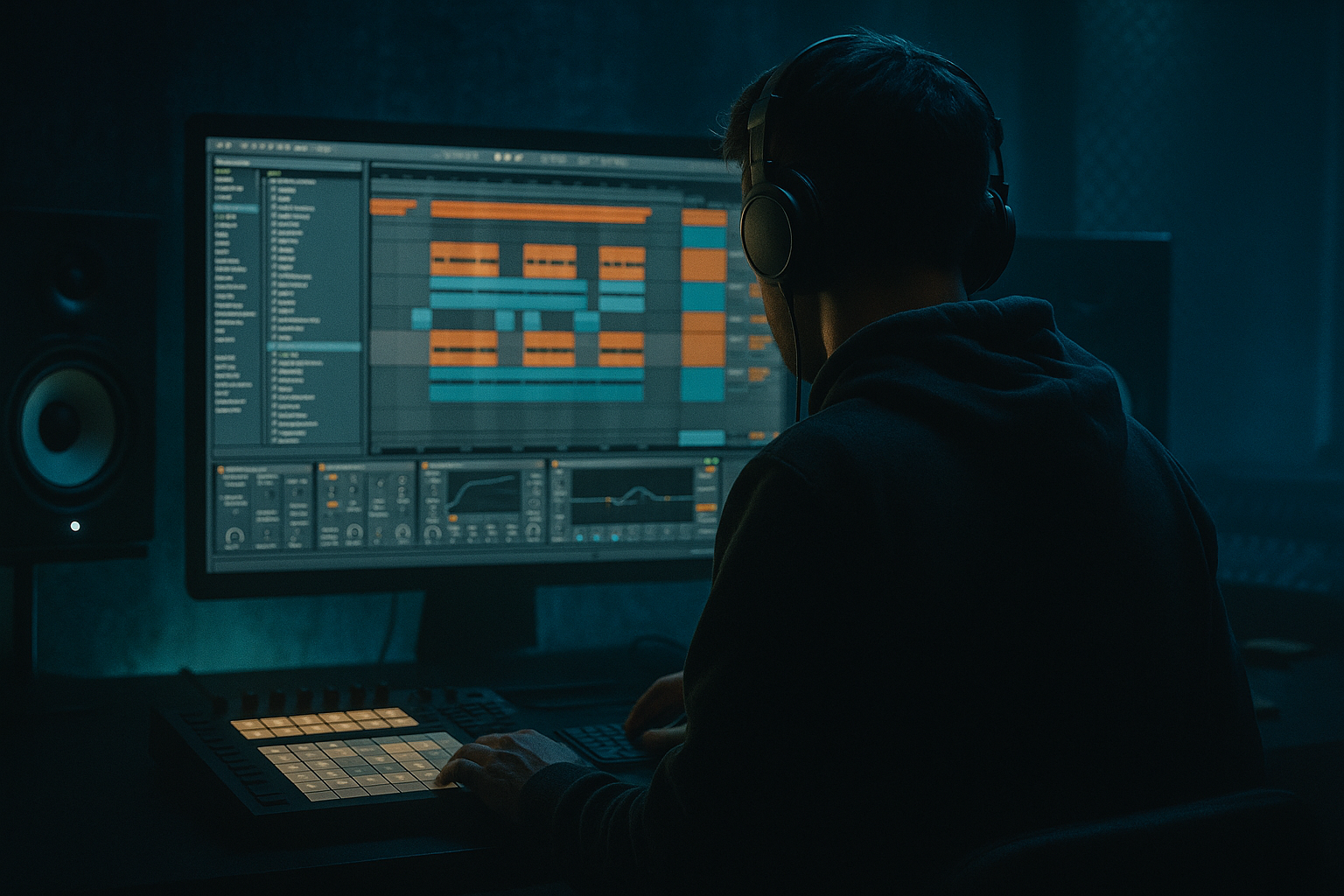
Main tutorial
```markdown
Workflow for Transition: Sunrise-Set Emotion in Ableton Live 12 (Oldskool Jungle / DnB Vibes) 🌅🥁
1) Lesson overview
This lesson is about building emotionally uplifting transitions—the kind you’d hear in a sunrise jungle/DnB set—using Ableton Live 12 as a DJ/production hybrid tool. You’ll learn a repeatable workflow to move from a darker rolling section into a warm, hopeful, airy “sunrise” drop, while staying rooted in oldskool jungle DNA: breaks, pads, dubby FX, and tasteful filtering.
You’re intermediate, so we’ll work fast and practical: device chains, automation lanes, arrangement markers, and performance controls you can reuse.
---
2) What you will build
A 64-bar transition block you can drop between tunes/sections:
- Start (Bars 1–16): rolling break + bass, darker tone
- Lift (Bars 17–32): energy thins, pads and atmos open up, tension builds
- Riser + “sunlight” moment (Bars 33–48): emotional chord/pad, vocal texture, brighter top
- Landing (Bars 49–64): back into the groove—but with a warmer palette
- A “Transition Bus” rack for quick control 🎛️
- Automation templates for filter → stereo → reverb → texture
- A sunrise-style pad + reese blend that still feels jungle
- Return A (DUB VERB): Hybrid Reverb
- Return B (TAPE ECHO): Echo
- Set each group’s Audio To → TRANSITION BUS
- Set `TRANSITION BUS → Master`
- Band 1 HP: 24 dB/oct @ 25–30 Hz (clean sub rumble)
- Gentle dip: -1 to -2 dB @ 250–350 Hz (mud control)
- Optional air: +1 dB shelf @ 10 kHz (only later in the transition)
- Type: Lowpass
- Slope: 24 dB
- Resonance: 0.70–1.10 (don’t over-squeal)
- Drive: 2–6% (for warmth)
- Attack: 10 ms
- Release: Auto
- Ratio: 2:1
- Aim: 1–2 dB gain reduction during loudest moments
- Width automation target: 80% → 115% during “sunrise”
- Gain for quick -1 to -3 dB dips during impact moments
- HP filter on drums rises from ~50 Hz → 180–250 Hz
- Reduce break level by -2 to -5 dB over 8–16 bars
- Send a snare hit or ghost hits to DUB VERB more heavily near bar 32
- Automate a low shelf or HP:
- Mode: Analog Clip
- Drive: 2–5 dB
- Soft Clip: On
- Width: 0% for sub-focused bass sections
- During the “Lift,” you can widen only the mid using a rack (optional), but keep true sub mono.
- Bars 17–32: gradually reduce sub (HP up) while increasing Saturator Drive slightly (+1–2 dB) so the bass doesn’t vanish, it just feels lighter.
- Osc 1: Sine / Triangle-based wavetable (smooth)
- Osc 2: subtle detune (or off)
- Voices: 6–8
- Unison Amount: 10–20%
- Filter: LP with gentle envelope
- For instant “uplift”: try +7 and +12 (5th + octave)
- Decay: 6–10s
- Low Cut: 250 Hz
- High Cut: 8–10 kHz
- Mix: 15–25% (or use send instead)
- Amount: 15–25%
- Rate: 1/2 or 1 bar (slow drift)
- In A minor vibe: Am → F → G → Em (simple, emotional, not too pop)
- Keep notes long: 2 bars each.
- Filter: LP
- Drive: small
- Add Vinyl Distortion very lightly (Tracing Model):
- Freq: 800 Hz – 3 kHz
- Resonance: 0.8
- Time: 3/16 (classic rolling feel)
- Feedback: 35–55%
- Decay: 8–12s
- Predelay: 25ms
- HP: 150–250 Hz
- Dip harshness: -2 dB @ 2.5–4 kHz if needed
- Short vocal phrase, timestretched, heavily wet
- Jungle ambience: rain, crowd, nature field recordings
- A single stab hit resampled and smeared into a pad
- Bring these in quietly at bar 17
- At bar 33, widen + increase wetness for “sunrise bloom”
- At bar 49, tuck them back under the groove
- `TRANSITION BUS → Auto Filter cutoff`: slowly down (darker/underwater) OR up (opening) depending on your narrative
- `DRUMS HP`: up to 200 Hz
- `BASS HP`: up to 80–110 Hz
- Reverb send: increase on snares + vox
- Master/Bus width: 80% → 95%
- Bring in SUNRISE PAD (full, wide)
- `TRANSITION BUS width`: 95% → 115%
- Add a crash/ride wash quietly (or filtered break top)
- Short tape stop / downlifter optional: use Shifter or resample for authentic vibe
- Reintroduce sub: `BASS HP` back down to 30–40 Hz
- Bring drums back from HP to full range
- Reduce reverb tail to avoid washing the groove
- Tighten stereo: width back to 100% so it punches
- Arranged (automation) ✅
- Improvised (macros) ✅
- Replace airy pad with a dissonant reese layer filtered up, then slam back:
- Use Drum Bus on drums (light):
- Make the “sunrise” moment more menacing:
- Add gated reverb snare moment for impact:
- Use sidechain compression on pads/atmos from kick/snare (Glue Comp or Compressor):
- You built a sunrise transition workflow that feels like a DJ set move—but inside Ableton Live 12.
- Key concept: remove weight → introduce air/emotion → return with punch.
- Core tools: Auto Filter, EQ Eight, Hybrid Reverb, Echo, Utility, Glue Compressor.
- The magic is contrast + automation + a memorable “event” (mute, stab, tail, or vocal ghost).
You’ll end with:
---
3) Step-by-step walkthrough
Step 0 — Session setup (fast but important)
1. Tempo: 165–170 BPM (classic jungle feel). Try 168 BPM.
2. Time markers: In Arrangement View, drop locators at:
- 1 “Dark Roll”
- 17 “Lift”
- 33 “Riser/Emotion”
- 49 “Return Groove”
3. Group your core elements:
- `DRUMS (Breaks)`
- `BASS`
- `MUSIC (Pads/Keys)`
- `FX / VOX`
4. Create a Return track:
- Return A: `DUB VERB`
- Return B: `TAPE ECHO`
Suggested Return settings (stock devices):
- Mode: Hall or Plate
- Decay: 4.5–7s
- Predelay: 18–30ms
- High Cut: 7–10 kHz
- Low Cut: 180–300 Hz
- Time: 1/4 or 3/16
- Feedback: 25–45%
- Filter: HP around 250 Hz, LP around 7–9 kHz
- Mod: subtle (5–10%)
---
Step 1 — Build a “Transition Bus” for DJ-style control 🎚️
Create a new Audio Track named `TRANSITION BUS` and route your groups into it:
On `TRANSITION BUS`, load this chain:
1) EQ Eight (pre-tone control)
2) Auto Filter (your main “DJ” filter sweep)
3) Glue Compressor (cohesion)
4) Utility (stereo + gain moves)
Why this matters: You now have a single lane to “DJ mix” your own arrangement like a set, with clean, controllable emotional movement.
---
Step 2 — Drums: thin the break, then reintroduce with sparkle 🥁
Oldskool transitions feel great when the break “backs off” then returns crisp.
On your DRUMS group:
1. Add Auto Filter
- Highpass
- 12 dB slope
- Start around 40–60 Hz
2. Add Redux (very subtle texture, optional)
- Downsample: 1.05–1.20
- Bit Reduction: 0 or 1
Keep it barely audible—this is “crunch air,” not destruction.
Automation idea (Bars 17–32):
Classic jungle move:
At bar 32, do a 1-beat break mute (or just kick+bass mute) and let reverb tail carry the listener into the emotional section. ✨
---
Step 3 — Bass: remove weight, add warmth, then bring it back clean 🔊
Sunrise transitions often remove sub first (so the “return” feels huge), while adding harmonic warmth in the midrange.
On BASS group:
1) EQ Eight
- If HP: start 30–40 Hz, rise up to 80–110 Hz by bar 32
2) Saturator
3) Utility (mono management)
Automation idea:
---
Step 4 — The “Sunrise” musical layer: pads + rave chord memory 🌅🎹
You want emotion without turning it into cheesy EDM. The oldskool way is simple chord movement + atmosphere, often with minor-to-relative-major hints.
#### Option A (Stock + fast): Wavetable pad
Create a MIDI track `SUNRISE PAD`:
Device chain:
1) Wavetable
2) Chord (MIDI effect)
Or keep it more soulful: +3 and +7 (minor triad-ish color)
3) Hybrid Reverb
4) Auto Pan
Chord progression idea (jungle-friendly):
#### Option B (More oldskool): sampled pad + filter
Drop a pad sample into Simpler (Classic mode):
- Drive: 0.5–1.5
- Crackle: 0–5%
---
Step 5 — Add “air” with jungle atmos + vocal ghosts ☁️🗣️
This is where sunrise emotion really lives.
Create `ATMOS / VOX` track:
Chain:
1) Auto Filter (Bandpass)
2) Echo
3) Hybrid Reverb
4) EQ Eight
Source ideas:
Arrangement trick:
---
Step 6 — The transition automation recipe (copy/paste template)
Here’s a reliable 32-bar automation arc you can reuse:
Bars 17–32 (“Lift”):
- Sunrise style often: open the highs gradually, but reduce sub first.
Bars 33–48 (“Emotion / Bloom”):
Bars 49–64 (“Return Groove”):
---
Step 7 — Make it performable (DJ Tools mindset) 🎛️
Map 6–8 key macros so you can “play” the transition:
Create an Audio Effect Rack on `TRANSITION BUS` and map:
1. Filter Cutoff (Auto Filter)
2. Filter Resonance
3. Reverb Send Amount (A) (map via track send or rack w/ External Audio Effect workaround; easiest is manual automation, but mapping is doable with Macro variations)
4. Echo Send Amount (B)
5. Width (Utility)
6. Bus Gain (Utility)
7. Pad Level (track volume)
8. Vox/Atmos Level (track volume)
Now your sunrise transition can be:
---
4) Common mistakes (and how to avoid them)
1. Too much reverb on sub/bass
- Always HP your reverbs (200–300 Hz) or use sends with EQ.
2. Over-filtering the entire mix
- If everything is filtered, you lose contrast. Filter drums/bass differently.
3. Stereo-widening the low end
- Keep sub mono. Use width mainly on pads, atmos, tops.
4. Transition has no “event”
- Add a moment: 1-beat mute, vocal stab, reversed crash, or a single clean chord hit.
5. Pads fight the break
- Carve space: dip pad around 200–400 Hz, and keep pad transients soft.
---
5) Pro tips for darker/heavier DnB (same workflow, tougher energy) 🖤⚙️
- Use Roar (Ableton 12) for controlled aggression:
- Drive moderate, focus mid harmonics, keep sub separate.
- Drive 2–6%, Boom 0–10% (careful), Damp to taste.
- Minor 2nd tension notes, detuned strings, distant vocal adlibs.
- Put a Gate after reverb on a snare send, time it rhythmically (1/8 or 1/16 feel).
- Ratio 2:1, fast attack, release timed to groove.
---
6) Mini practice exercise (20 minutes) ⏱️
1. Pick an oldskool break (Amen-ish or tight 2-step) and a reese bass.
2. Build a 64-bar loop with locators at 1/17/33/49.
3. Add `TRANSITION BUS` chain: EQ Eight → Auto Filter → Glue → Utility.
4. Automate:
- Drums HP up from bar 17 to 32
- Bass HP up from bar 17 to 32
- Pad enters at bar 33 with reverb bloom
- Full groove returns at bar 49 with sub restored
5. Bounce a quick render and listen on low volume:
- Does the emotion read without losing the beat identity?
Bonus: Do a second version where the “sunrise” is more subtle (less pad, more atmos + chord stab).
---
7) Recap
If you want, tell me your target vibe (LTJ Bukem-style liquid sunrise vs. ragga jungle vs. dark roller into uplift) and I’ll tailor a specific chord palette + break edit strategy for it.
```

