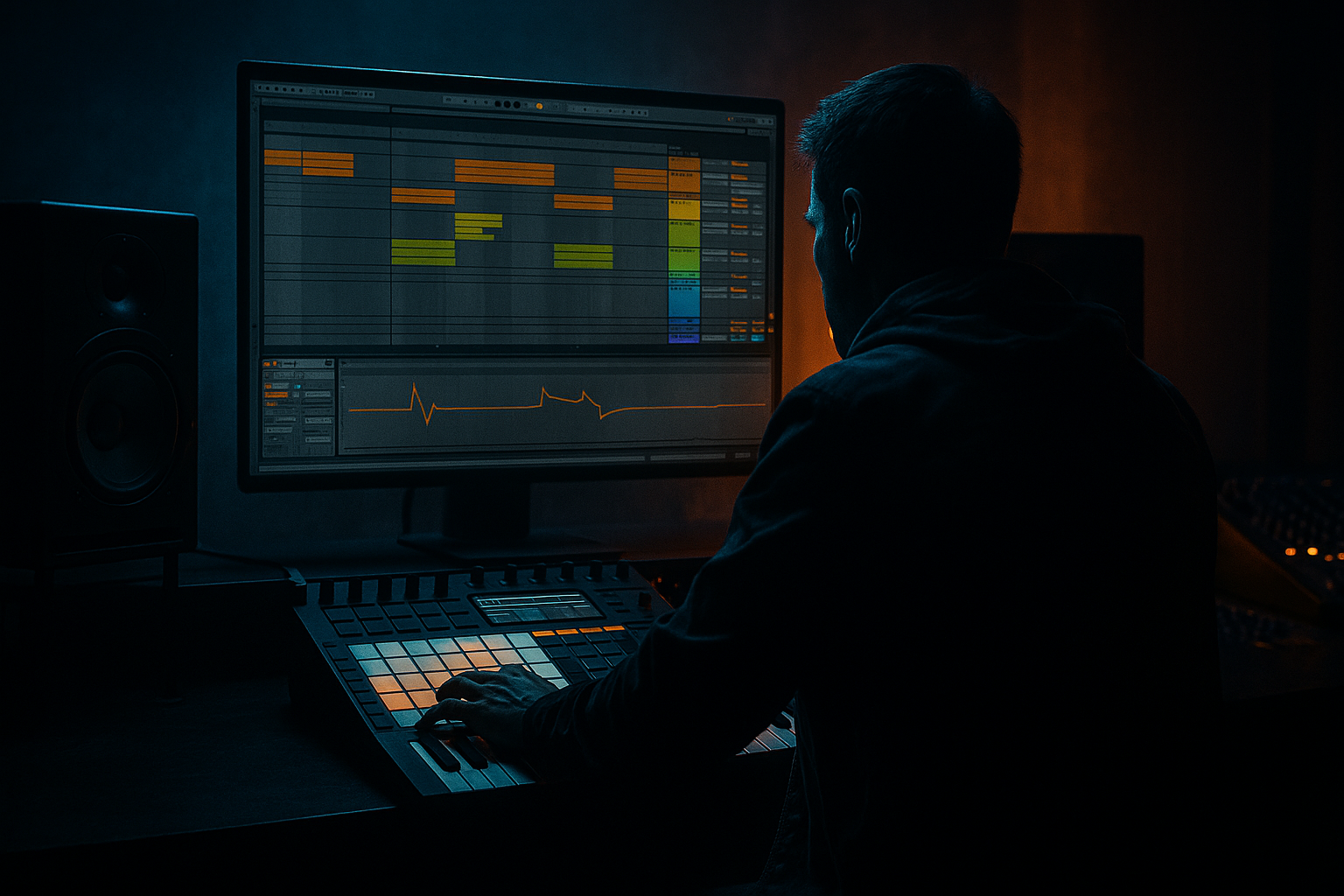
Main tutorial
Writing Atmospheric Jungle for Late-Night Moods (Ableton Live) 🌙🔥
Skill level: Advanced (Composition-focused)
Context: Drum & bass / jungle, rolling, cinematic, hypnotic, “2–4am city lights”
---
1. Lesson overview
Atmospheric jungle is about contrast: crisp, kinetic breakbeats against wide, ghostly ambience. The late-night mood comes from space, restraint, and tension—less “festival,” more “headphones on the night bus.”
In this lesson you’ll build a full atmo jungle loop into a short arrangement using Ableton Live stock devices and pro workflow habits:
- Breakbeat programming + micro-edits for swing and grit
- Deep sub + restrained reese layer with movement
- Pads, drones, and “air” built from resampling and modulation
- Arrangement that evolves via energy management, not constant new parts
- Amen-style break (or similar) with controlled chaos
- Sub bass (clean, mono) + mid layer (texture + motion)
- Moody pad/drone bed (wide, filtered, modulated)
- Late-night ear candy: vinyl noise, distant sirens, reverse reverbs, filtered one-shots
- A rolling arrangement: intro → drop → mid-section variation → outro
- Utility (for quick gain staging)
- Spectrum (visual low-end sanity check)
- Drop an Amen-style break onto an audio track.
- Right click → Warp:
- Right click break → Slice to New MIDI Track
- Kick emphasis on 1 and “and” variations (jungle rarely stays static)
- Snare solid on 2 and 4, plus ghost notes
- Hats/shuffles from the break slices (avoid rigid 16ths)
- Use Groove Pool: try MPC 16 Swing 55–60
- Apply lightly (20–40%) so it breathes without getting lazy.
- EQ Eight: high-pass at 400–800 Hz
- Hybrid Reverb: small room/plate, short 0.4–0.9s, low mix
- Saturator: gentle drive
- Osc A: Sine
- Envelope:
- Add Saturator after Operator:
- Work in F / F# / G range (common for weight).
- Write a 2-bar bassline with rests. Late-night feel = negative space.
- Osc 1: Saw
- Osc 2: Saw (detune slightly, or different wavetable position)
- Unison: 2–4 voices, Amount low
- Filter: LP24, cutoff 200–600 Hz (automate slowly)
- Add LFO to filter cutoff: 0.05–0.15 Hz (super slow)
- Add subtle Pitch Env or FM if you want grit, but keep it under the drums.
- Create an audio track set to Resampling, record 8–16 bars.
- Reverse some sections, fade them in/out, and re-filter.
- Vinyl crackle, tape noise, rain, distant traffic
- One ghostly vocal shot (pitched down, washed out)
- A single “city siren” tone (low in mix, filtered)
- Auto Filter (band-pass, slowly moving)
- Redux (very subtle bit reduction for lo-fi)
- Hybrid Reverb (shorter than pad, maybe 1–2s)
- Utility (keep it tucked)
- 1–16: Intro atmos only + filtered break teasers
- 17–33: Drop (full break + sub)
- 33–49: Variation A (remove some drum elements; bring pad forward)
- 49–65: Second drop (add mid-bass movement + extra percussion)
- 65–81: Breakdown (strip to atmos + vocal smear + distant kick)
- 81–96: Outro (filter drums down, keep drone)
- Break HP filter (e.g., 40 Hz → 120 Hz in intros/outros)
- Reverb send on snare/ghosts (bigger at transitions)
- Pad filter cutoff (slow drift across 16–32 bars)
- Mid-bass filter (more open in second drop)
- Noise layer volume (rises into fills, dips on drops)
- Reverse snare into the 1
- 1/8-bar break stutter (audio)
- A single tom/perc hit (from break slices)
- Interval: 1 Bar
- Grid: 1/8 or 1/16
- Chance: 10–25%
- Filter On: slightly band-limited
- Sub and kick relationship: use Spectrum and your ears.
- Mono compatibility: put Utility on master → Width 0% briefly; does it fall apart?
- Headroom: keep master peaks around -6 dB while composing.
- If the mix feels crowded, don’t add EQ first—mute one layer.
- Use sidechain gently on pads/atmos from the snare to create breathing room (very subtle, 1–2 dB GR).
- Use minor harmony, but avoid “happy” chord movements. One chord can carry 64 bars if it’s evolving.
- Pitch your breaks down 1–3 semitones and tighten with Warp for heavier feel (watch transients).
- Controlled distortion: put Saturator before EQ for tone, then carve harshness after.
- Threatening mid layer: keep it minimal, but automate filter/resonance subtly—movement reads as intensity.
- Add “distant impact”: a low, reverb-heavy hit on transitions (HP it so it doesn’t fight sub).
- Use silence as drama. Drop the break for 1/2 bar before the drop—instant late-night tension.
- Late-night atmospheric jungle is break urgency + ambient depth, managed through space and evolution.
- Build your groove from sliced breaks, then shape with Drum Buss / Glue / careful EQ.
- Keep sub mono and simple; make interest with movement, not extra notes.
- Create atmosphere through resampling, Hybrid Reverb, slow modulation, and quiet textures.
- Arrange by energy control: remove elements, automate filters/sends, use tasteful fills.
---
2. What you will build
By the end, you’ll have a 64–96 bar atmospheric jungle sketch featuring:
Target vibe references (sonically): early jungle atmos + modern clarity (think weighty low end, crispy breaks, dreamy haze).
---
3. Step-by-step walkthrough
Step 0 — Session setup (fast but important) ⚙️
1. Tempo: set 165–170 BPM (try 168 BPM as a sweet spot).
2. Time signature: 4/4.
3. Project organization:
- Group tracks: DRUMS, BASS, ATMOS, FX, REF
- Color-code and name everything now—saves serious time later.
Master chain (minimal while composing):
Keep it light; don’t “mix into” a limiter yet.
---
Step 1 — Build a late-night break foundation (Amen or similar) 🥁
Goal: rolling but controlled; gritty but not harsh.
#### 1A) Pick/prepare your break
- Warp Mode: Beats
- Preserve: Transients
- Envelope: ~20–40 (lower = punchier; higher = smoother)
#### 1B) Slice to MIDI for advanced control
- Slicing: Transient
- Create: Drum Rack
Now you can re-sequence hits while retaining the break character.
#### 1C) Create your core 2-bar groove
Program a 2-bar pattern with:
Swing:
#### 1D) Drum processing chain (stock)
On the DRUMS group, use this chain:
1. EQ Eight
- HP filter around 25–35 Hz (12 dB/Oct)
- Dip harshness: often 3–6 kHz (-2 to -4 dB, Q ~2) if needed
2. Drum Buss
- Drive: 5–15%
- Crunch: 0–10 (use sparingly for late-night vibe)
- Boom: OFF or very low (Boom can fight your sub)
3. Glue Compressor
- Attack: 3–10 ms
- Release: Auto
- Ratio: 2:1
- Aim for 1–2 dB GR max (just to gel)
4. Saturator (optional)
- Soft Clip ON
- Drive 1–4 dB for density
Parallel “air” return (recommended):
Create a Return track A – Drum Air:
Send snares/ghosts into this to make them feel present in space without washing out the groove.
---
Step 2 — Write a moody sub + restrained mid-bass (movement without clutter) 🔊
Atmos jungle bass is often simple notes with complex motion.
#### 2A) Sub bass (clean + consistent)
Create a MIDI track → Wavetable (or Operator).
Operator Sub (fast + reliable):
- Attack 0 ms
- Decay ~300 ms (optional)
- Sustain -inf if you want plucks; or Sustain 0 dB for sustained notes
- Drive 1–3 dB, Soft Clip ON (helps translation)
Notes:
Sub chain (stock):
1. EQ Eight: low-pass around 120–180 Hz (keep it pure)
2. Compressor (sidechain from kick/snare or kick only)
- Ratio 2:1–4:1
- Attack 5–15 ms
- Release 60–120 ms
- GR: 1–3 dB, subtle but consistent
3. Utility
- Width: 0% (mono sub always)
- Gain trim to hit your headroom targets
#### 2B) Mid-bass/reese layer (quiet but alive)
Create another MIDI track: Wavetable.
Wavetable Reese starter:
Mid chain:
1. Saturator (Drive 2–6 dB)
2. EQ Eight
- High-pass 120–180 Hz (stay out of sub)
- Tame mud: 250–400 Hz if it fogs the mix
3. Auto Filter (optional for movement)
4. Utility: Width ~120–160% (only for mids; never for sub)
Composition tip: keep mid layer -10 to -18 dB under drums. You should feel it more than hear it.
---
Step 3 — Build the atmosphere bed (pads, drones, noise, “distance”) 🌫️
This is where late-night mood is made.
#### 3A) Drone/pad from resampling (fast, unique, cohesive)
1. Create a pad with Analog or Wavetable (or even a sampled chord).
2. Play a minor 7 or minor 9 chord (e.g., Fm9: F–Ab–C–Eb–G).
3. Add a chain to make it cinematic:
Pad chain (stock):
1. EQ Eight: high-pass 150–300 Hz (don’t fight bass)
2. Chorus-Ensemble (subtle width)
3. Hybrid Reverb
- Algorithm: Plate/Hall
- Decay: 4–9s
- Pre-delay: 10–30 ms
- Low Cut: 250–500 Hz
- High Cut: 6–10 kHz
4. Auto Filter
- Slowly modulate cutoff for movement
5. Utility: Width 140–200% (pads can be wide)
Now Resample it:
This gives that “found footage” ambient smear that sits perfectly behind breaks. 🎛️
#### 3B) Texture layers (the “late-night air”)
Add 1–3 subtle layers:
Texture chain idea:
Keep textures quiet. If you notice them, they’re probably too loud.
---
Step 4 — Write a jungle arrangement that breathes (energy design) 🧠
Atmospheric jungle doesn’t need constant new instruments; it needs controlled evolution.
#### 4A) Suggested arrangement (96 bars)
#### 4B) Automation targets (make it feel “alive”)
Create automation lanes for:
#### 4C) Jungle fills (tasteful, not clowny)
Every 8 or 16 bars:
Use Beat Repeat for controlled glitch:
Print it to audio when you catch a good moment.
---
Step 5 — Tighten the groove without killing the haze 🎚️
Atmos jungle needs clarity, but not “EDM clean.”
Quick checks:
Drum/bass space management:
---
4. Common mistakes ❌
1. Over-layering ambience until the drums lose urgency
- Fix: high-pass more, lower levels, reduce reverb decay.
2. Wide sub bass (phasey, weak in clubs)
- Fix: Utility width 0% below ~120 Hz (or keep sub track mono).
3. Too much break distortion → harsh fatigue
- Fix: tame 3–6 kHz, reduce Drum Buss Crunch, softer saturation.
4. No arrangement story (loop syndrome)
- Fix: commit to 3–4 automation arcs over 96 bars.
5. Reverb everywhere causing mush
- Fix: reverb returns with EQ (low cut + high cut). Keep dry transients.
---
5. Pro tips for darker/heavier DnB 🖤
---
6. Mini practice exercise (20 minutes) ⏱️
Create a 32-bar atmospheric jungle idea with these constraints:
1. Only one break (sliced) + one sub + one pad + one texture.
2. Automation required:
- Pad cutoff slowly opening across bars 1–16
- Drum reverb send increases into bar 17 drop
3. One fill every 8 bars using printed Beat Repeat (resampled).
4. Mix rule: pad must be at least 10 dB quieter than snare peak.
Export and listen at low volume. If the groove still feels alive, you nailed it.
---
7. Recap ✅
If you want, tell me your target vibe (more classic jungle vs more modern halftime-dark), and I’ll give you a specific 8-bar drum blueprint + bass note map in your chosen key.

