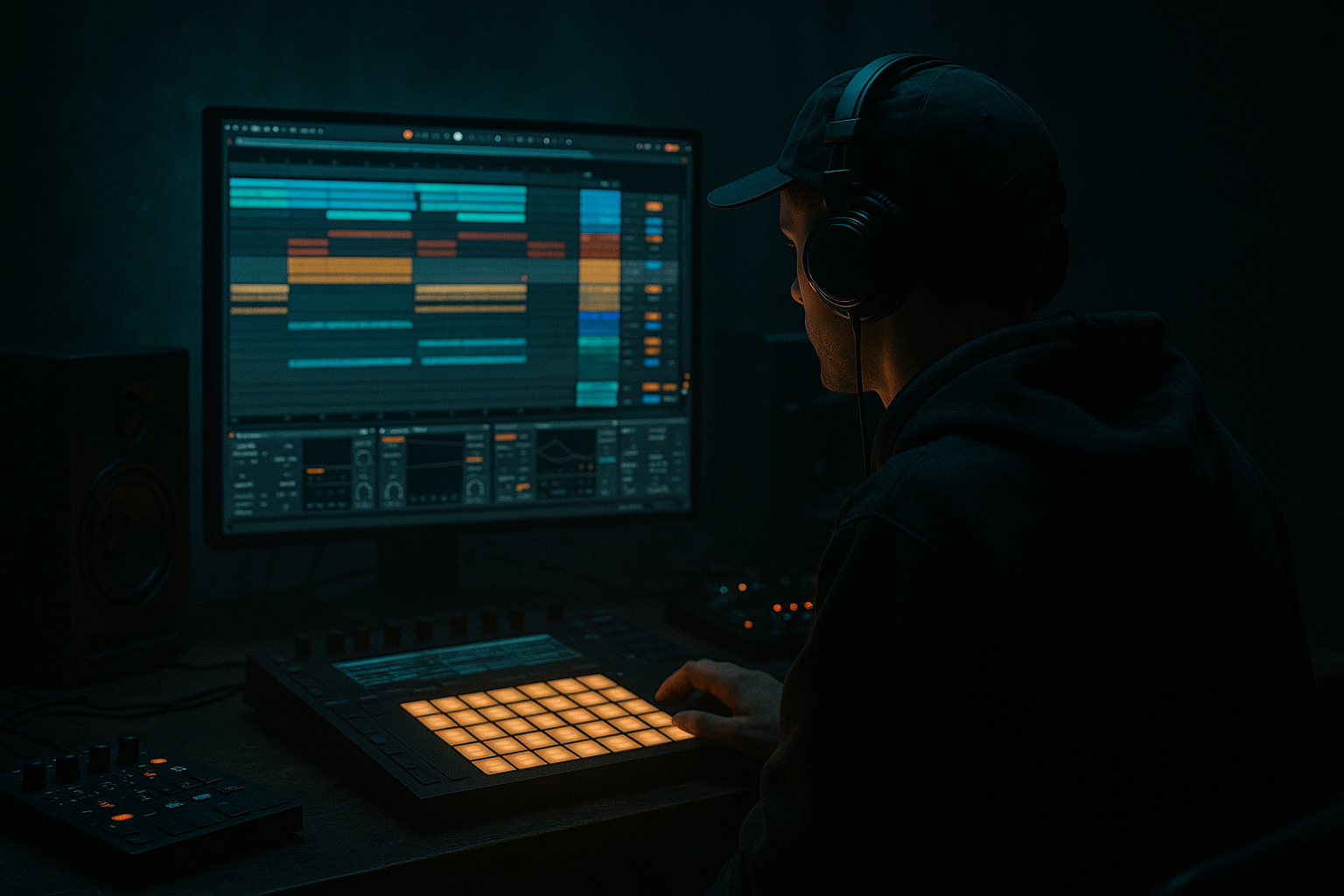
Main tutorial
```markdown
Writing Dark DnB Motifs in Ableton Live (Beginner Composition Lesson) 🖤⚡
1. Lesson overview
A motif is a short musical idea (2–8 notes) that becomes the identity of your track. In dark drum & bass, motifs are often:
- Minor-key, tense, and repetitive (hypnotic)
- Built from simple intervals (b2, tritone, minor 3rd)
- Designed to lock into the groove of drums + bass
- A dark 2-bar motif (MIDI) that sounds “D&D” (deep & dangerous)
- A lead / stab sound using Ableton stock devices
- A simple arrangement plan (intro → drop → variation)
- A workflow you can repeat fast 🔁
- Return A (Reverb): Hybrid Reverb
- Return B (Delay): Echo
- F minor, G minor, D minor, C# minor (all common in DnB)
- Instrument: Wavetable (or Operator if you prefer)
- Reverb send: 5–15%
- Delay send: 8–20%
- Short
- Repetitive
- Rhythmically interesting (syncopation)
- Bar 1: F3 (1.1), Gb3 (1.2.3), F3 (1.3), Eb3 (1.4.2)
- Bar 2: repeat, but leave a gap before the last note
- Put Ab on an offbeat 16th for that lurching feel
- End bar 2 with C to imply tension against bass
- Use sparingly: 1–2 hits per bar
- Typical motif note length: 1/16 to 1/8
- Let reverb/delay do the tail, not long MIDI notes
- Make the “answer” notes quieter
- Example: main hit velocity 100–115, ghost hits 55–80
- Press A to show automation
- Draw smooth ramps into the drop 📈
- Load a Drum Rack and place:
- Osc A: Sine
- Envelope: short attack, medium release
- Add Saturator (Drive 3–6 dB), EQ Eight lowpass ~200 Hz if needed
- Motif filtered low (Auto Filter cutoff ~400–700 Hz)
- More reverb send
- Tease drums (hats, ghost snare)
- Introduce full drum groove
- Open filter gradually
- Add a second motif layer (same MIDI, different sound)
- Full drums + bass
- Motif is drier, brighter, slightly more saturated
- Consider call/response: motif plays bar 1, rests bar 2 (or vice versa)
- Keep motif notes the same
- Change rhythm or remove 1 note for surprise
- Add a one-shot stab at phrase ends
- Use the b2 (minor second) sparingly: it’s instant dread (e.g., F → Gb).
- Resample your motif:
- Create a “shadow layer”:
- Tight stereo discipline:
- Use phasing movement, not chord changes:
- Dark DnB motifs are short, tense, and groove-locked 🖤
- Choose a minor key (like F minor), and lean on b2 / tritone / minor 3rd for darkness
- Use Ableton stock tools: Wavetable/Operator → Saturator → Auto Filter → EQ Eight
- Make it feel alive with velocity, micro-timing, and automation
- Arrange in 8/16/32 bar phrases, using tone changes more than note changes
In this lesson you’ll write a dark motif in Ableton Live, shape it with stock devices, and arrange it like a real rolling DnB tune.
---
2. What you will build
You’ll end up with:
Tempo target: 172–176 BPM (we’ll use 174 BPM)
---
3. Step-by-step walkthrough
Step 0 — Set up your session (the “DnB defaults”)
1. Set Tempo = 174 BPM
2. Set Time Signature = 4/4
3. Create 4 tracks:
- MIDI Track 1: `Motif Lead`
- MIDI Track 2: `Bass (simple placeholder)`
- Audio Track 1: `Drums (loop or kit)`
- Return A: `Reverb`
- Return B: `Delay`
Return settings (quick & effective):
- Algorithm: Hall
- Decay: 2.5–4.5s
- Predelay: 15–25ms
- High Cut: 7–10 kHz
- Wet: 100% (since it’s a return)
- Time: 1/8 or 1/4 dotted
- Feedback: 25–40%
- Filter: Highpass ~ 200 Hz, Lowpass ~ 6–8 kHz
- Wet: 100%
Why: dark DnB motifs feel big but controlled—returns help you keep the dry signal punchy.
---
Step 1 — Pick a dark key + scale (fast win)
Choose a key that naturally feels dark:
We’ll use: F minor.
In Ableton:
1. Create a MIDI clip on `Motif Lead` (length 2 bars).
2. Add Scale (MIDI Effect) before your instrument:
- Base: F
- Scale: Minor
3. Turn on the Piano Roll Fold (top left of MIDI editor) to only show notes you use.
This keeps you in key while you experiment. ✅
---
Step 2 — Build a classic dark DnB sound (stock device chain)
On `Motif Lead`, load:
Option A: Wavetable “Dark Razor Lead” (simple + mean)
1. Load Wavetable
2. Osc 1: Saw (or something slightly harsh)
3. Unison: 2–4 voices, Amount low
4. Filter: LP24
- Cutoff: 400–1.5kHz (we’ll modulate)
- Drive: 2–5
5. Amp Envelope:
- Attack: 0–5 ms
- Decay: 200–500 ms
- Sustain: 0–30%
- Release: 80–150 ms
Then add this device chain after Wavetable:
1. Saturator
- Drive: 2–6 dB
- Soft Clip: On
2. Auto Filter
- LP24
- Set Cutoff around 800 Hz
- Add a tiny Envelope amount (5–15%) so notes “bite”
3. Corpus (optional but very DnB)
- Mode: Tube or Beam
- Decay: short (0.2–0.6s)
- Mix: 10–25%
4. EQ Eight
- Highpass: 150–250 Hz (keep motif out of sub range)
- Dip harshness: try 2.5–4.5 kHz if needed
5. Utility
- Width: 80–120% (careful—don’t go too wide)
Send a little to returns:
---
Step 3 — Write the motif (2 bars, groove-focused) 🎯
Dark motifs are usually:
DnB rhythm tip: avoid placing every note on the grid. Use offbeats and gaps.
In your 2-bar MIDI clip:
1. Set grid to 1/16
2. Start with 3–5 notes total and repeat them
Here are three motif blueprints you can copy (all in F minor).
(Octaves shown for clarity; adjust to taste.)
#### Blueprint 1: “B2 tension” (simple + ominous)
Use F – Gb – F – Eb (Gb is the b2 = instant darkness)
#### Blueprint 2: “Minor 3rd hook” (classic rolling vibe)
Use F – Ab – F – C
#### Blueprint 3: “Tritone menace” (heavier/techy)
Use F – B – F – Eb (B natural is nasty tension)
Important: keep note lengths short-ish:
---
Step 4 — Make it groove like DnB (quantize with feel)
1. Select all notes
2. Quantize Settings:
- Quantize To: 1/16
- Amount: 70–85% (not 100!)
3. Add micro-timing:
- Nudge a few notes late by 5–15 ms (especially offbeats)
- In Live, you can use clip Delay (in Track Delay) or drag notes slightly
Velocity shaping (huge for darkness):
This makes the motif feel “spoken,” not typed.
---
Step 5 — Add movement with automation (dark = evolving)
Dark DnB motifs often stay the same notes but change tone.
Automate these:
1. Auto Filter Cutoff
- Intro: lower cutoff (300–600 Hz)
- Drop: open it (900 Hz–2 kHz)
2. Saturator Drive
- +1 to +3 dB more in the drop
3. Reverb Send
- More in breakdowns, less in drops (keep drop punchy)
In Arrangement View:
---
Step 6 — Place it in a real DnB context (drums + bass relationship)
A motif sounds “DnB” when it locks with drums and doesn’t fight the bass.
#### Quick drum foundation (starter)
If you don’t have drums yet:
- Kick on 1
- Snare on 2 and 4 (classic DnB)
- Add hats on offbeats (1/8) + 1/16 shuffles
Or drag a break (Amen-style) to an audio track, warp it, and layer a clean kick/snare.
#### Basic bass placeholder (so you compose correctly)
On `Bass`, use Operator:
Rule: your motif should be highpassed so the bass owns the sub.
---
Step 7 — Arrange the motif like a rolling DnB tune
Here’s a beginner-friendly structure:
0:00–0:32 (Intro / Atmosphere)
0:32–1:04 (Build)
1:04 (Drop)
1:36 (Variation)
Phrase tip: DnB often breathes in 8, 16, or 32 bar blocks.
---
4. Common mistakes
1. Too many notes
Dark motifs are simple but intentional. If it sounds “melodic,” you may be writing a lead line, not a motif.
2. Clashing with the bass
If your motif has lots of energy under 150–250 Hz, it will fight the sub and muddy the drop.
3. Over-reverb in the drop
Huge reverb washes out the groove. Use sends and automate down at impact.
4. Quantizing 100% + same velocities
That creates stiff, “MIDI demo” energy. Groove comes from slight timing + dynamics.
5. No repetition = no identity
A motif needs to repeat enough to become recognizable.
---
5. Pro tips for darker/heavier DnB 🧨
1. Freeze & Flatten the motif track (or record to audio)
2. Chop 1–2 hits into a new audio clip
3. Add Redux (light) + Saturator for grit
- Duplicate the motif
- Pitch it -12 semitones
- Highpass it around 200–300 Hz
- Keep it quiet (adds weight without stealing sub)
- Keep motif mostly mono-ish in the drop (Utility Width ~80–100%)
- Make width a build-up reward (wider before drop, tighter at drop)
- Phaser-Flanger at low mix (5–15%) can add creepy motion without getting “pretty.”
---
6. Mini practice exercise (15 minutes) ⏱️
1. Set tempo to 174 BPM, key F minor
2. Write three different 2-bar motifs using:
- Motif A: includes Gb (b2)
- Motif B: includes Ab (minor 3rd)
- Motif C: includes B natural (tritone tension) only once per bar max
3. Keep each motif to 5 notes or fewer
4. For each motif:
- Quantize to 1/16 at 80%
- Set velocities with at least 2 dynamic levels
- Automate filter cutoff from 600 Hz → 1.5 kHz over 8 bars
5. Pick the best one and arrange 16 bars:
- 8 bars filtered intro
- 8 bars full tone
---
7. Recap
If you want, tell me the vibe (deep/rolling, neuro, jungle-tech, halftime) and I’ll give you two motif MIDI patterns + a matching Wavetable patch recipe tailored to it.
```

