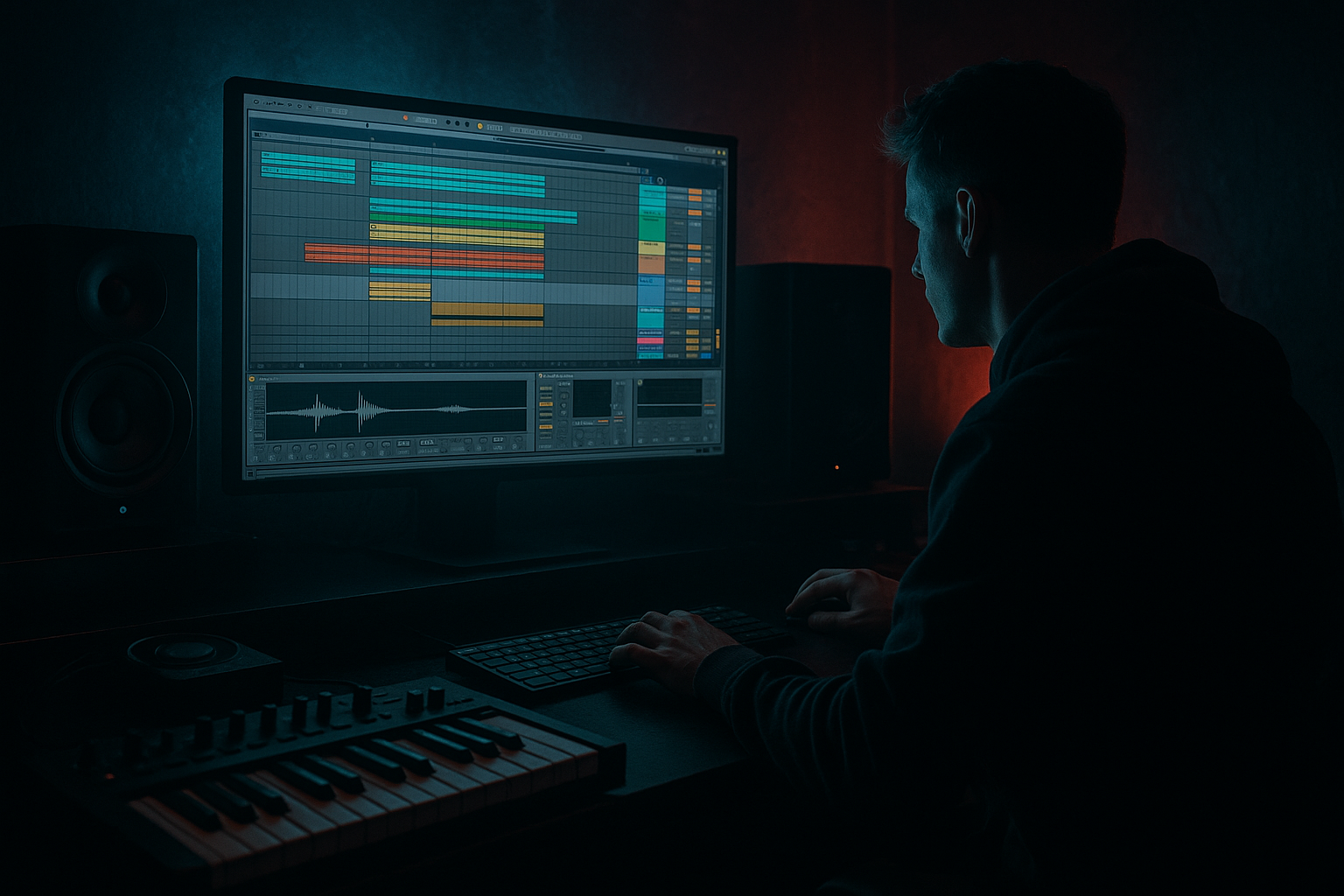
Main tutorial
```markdown
Writing Motifs Around Vocal Cadence (DnB in Ableton Live) 🎤⚡️
Skill level: Advanced
Category: Composition (drum & bass / jungle / rolling bass)
---
1. Lesson overview
In drum & bass, a vocal is often the hook—but the track still needs musical identity beyond the lyric. This lesson shows you how to extract rhythmic and melodic information from a vocal cadence and turn it into motifs that drive the drop, glue the arrangement, and reinforce the vocal without crowding it.
You’ll work like a producer and an editor: slice the vocal, map its cadence to MIDI, build call/response motifs, and orchestrate them across bass, stabs, and percussion—classic rolling DnB technique with modern polish. 🔥
---
2. What you will build
You’ll create a DnB drop section where:
- The vocal sits upfront (tight timing, clean pocket)
- A lead motif mirrors the vocal’s cadence (but doesn’t copy it)
- A secondary motif answers the vocal (call/response)
- The motifs are distributed across:
- The arrangement breathes: motifs appear, mutate, and disappear to maintain momentum
- Simpler (Slice mode), Warp, Groove Pool
- EQ Eight, Compressor, Glue Compressor
- Saturator, Auto Filter
- Corpus (metallic hits), Echo, Hybrid Reverb
- Utility (mono control), Limiter
- distinct rhythmic phrasing (rests + accents)
- consonant hits (“t”, “k”, “p”) that can inform groove
- a clear “question/answer” contour (even in spoken vocals)
- Vocal A (Main): clean, full
- Vocal B (Cadence Tool): for slicing/extraction (muted later)
- Align phrase starts and key syllable accents (downbeats, snare hits).
- Leave micro-timing inside the phrase intact unless it’s messy.
- Use Convert Melody to New MIDI Track (if it’s sung and monophonic-ish).
- lands after a vocal phrase (end of bar 2 or bar 4)
- is slightly more melodic or harmonically defined
- can be a bass growl, a rave stab, or a jungle-style horn nod
- Keep vocal center-focused
- Use Utility: Width 80–120% (taste), but avoid ultra-wide if bass is wide too
- Control low-mids (200–400 Hz) with EQ Eight to avoid boxiness
- Keep it narrower than you think in the drop
- EQ Eight: carve a small dip where the vocal presence lives (often 1–3 kHz)
- Keep it mono-ish below ~200 Hz (Utility bass mono)
- Use width above that if needed, but check mono compatibility
- Sidechain motifs to the snare lightly for clarity:
- Bars 1–4: Vocal + Motif #1 (shadow cadence). Keep Motif #2 minimal.
- Bars 5–8: Introduce Motif #2 as a clear response at bar ends.
- Bars 9–12: Remove Motif #1 for 2 bars; let vocal breathe; add percussive motif instead.
- Bars 13–16: Bring Motif #1 back with variation (pitch up/down, rhythmic cut), add a one-shot turnaround.
- Note length changes (staccato vs slightly legato)
- Rhythmic displacement (move motif 1/16 earlier or later)
- Call/response inversion (motif plays first, vocal answers)
- Automation: Auto Filter cutoff or Saturator drive ramp over 8 bars
- Use dissonant “tag notes”: minor 2nd or tritone jumps at phrase ends for menace.
- Resample motif #2 to audio and mangle it:
- Automate band-pass talking:
- Create a “mid bass call” that answers the vocal:
- Add controlled distortion:
- Snare dominance rule:
- Extract cadence, not just melody: slice vocal → build a MIDI rhythm skeleton.
- Build two motifs:
- Use Ableton stock tools (Simpler, Wavetable, EQ Eight, Saturator, Auto Filter, Groove Pool) to lock timing and carve space.
- Arrange like proper DnB: rotate elements every 4–8 bars, keep snare + vocal king.
- a reese or neuro-style bass layer
- a mid stab/synth
- a percussive “ear candy” element (rim/woodblock/foley)
---
3. Step-by-step walkthrough
Step 0 — Session setup (fast + DnB-ready) ⚙️
1. Tempo: 172–176 BPM (pick 174 BPM as baseline).
2. Warp mode (vocal): usually Complex Pro
- Formants: 0 to +20 (taste)
- Envelope: 80–140 (more = smoother, less = snappier)
3. Add a basic DnB skeleton first:
- Drum rack with: kick, snare, hats, ride, ghost snare
- A simple rolling bass (even a placeholder sine/sub is fine)
Ableton stock devices you’ll likely use:
---
Step 1 — Choose a vocal phrase with clear cadence 🗣️
Pick one phrase (1–2 bars) that has:
Pro move: Duplicate the vocal track:
---
Step 2 — Tighten the vocal pocket without killing vibe 🎯
1. In Arrangement View, set Warp markers so the vocal lands correctly on the bar grid.
2. Don’t hard-quantize every syllable—DnB likes urgency, but vocals need human push/pull.
Workflow tip:
---
Step 3 — Convert cadence into a MIDI “rhythm skeleton” 🧠➡️🎹
You want the rhythmic pattern of the vocal, not necessarily the melody.
Method A (manual but best):
1. On Vocal B, right-click → Slice to New MIDI Track
- Slicing preset: Transient (or Warp Marker if you pre-marked syllables)
2. Open the new Simpler track (Slice mode).
3. Create a new empty MIDI clip and tap in a pattern using the vocal slices:
- Put notes only where the cadence accents occur
- Keep it to 1–2 bars (motifs should be compact)
Now you have a MIDI clip that represents cadence.
Method B (quick extraction):
Then simplify it aggressively (delete fluff, keep accents).
---
Step 4 — Design Motif #1: “Shadow the cadence” (support motif) 👤
This motif reinforces the vocal’s rhythm but stays out of its frequency space.
Instrument idea: mid stab / pluck that sits 500 Hz–4 kHz but not too wide.
Ableton chain (stock):
1. Wavetable (or Operator)
- Osc 1: Saw (or Square)
- Unison: 2–4 voices, low amount (don’t smear transients)
2. Auto Filter
- HP 24 dB @ ~180–300 Hz (keep out of bass/sub)
- Add a touch of envelope to give “pluck”
3. Amp
- Slight drive for edge
4. Saturator
- Soft Clip ON, Drive 2–6 dB (DnB needs density)
5. EQ Eight
- notch any harshness around 2.5–4.5 kHz if it fights the vocal
6. Compressor (or Glue)
- light control, not pumping yet
Composition steps:
1. Paste your cadence MIDI onto the stab track.
2. Choose 2–4 notes only (DnB motifs often live on minimal pitch sets).
3. Make it “shadow,” not “sing”:
- Use short notes (1/16–1/8)
- Leave space on snare hits (or deliberately answer after snare)
Practical note:
If the vocal is busy, your motif should often hit between the syllables, not on top of them.
---
Step 5 — Design Motif #2: “Answer phrase” (call/response hook) 📞↩️
This is where the track becomes memorable. The answer motif usually:
Instrument idea: resampled bass hit (midrange) or rave stab.
Ableton chain (bass-mid motif, stock):
1. Wavetable
- Osc 1: Saw, Osc 2: Square (detune small)
2. Saturator
- Drive 4–10 dB, Soft Clip ON
3. Auto Filter
- Band-pass movement (automate cutoff to “speak”)
4. Corpus (optional, subtle)
- Adds metallic resonance to make it cut through dense drums
5. EQ Eight
- HP @ 120–180 Hz (keep sub separate)
6. Limiter
- prevent random resonant spikes
Composition steps:
1. Copy the cadence MIDI, then simplify:
- keep only the last 2–5 hits of the phrase
2. Shift it later (classic response feel):
- e.g., vocal phrase on bar 1–2, response motif on the “&” of beat 3 or beat 4
3. Pitch it as a “tag”:
- try a minor 2nd / tritone / minor 3rd motion for darker DnB tension
---
Step 6 — Tie motifs to drums using groove (micro-swing) 🥁🕺
DnB groove lives in hats/ghosts, but your motifs must lock too.
1. Grab a groove from Core Library (e.g., MPC swing) or extract groove from a shuffled hat loop:
- Right-click a hat clip → Extract Groove
2. Apply groove to motif MIDI clips at:
- Timing: 10–30%
- Velocity: 0–15% (subtle)
3. Commit only if needed (advanced tip: keep it uncommitted for later edits).
Important:
If the vocal is straight, don’t over-swing the motifs. Let drums swing; keep motif swing lighter.
---
Step 7 — Frequency and spatial arrangement: “Don’t fight the vocal” 🎚️
Use deliberate placement:
Vocal (Main):
Motif #1 (stab/pluck):
(DnB drums already fill stereo)
Motif #2 (answer bass mid):
Sidechain (stock):
- Compressor → Sidechain input: Snare bus
- Ratio 2:1–4:1, Attack 1–10 ms, Release 60–140 ms
This creates “snare speaks, motif steps back” without full EDM pumping.
---
Step 8 — Arrange motifs like DnB: rotate, don’t loop forever 🔁
A rolling DnB drop typically evolves every 4–8 bars.
Practical 16-bar drop plan:
Variation tools (fast):
---
Step 9 — Add a percussive motif derived from consonants (jungle trick) 🪘
Turn vocal consonants into rhythmic ear candy.
1. On Vocal B, find a hard consonant (“t”, “k”, “ch”).
2. Consolidate a tiny slice and drop into Simpler (One-Shot).
3. Pitch it up, shorten decay, and treat it like a rim/woodblock:
- EQ Eight: HP @ 400–800 Hz
- Saturator: light drive
- Echo: 1/8 or dotted 1/8, low feedback (10–20%)
4. Program it to double your motif or answer the snare.
This can create that “talking percussion” vibe common in darker rollers.
---
4. Common mistakes ❌
1. Motifs copy the vocal exactly
That becomes clutter, not support. Shadow rhythm, don’t unison everything.
2. Too many notes, too many pitches
DnB hooks are often rhythm-first. Keep pitch sets tight.
3. Motifs collide with vocal presence range (1–4 kHz)
If you can’t hear lyrics clearly, your motif is too dense or too bright.
4. Every bar identical
Rolling music needs rotation. Change something every 4 bars.
5. Over-swinging the motif
Let drums carry most of the shuffle; motifs should be slightly disciplined.
---
5. Pro tips for darker/heavier DnB 🖤🔊
- Freeze/Flatten → slice → re-order hits for controlled chaos
- Auto Filter band-pass + envelope follower feel (manual automation works great)
- Keep sub separate (clean sine) and let mids do the talking.
- Saturator soft clip + EQ Eight post (cut fizz above 10–12 kHz)
- If anything masks the snare crack around 180–250 Hz (body) or 2–5 kHz (snap), carve it.
---
6. Mini practice exercise 🧩
Goal: 8-bar drop loop with vocal + two motifs.
1. Choose a 1–2 bar vocal phrase.
2. Slice to MIDI (transients) and build a cadence MIDI clip.
3. Create:
- Motif #1: 1–2 bar stab shadow (2–3 notes)
- Motif #2: 1/2 bar answer tag at end of bar 2 and bar 4
4. Arrange 8 bars:
- Bars 1–4: Motif #1 active, Motif #2 only once
- Bars 5–8: Motif #2 every 2 bars, Motif #1 reduced
5. Bounce a quick reference and check:
- Can you understand the vocal at -6 dB on master?
- Does the snare still feel like the loudest “event”?
---
7. Recap ✅
- Shadow motif (supports cadence, stays out of the way)
- Answer motif (hooky tag at phrase ends)
If you want, share a vocal phrase screenshot (warp markers + clip view) and I’ll suggest exact motif placements and note choices for a darker roller or a more jump-up/jungle-leaning vibe.
```

