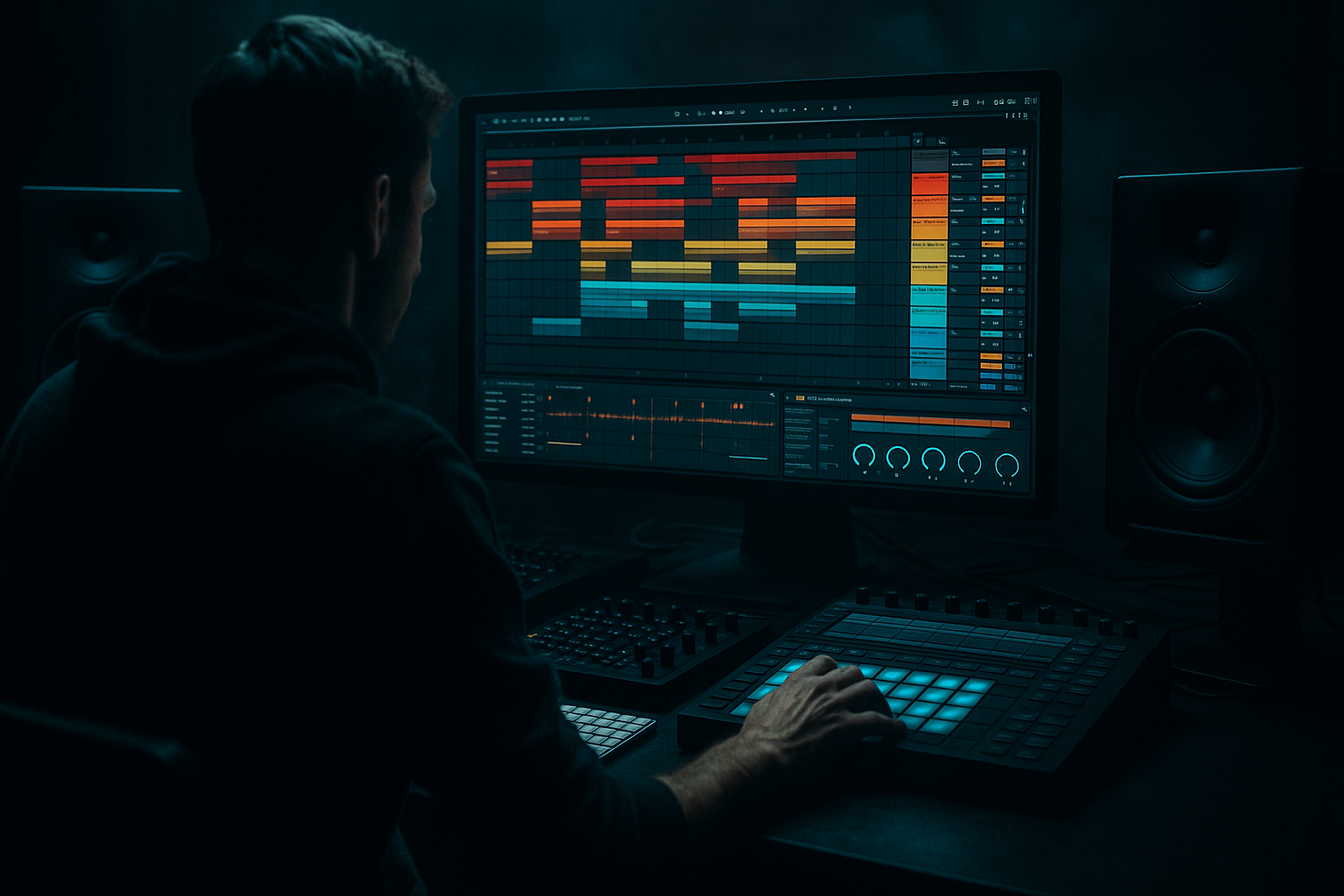
Main tutorial
```markdown
Writing motifs that survive heavy FX (DnB in Ableton Live) 🎛️⚡
1) Lesson overview
In drum & bass, motifs often get absolutely mangled: resampling, distortion, bitcrushing, pitch drops, heavy filtering, reverb throws, time-stretching, and aggressive bus processing. The problem: the moment you add the “fun” FX, the hook disappears.
This lesson shows you how to write motifs with strong identity at multiple levels—rhythm, contour, register, and timbre—so they remain recognizable even after brutal processing. You’ll build a “motif core” and a “FX shell” around it, using stock Ableton devices and a DnB-friendly workflow.
---
2) What you will build
You’ll create a 4- or 8-bar motif system that holds up under heavy FX:
- A motif core: a short musical idea (bass or lead stab) that stays recognizable
- A shadow layer (parallel) that carries identity when the main layer gets destroyed
- A resampling chain for “print → slice → recompose” jungle/DnB style
- An arrangement approach: A/B states (clean vs. destroyed) + call/response that works over rolling drums
- Distort it hard
- Band-limit it
- Pitch it down
- Add huge reverb
- Stretch or grain it
- Smash it with bus compression
- Kick: 1.1 and 1.3 (or 1.1 + a ghost at 1.2.3)
- Snare: 1.2 and 1.4 (classic)
- Hats: 1/16 closed hats with slight velocity variation
- Add a ride on offbeats if you want more drive
- Notes: F2 → Ab2 → (rest) → G2 → F2
- Rhythm (16ths):
- Make it short: 3–6 hits per bar is plenty.
- Create a MIDI track: Operator (simple, stable)
- In MIDI clip, program the rhythm first using one note (F2)
- Then change a few hits to Ab2/G2 to create contour
- Algorithm: A only (no FM yet)
- Osc A: Saw (or Square if you want more hollow)
- Filter: On, LP24
- Amp Env:
- Add Saturator (stock)
- Add EQ Eight
- Motif MAIN
- Motif SHADOW
- Simpler with a short clicky stab sample OR
- Operator with a Square wave
- Osc A: Square
- Filter LP24:
- Amp Env: shorter than MAIN
- Auto Filter after Operator:
- Utility:
- dynamics flatten completely
- the spectrum becomes too wide
- transients disappear
- Compressor
- EQ Eight (post)
- Group MAIN + SHADOW into a group: MOTIF BUS
- Create two returns or two chains:
- Put Audio Effect Rack on MOTIF BUS
- Create 2 chains: A Clean, B Destroy
- Map Chain Selector to Macro 1 (“State”)
- Automate Macro 1 across sections (intro/verse/drop)
- Keep SHADOW mostly constant across A/B.
- Let MAIN do the wild transformations.
- Drop the recording into Simpler (Slice mode)
- Now re-trigger slices with MIDI:
- Keep sub separate. Your motif is typically mid-bass / lead, not the sub itself.
- Sidechain motif slightly to the kick/snare to avoid masking.
- On MOTIF BUS: Compressor → Sidechain from Kick + Snare bus
- If MAIN is wide and distorted, keep SHADOW mono.
- Use Utility:
- Check mono often (Utility → Width 0% on Master briefly)
- Use formant-like anchors:
- Make the rhythm “anti-generic”:
- Parallel distortion instead of serial-only:
- Reverb throws, not constant reverb:
- Print “impact versions”:
- Motifs that survive heavy FX are built on identity anchors—especially rhythm and contour.
- Use a Motif Core (clean readability) + Shadow Layer (mid-forward, stable) so the hook survives destruction.
- Apply heavy FX, but constrain the chaos with post EQ/dynamics and a stable reference.
- Resample + slice to turn mangled sound into controllable rhythm—classic jungle/DnB technique.
- Arrange with A/B states so the listener learns the motif before you obliterate it.
By the end you’ll have a motif that still reads when you:
---
3) Step-by-step walkthrough
Step 0 — Session prep (DnB context)
Tempo: 172–175 BPM
Grid: 1/16 (and toggle triplets when needed)
Drum bed: Use a basic rolling pattern so you can judge whether the motif “speaks.”
Quick drum skeleton (1 bar):
> You need the groove running early—motifs that survive FX still have to cut through the break/step energy. 🥁
---
Step 1 — Write a motif that has “identity anchors”
A motif survives heavy FX when it has at least two of these anchors:
1) Rhythmic fingerprint (the most FX-proof)
2) Pitch contour (up/down shape, not exact notes)
3) Register placement (where it lives: sub vs. mid vs. air)
4) Transient shape (staccato stab vs. swell)
5) Timbre marker (a formant-ish bite, metallic click, etc.)
#### Practical rule (DnB-friendly):
Write motifs that work as rhythm first, melody second. Think: jungle stabs, reese phrases, fog-horn calls, neuro growl patterns.
Example motif (1 bar, 1/16 grid, in F minor):
- Hit on 1.1, 1.1.3, 1.2.3, 1.3, (rest), 1.4.2
Ableton workflow:
---
Step 2 — Build the “Motif Core” patch (clean, readable)
Use a simple synth so the motif isn’t accidentally relying on fragile detail.
Operator (Motif Core) – suggested starting point:
- Freq: ~1.2–2.5 kHz (depends on brightness)
- Res: 0.8–1.5
- Attack: 0–5 ms
- Decay: 150–300 ms
- Sustain: -inf (or very low)
- Release: 60–120 ms
Add a “transient marker” (super important):
- Drive: 2–6 dB
- Soft Clip: On
- High-pass: ~120–200 Hz (if this is not your sub)
- Add a narrow bell +2 to +4 dB around 2–4 kHz (this becomes a “readable bite”)
> That 2–4 kHz bite is an identity tag—even if you filter/distort, some part of it will survive. 🔪
---
Step 3 — Add a “Shadow Layer” that survives when the main gets destroyed
This is the secret weapon: a parallel layer that keeps the motif recognizable even if the main layer becomes pure noise.
Duplicate the MIDI track (Cmd/Ctrl+D). Name them:
#### Motif SHADOW settings (make it simple + mid-forward)
Use a very stable source:
Operator Shadow example:
- Freq: 700–1.5 kHz (band-limited on purpose)
- Decay: 80–180 ms
- Mode: Band-Pass
- Freq: ~900 Hz
- Q: 0.8–1.2
- Width: 0% (mono)
- Gain: -6 to -12 dB (keep it tucked)
You want the shadow to feel like a ghost of the motif that still reads on small speakers. 👻
---
Step 4 — Build a heavy FX chain without losing the motif
Now we’ll process the MAIN hard, but keep its identity via constraints and parallel routing.
#### Recommended device chain (Motif MAIN):
1) EQ Eight (pre)
- Cut extreme lows (HP 80–150 Hz)
- Optional: small notch at harsh resonances later
2) Saturator
- Drive 6–12 dB
- Soft Clip On
3) Amp (stock)
- Mode: Clean or Rock
- Gain: 10–30
- Bass/Mid/Treble: start neutral, then adjust
4) Redux (optional for grit)
- Downsample: 2–6
- Bit reduction: 10–14 (don’t go full 1-bit unless you want total destruction)
5) Auto Filter
- Use it as your “readability control”
- Map Filter Freq to a Macro so you can open/close in arrangement
6) Corpus (optional, adds metallic identity)
- Try Tube or Beam
- Tune to track key (e.g., F)
- Mix low (5–15%)
#### Key concept: constrain the chaos
Heavy FX becomes unreadable when:
So add post control:
After the chain:
- Ratio: 2:1–4:1
- Attack: 10–30 ms (let some transient through)
- Release: 60–150 ms
- Aim 2–5 dB GR
- Restore presence: gentle shelf +1–2 dB at 3–6 kHz if needed
- Trim mud: -2 to -5 dB around 200–400 Hz if it builds up
---
Step 5 — Set up “A/B states” (Clean vs Destroyed) for arrangement impact
Motifs survive FX better when the listener hears a clean reference first.
Workflow:
- State A (Clean-ish): mild saturation, tight filter
- State B (Destroyed): full chain, wider, noisier, more movement
Ableton method (simple + fast):
Bonus readability trick:
That means even when you go full mayhem, the ear still tracks the motif. 🎯
---
Step 6 — Resample, slice, and recompose (DnB/jungle DNA) 🔁
Motifs that survive heavy FX often do so because they become audio you can re-edit rhythmically.
Resampling method:
1. Create new audio track: RESAMPLE MOTIF
2. Set input to Resampling
3. Record 8 bars while automating:
- Auto Filter cutoff
- Distortion amount
- Reverb throws
Then:
- Slice by: Transients (or 1/8 if your motif is grid-tight)
- Warp: On
- Keep the original rhythm fingerprint on key beats
- Add variation with 1–2 slice swaps per bar
> Even if the sound is destroyed, the slice rhythm preserves identity. This is why old-school jungle edits still hit. 🧬
---
Step 7 — Mix placement so the motif cuts through rolling drums
Motifs vanish because the drums and bass take all the perceived space.
Tactics:
Stock setup:
- Ratio: 2:1
- Attack: 5–15 ms
- Release: 80–140 ms
- GR: 1–3 dB (subtle)
Stereo discipline:
- MAIN width 120–160% (if it works)
- SHADOW width 0%
---
4) Common mistakes
1) Motif relies on fragile detail
If the hook is “that tiny filter squeak,” distortion will erase it. Build a rhythmic fingerprint instead.
2) Too many notes
Busy motifs blur under saturation and compression. In DnB, fewer hits with stronger timing usually wins.
3) No clean reference
If you never let the listener hear the motif clearly, they won’t recognize it when it’s mangled.
4) FX chain has no constraints
You distort → widen → reverb → compress and everything becomes a flat wash. Add post-EQ and transient/dynamic control.
5) Masking with hats and breaks
The motif’s bite (2–4 kHz) gets eaten by hats. Carve space with EQ or shift the motif’s presence higher/lower.
---
5) Pro tips for darker/heavier DnB 🖤
Try Auto Filter with high resonance + subtle movement, or Corpus tuned to the key. These create recognizable “vowels” even in distortion.
Place at least one hit in a slightly unexpected spot (e.g., 1.2.3 or 1.4.2). That off-grid-ish syncopation survives almost any FX.
Use an Audio Effect Rack with:
- Chain 1: Clean/Shadow tone
- Chain 2: Distorted (Saturator/Amp/Redux)
Blend with chain volumes. This keeps definition.
Put reverb on a return (e.g., Hybrid Reverb).
Automate send only on the last hit of a phrase. DnB stays punchy but gets massive moments.
Record 3–5 versions: clean, medium, destroyed, pitched -2/-5, stretched. Then arrange with switching—that’s where the hook becomes a system.
---
6) Mini practice exercise (20 minutes) ⏱️
1. Write a 1-bar motif with:
- 4–6 hits
- One syncopated placement
2. Create MAIN + SHADOW layers.
3. On MAIN, build a heavy chain with:
- Saturator → Amp → Auto Filter
4. Automate Auto Filter cutoff over 8 bars.
5. Resample 8 bars and slice it in Simpler.
6. Rebuild the rhythm using slices, but keep the same hit positions for at least 3 hits per bar.
7. A/B test:
- Mute SHADOW: does the motif still read?
- Mute MAIN: does the motif still read?
Goal: it should be recognizable in both cases (even if reduced).
---
7) Recap
If you want, tell me what subgenre you’re aiming for (roller, jungle, neuro, foghorn, dancefloor) and I’ll give you a motif blueprint (rhythm + note contour + exact Ableton rack) tailored to it.
```

